Korean and Mathematics Set at Last Year's CSAT Level; English Relatively Easy
Uncertainty High for Actual CSAT Due to Satamrun and Increased Repeat Test-Takers
Difficult to Predict Scores
The June mock test for the 2026 College Scholastic Ability Test was evaluated as being set at a similar level of difficulty to last year's CSAT, without any so-called "killer questions" of extreme difficulty. However, it remains uncertain whether the results of the June mock test will be directly reflected in the actual CSAT. The 2026 CSAT will be taken by both current third-year high school students born in the Year of the Golden Pig (2007) and an increased number of repeat test-takers, which could intensify competition among upper-middle-tier students. Additionally, there is significant uncertainty due to the accelerating trend of science-track students choosing social studies subjects (known as "Satamrun") and the return of medical school admissions quotas to previous levels.
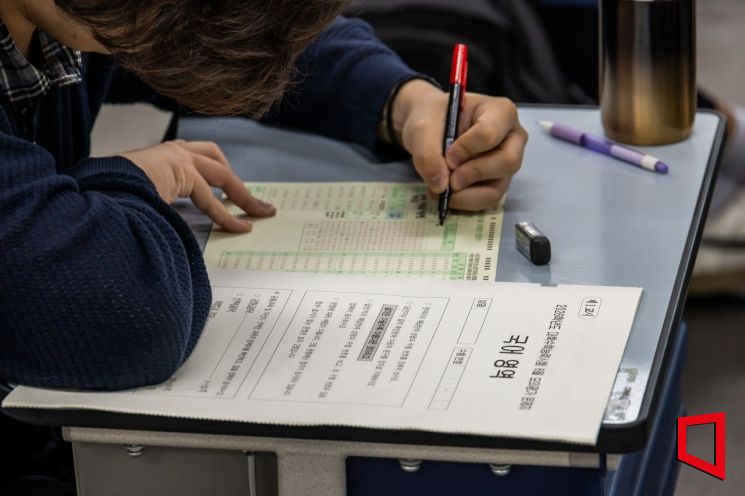 On the morning of June 4, the day of the June mock test for the College Scholastic Ability Test, students were filling out answer sheets at Geumcheon High School in Geumcheon-gu, Seoul. 2025.06.04. Photo by Joint Press Corps
On June 4, the EBS field teachers' group and the admissions industry assessed that the Korean and mathematics sections were set at a level similar to last year's CSAT. They analyzed that students who thoroughly studied the passages, works, and key concepts from the EBS-linked CSAT materials were able to answer the questions sufficiently. Mathematics was generally moderate in difficulty, but some questions required a significant amount of time, and calculus may have been burdensome for some students. Jinhaksa noted, "There were no complex, high-difficulty questions, and overall, the test consisted of moderately difficult questions. However, the perceived difficulty of elective subjects would have varied depending on how well students managed their time."
The English section was evaluated as being similar to or somewhat easier than last year's CSAT, where the proportion of students achieving the highest grade (Grade 1) was 6.22%. Kim Yeryeong, a teacher at Daewon Foreign Language High School and a member of the EBS teachers' group, said, "Questions that could be solved by carefully reading and understanding the passages were evenly distributed across various types, ensuring overall discrimination."
The Ministry of Education reported that, for social studies, extremely difficult and overly detailed questions were excluded, while for science, efforts were made to include questions that could measure comprehensive thinking skills.
Typically, the June mock test serves as a benchmark for students to gauge their standing in the actual CSAT, as it is taken by both third-year high school students nationwide and repeat test-takers. However, this year, there are many variables, making predictions difficult. For instance, with increases in both current third-year students born in the Year of the Golden Pig (413,685 students) and repeat test-takers (89,887 students), and with additional students retaking the test after partial enrollment in university, competition among upper-middle-tier students could become even fiercer. Furthermore, since registration for this June mock test took place before the adjustment of medical school admissions quotas, it is estimated that a large number of top-performing repeat test-takers participated. There are also predictions that the academic level of repeat test-takers could change by the time of the actual CSAT.
Lim Seongho, CEO of Jongro Academy, stated, "In addition, the sharp increase in the Satamrun phenomenon, the rise in the number of students taking probability and statistics (reflecting an increase in liberal arts students), and the increase of about 47,000 third-year students all combine to make it difficult to predict CSAT scores."
Given the many variables leading up to the CSAT, experts advise that it is important for students to prepare steadily without wavering. Kim Byungjin, director of the Etoos Educational Evaluation Research Institute, said, "The June mock test is meaningful as a 'preparation for the CSAT.' Students should identify new types of questions in terms of arrangement and questioning style and set their study direction to internalize them." He added, "Do not be swayed; use the June mock test as a starting point for your studies."
© The Asia Business Daily(www.asiae.co.kr). All rights reserved.
![From Hostess to Organ Seller to High Society... The Grotesque Scam of a "Human Counterfeit" Shaking the Korean Psyche [Slate]](https://cwcontent.asiae.co.kr/asiaresize/183/2026021902243444107_1771435474.jpg)
















