"Lee Jae-myung's Pragmatism" and "Trump's Transactionalism"
The Importance of Trade Negotiations with President Trump
"It Will Be a Very Difficult Diplomatic Balancing Act"
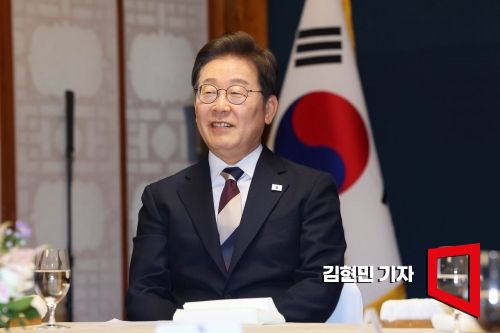 President Lee Jae-myung is having a conversation before lunch with Woo Won-sik, Speaker of the National Assembly, and other ruling and opposition party leaders at Sarangjae of the National Assembly on June 4, 2025. Photo by Kim Hyun-min
A Korea expert at a U.S. think tank has assessed that with the inauguration of the Lee Jae-myung administration, South Korea's diplomatic line has shifted from "values-based diplomacy" to "pragmatic diplomacy." It is also anticipated that the future relationship between the two governments will depend on how the new administration aligns with President Donald Trump during trade negotiations.
Andrew Yeo, the Korea Chair at the Brookings Institution, wrote in a commentary posted on the institute's website on June 3 (local time) that "President Lee Jae-myung's diplomatic pragmatism began in earnest when he recruited former diplomat Wi Sung-lac as an advisor during his 2022 presidential campaign." Wi Sung-lac, a member of the Democratic Party, was newly appointed as Director of the National Security Office on June 4.
Yeo also highlighted President Lee's contribution to Foreign Affairs in February 2022. At the time, Lee, then the Democratic Party's presidential candidate, argued, "While acknowledging China's assertive posture, South Korea should maintain a cooperative relationship with China," and added, "Blatant hostility is not in South Korea's national interest nor beneficial to the South Korea-U.S. alliance."
Yeo noted that even three years later, President Lee continues to make pragmatism the core of his diplomatic approach. During intensive campaigning in April and May, Lee made a series of nuanced statements. He sparked controversy by saying, "We must maintain friendly and cooperative relations with China and Russia." However, in May, seemingly aware of concerns within diplomatic circles, he moderated his remarks, stating, "The South Korea-U.S. alliance is the foundation of diplomacy and security and must be further strengthened, but not everything should be placed in a single basket." He also said, "The South Korea-U.S. alliance is the cornerstone of diplomacy and should be developed gradually, substantively, and with a future-oriented perspective."
Yeo concluded, "President Lee Jae-myung has expressed clear support for the South Korea-U.S. alliance while also keeping the door open for flexible diplomacy with China, North Korea, and Russia. This marks a clear shift from former President Yoon Suk-yeol's 'values-based diplomacy' to 'pragmatic diplomacy.'"
He identified four key pillars of Lee's diplomatic policy: the central axis being the South Korea-U.S. alliance; pursuing balanced diplomacy between the United States and China; keeping the possibility of dialogue with North Korea open; and seeking diversification in diplomacy through practical cooperation with countries such as the four Indo-Pacific nations, rather than focusing solely on the "global pivotal state" concept.
On the same day, the Trump administration congratulated the election of the progressive president but also preemptively expressed concerns about the possibility of South Korea shifting toward a pro-China stance. U.S. Secretary of State Marco Rubio, in an official statement, reminded both countries of the structural foundation of their relationship, stating, "The United States and South Korea share an ironclad commitment to our alliance, based on our mutual defense treaty, shared values, and deep economic ties."
The White House, responding to a written inquiry from Asia Economy regarding the U.S. government's position on the South Korean presidential election results, replied under the name of a "White House official" that "the South Korea-U.S. alliance remains ironclad," and added, "While it is clear that South Korea has held a free and fair election, the United States continues to express concern and opposition to China's interference and influence over democracies around the world."
Meanwhile, Yeo predicted that the first tasks for the Lee Jae-myung administration would likely include trade negotiations involving tariffs and the issue of defense cost-sharing (South Korea's share of the cost for stationing U.S. forces in Korea). He analyzed that these would be critical variables in shaping the South Korea-U.S. relationship in the early days of the administration. The U.S. government is also demanding increased defense contributions and stronger deterrence against China from its Asian allies. The South Korean government and the United States have set July 8 as the "deadline" for ongoing trade talks.
Yeo stated, "If the two sides achieve a win-win outcome in trade negotiations, the Lee Jae-myung administration will secure legitimacy, and President Trump can demonstrate strengthened alliances. However, if the United States insists on unilateral demands, there is a higher likelihood that Lee Jae-myung will tilt toward China, which could provoke backlash from hardliners within the U.S. government."
He added, "President Lee Jae-myung is pursuing 'balanced diplomacy' by strengthening the South Korea-U.S. alliance while also seeking improved relations with China and North Korea. Although this is a very difficult diplomatic balancing act, if Lee's pragmatism meets Trump's transactional approach, there could be new opportunities for cooperation."
© The Asia Business Daily(www.asiae.co.kr). All rights reserved.
![Clutching a Stolen Dior Bag, Saying "I Hate Being Poor but Real"... The Grotesque Con of a "Human Knockoff" [Slate]](https://cwcontent.asiae.co.kr/asiaresize/183/2026021902243444107_1771435474.jpg)
















