Article 84 Presidential Immunity
Trials Suspended During Term if Applied
Co-defendants' Cases Likely to Proceed
Summons May Be Sent to Lee if Trials Continue
First Retrial Hearing on Election Law Case Set for the 18th
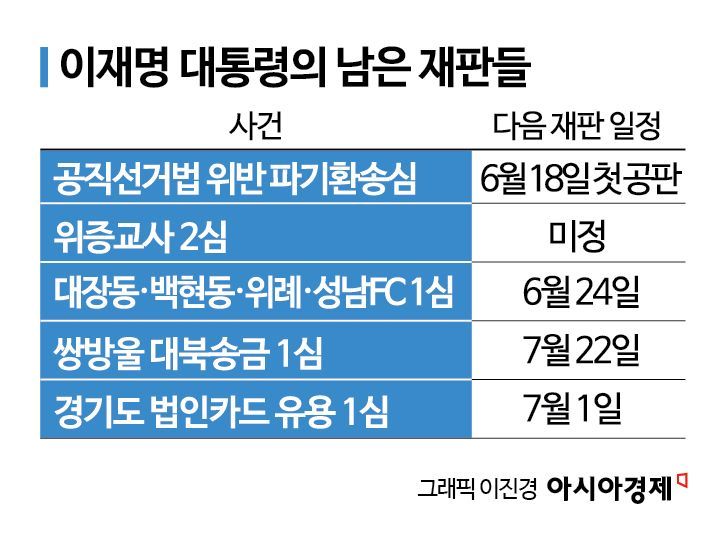
The Supreme Court maintains that, in principle, the interpretation of Article 84 of the Constitution should be determined by each individual trial panel. As a result, the retrial on the election law violation case scheduled for the 18th is drawing particular attention. This is because the decision made by the Seoul High Court's Criminal Division 7 (Presiding Judge Lee Jaegwon) could influence the panels handling the other cases.
If the Seoul High Court decides to continue the trial, it can issue a summons to President Lee. However, it is highly likely that President Lee will not appear, citing reasons such as the management of state affairs. If this situation continues, the court may deliver a verdict in absentia. The panel has not yet expressed its opinion regarding these issues. Conversely, if the panel determines that presidential immunity extends to ongoing trials, the proceedings will be suspended until the end of President Lee's term in June 2030.
In the case of other trials, the prevailing interpretation in the legal community is that proceedings can continue for the co-defendants who were indicted alongside President Lee. This is because they are not protected by Article 84 of the Constitution. Even if President Lee's trial is suspended, it is highly likely that the proceedings for the other defendants will continue separately. Jeong Jinsang, former Chief of Political Coordination at the Democratic Party leader's office, was indicted alongside President Lee in the Daejang-dong case, and Kim Jinsung, former secretary to the late Kim Byeongryang, former mayor of Seongnam, was indicted for perjury. Cha Jina, a professor at Korea University Law School, stated, "Even if Article 84 is interpreted to prevent the trial of President Lee from proceeding, the trials of co-defendants will continue. If President Lee's trial resumes after his term ends, its outcome is likely to be influenced by the results of the other defendants' trials."
Some in political and legal circles suggest that certain cases may be concluded through the prosecution's withdrawal of indictments. This refers to the first trials of the Daejang-dong, Baekhyeon-dong, Wirye, and Seongnam FC cases, the first trial of the Ssangbangwool Group's North Korea remittance case, and the first trial of the Gyeonggi Province corporate card misuse case. President Lee Jaemyung has consistently claimed that the charges against him were fabricated. The Democratic Party also filed a complaint with the Corruption Investigation Office for High-ranking Officials, alleging that the prosecutor in charge of President Lee's Daejang-dong case fabricated evidence. If this is true, it could be grounds for withdrawal of the indictment. However, such withdrawal is only possible before a first-instance verdict is delivered, so the perjury instigation case, which is already in the second instance, is excluded.
Finally, there is a possibility that some trials could be suspended or resolved through legislative action. Last month, the Democratic Party passed a revision to the Criminal Procedure Act in the Legislation and Judiciary Committee, which includes a provision for suspending trials against a sitting president, as well as an amendment to the Public Official Election Act that removes the term "act" from the requirements for false information. If these bills pass the plenary session, the election law violation case would be dismissed, and the remaining trials would be postponed until after the end of the presidential term.
© The Asia Business Daily(www.asiae.co.kr). All rights reserved.

![Clutching a Stolen Dior Bag, Saying "I Hate Being Poor but Real"... The Grotesque Con of a "Human Knockoff" [Slate]](https://cwcontent.asiae.co.kr/asiaresize/183/2026021902243444107_1771435474.jpg)















