"Yoon Administration's Environmental Regression... Now Is the Time for a Complete Shift"
Calls for Acceleration of Renewable Energy, Nuclear Phase-Out, and Coal Phase-Out
On the 4th, the Gwangju Environmental Conference issued a statement congratulating the inauguration of the 21st President Lee Jae Myung's administration and emphasized, "It is essential to establish and strongly implement sustainable environmental policies that are appropriate for the era of climate crisis."
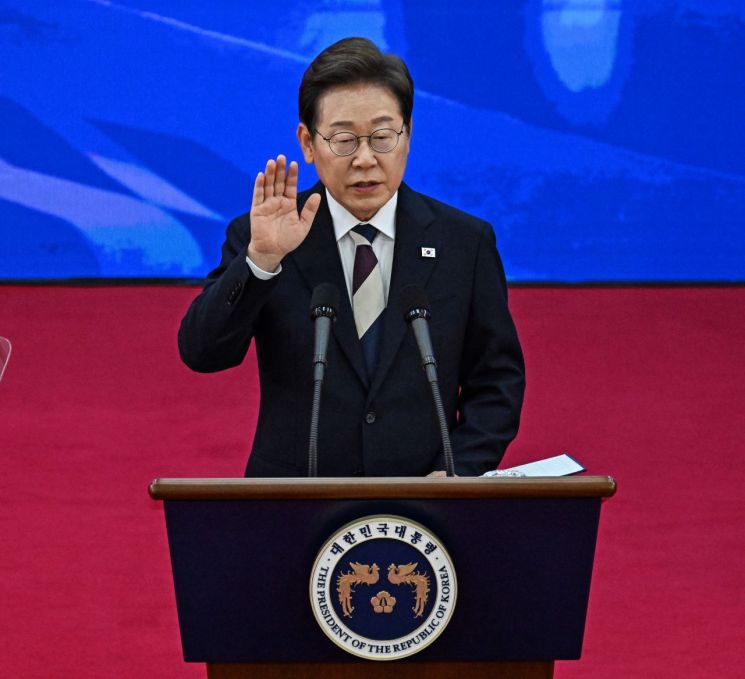 President Lee Jae Myung is taking the oath of office at the 21st presidential inauguration ceremony held at the National Assembly in Yeouido, Seoul on the 4th. Photo by Yonhap News
The Gwangju Environmental Conference stated, "The Republic of Korea is facing a complex crisis where the climate crisis overlaps with social and economic inequality," and added, "We hope that President Lee Jae Myung's awareness of environmental issues and his campaign pledges will be translated into concrete policies."
The statement described the environmental policies of the Yoon Suk Yeol administration as a "comprehensive regression." It cited the approval of the Seoraksan cable car, the partial removal of national park status, the promotion of airports in Saemangeum and Gadeokdo, the construction of climate response dams, the relaxation of plastic regulations, and the suspension of the Four Major Rivers Restoration Project as examples of anti-environmental policies.
The Gwangju Environmental Conference stressed, "Now is the time not only to restore previous policies but to establish new environmental policies suitable for the era of climate crisis," and pointed out, "The Ministry of Environment must reclaim its fundamental responsibilities of land conservation and climate response, without being swayed by the growth-oriented logic of the Ministry of Land, Infrastructure and Transport or the Ministry of Trade, Industry and Energy."
The group also referenced a statement made by President Lee Jae Myung during his candidacy, in which he said, "Energy policy is not a matter of ideology, but a real issue of responding to the climate crisis and the industrial economy." The Gwangju Environmental Conference emphasized, "We hope this statement does not remain an empty slogan," and called for the expansion of renewable energy, improvement of energy efficiency, a halt to the extension of the lifespan of aging nuclear power plants, and the implementation of a coal phase-out roadmap. They also noted, "The greatest victims of the climate crisis are the socially and economically vulnerable," and asserted, "Climate justice is not a task for the Ministry of Environment alone, but an integrated challenge that the entire society must address together."
The group further stressed the need to learn from the lack of environmental policy implementation under the Moon Jae In administration and the regression under the Yoon Suk Yeol administration. The organization stated, "Protecting the land, transforming ecosystem resilience, and improving water circulation are not merely environmental protection measures, but are new foundations for the economy and welfare."
The Gwangju Environmental Conference stated, "Policy implementation is a promise to the people and a responsibility to future generations," and added, "Institutional guarantees must be made for communication and participation with civil society." The group concluded, "We hope the new administration will be remembered as one that revitalized environmental policy, and we will fulfill our roles of criticism and action together with the citizens of Gwangju."
© The Asia Business Daily(www.asiae.co.kr). All rights reserved.

















