Outbreak of Peach Anthracnose in Yeongdeok County This Year
The Yeongdeok County Agricultural Technology Center has urged concentrated control measures in June and thorough orchard monitoring to prevent anthracnose, one of the causes of reduced apple and peach yields.
Recently, orchards affected by anthracnose were discovered in peach orchards in Yeongdeok County. As precipitation has increased by more than 40% compared to last year, a hot and humid environment is expected to develop during the summer, which is likely to lead to a rise in disease occurrence.
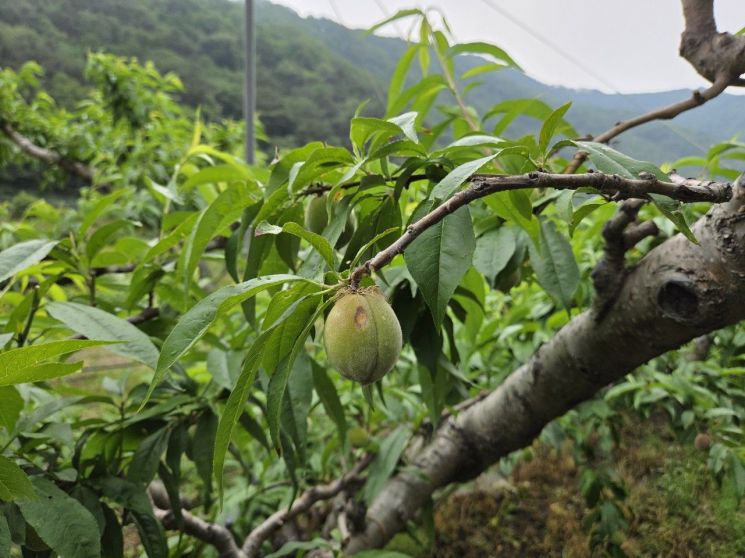
Anthracnose, which mainly affects apples and peaches, occurs when fungal spores are dispersed through rainwater or wind and then penetrate the fruit.
In the early stages of apple anthracnose, small black spots appear on the fruit. As the disease progresses, the infected area becomes sunken and turns brown.
Symptoms of anthracnose on peaches include dark brown spots that gradually expand, with the affected areas cracking open or becoming deeply sunken. In addition, large amounts of orange spores are produced.
Spraying chemicals after symptoms of anthracnose are visible is less effective, so it is essential to prevent infection in advance. Before the onset of anthracnose, protective (non-systemic) fungicides should be used. If infected fruit is found in the orchard, systemic fungicides should be applied.
At this time, the same type of chemical should not be used repeatedly. Information on control chemicals can be found on the main page of the Rural Development Administration's "Pesticide Safety Information System" under "Pesticide Search."
After spraying, orchards should be monitored, and any diseased fruit should be immediately removed and buried outside the orchard. In particular, when bagging peaches, the bags must be tightly fastened to the branches to reduce the risk of pathogens entering the fruit with rainwater.
Fungicides to prevent "apple ring rot" and "peach bacterial shot hole disease" should also be applied. Symptoms of apple ring rot initially appear as light brown spots, which gradually develop into circular band patterns. Unlike anthracnose, the infected area does not become sunken.
Peach bacterial shot hole disease causes water-soaked spots to appear on the leaves, which then turn brown and fall out, leaving holes. Pathogens infecting the leaves can also spread to the fruit.
Hwang Dae-sik, director of the Yeongdeok County Agricultural Technology Center, stated, "Due to recent climate change, the risk of diseases such as fruit anthracnose is increasing, so fruit growers need to pay special attention to disease and pest prevention and control. We will do our utmost to support high-quality fruit production and increase farmers' income by providing control measures, monitoring, and on-site technical support according to weather forecasts and disease and pest trends."
© The Asia Business Daily(www.asiae.co.kr). All rights reserved.

















