'Prosecution Office' Dedicated to Indictments... 'Serious Crimes Investigation Office' for Major Investigations
Separate Investigative Procedure Law for Human Rights
More Supreme Court Justices to Resolve Appeal Backlog
Online Trials to Reduce Geographic and Economic Barriers
Greater Transparency Through Expanded Citizen Participation Trials
President Lee Jaemyung was elected under the banner of "Overcoming Insurrection and Restoring Democracy." In the field of criminal justice, his core policy is the complete separation of the prosecution's investigative and indictment powers. He also pledged to reform the judicial system by introducing online trials and increasing the number of Supreme Court justices, with the goal of shortening trial periods.
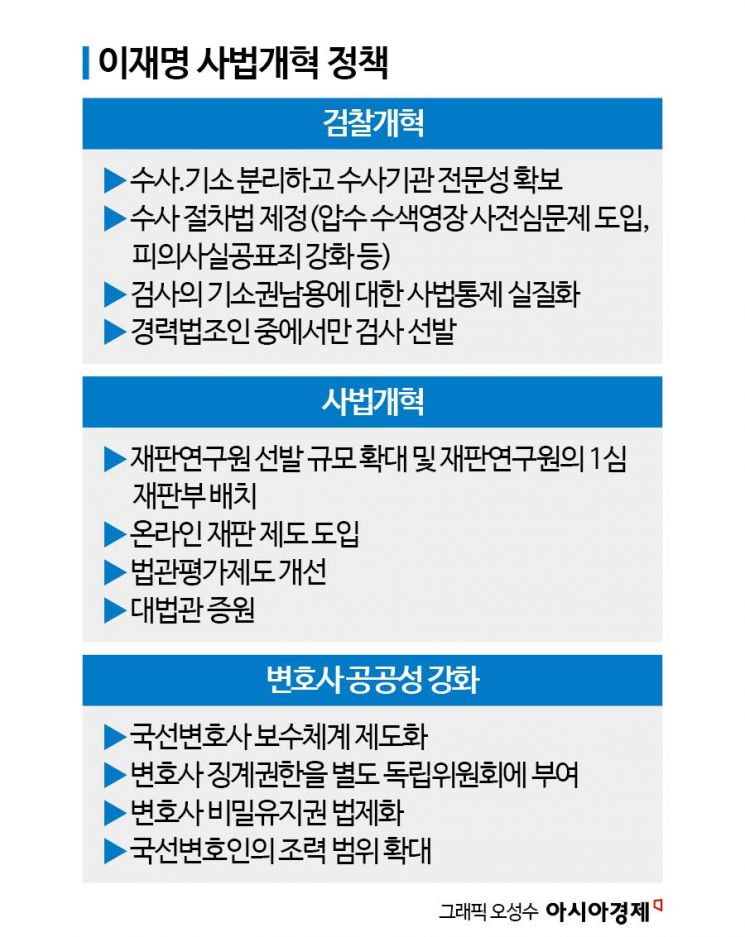
The central pledge of prosecution reform is the "separation of investigation and prosecution." During the presidential campaign, President Lee announced plans to clearly separate the investigative and indictment powers held by the prosecution and to establish specialized investigative agencies for particular fields. To achieve this, he proposed dividing the existing prosecution offices into a "Prosecution Office," which would be responsible solely for indictments, and a "Serious Crimes Investigation Office," which would be dedicated to investigating major crimes.
He also promised to enact a separate investigative procedure law to prevent human rights violations during investigations. He pledged to introduce a pre-hearing process in courts before issuing search and seizure warrants, and to legislate the presidential decree on investigative guidelines to prevent abuse of authority by investigative agencies. The administration also plans to strictly limit the disclosure of criminal suspects' information, strengthen penalties for evidence fabrication by investigative agencies, and introduce special statutes of limitations.
To address the abuse of indictment powers by prosecutors, judicial oversight will be strengthened. A system for dismissing prosecutors will be introduced to ensure swift and strict punishment of prosecutors found guilty of misconduct. The personnel system will also be reformed so that, as with the appointment of judges, only experienced legal professionals can be appointed as prosecutors.
President Lee has identified increasing the speed of trials and improving transparency as the core directions for court reform. He plans to gradually increase the number of Supreme Court justices, currently set at 14, to resolve the backlog of appeals cases. The specific number of additional justices has not yet been determined.
The new administration believes that this will reduce the workload of the Supreme Court, improve the speed of trials, and ease the burden on the public. In addition, judicial researchers who assist judges will be assigned to lower courts to accelerate case processing, and online trials will be introduced so that citizens can easily access trials without geographical or economic burdens.
President Lee also pledged to improve the system for evaluating judges. To ensure that performance evaluations and interim assessments of judges are conducted transparently and fairly, a Judicial Evaluation Committee will be established to enhance accountability and trust. To further increase transparency in trials, he announced plans to expand citizen participation trials, broaden the scope of disclosure of lower court rulings, and make the broadcasting of appellate court oral arguments mandatory, in cooperation with the judiciary.
The authority to discipline attorneys will be transferred from the Korean Bar Association to an independent external committee to enhance the fairness of disciplinary actions. The attorney-client privilege (ACP) will be codified to protect the confidentiality of consultations. In addition, the compensation for public defenders will be reasonably increased, and public defense in criminal cases will be expanded to cover the investigative stage. The introduction of public defenders for civil cases will also be considered.
However, these prosecution and court reform policies are likely to spark considerable controversy, including opposition from the political opposition. In particular, there is criticism that increasing the number of Supreme Court justices could infringe on judicial independence.
© The Asia Business Daily(www.asiae.co.kr). All rights reserved.
![Clutching a Stolen Dior Bag, Saying "I Hate Being Poor but Real"... The Grotesque Con of a "Human Knockoff" [Slate]](https://cwcontent.asiae.co.kr/asiaresize/183/2026021902243444107_1771435474.jpg)

















