Pledge to Expand Regional and Public Healthcare Workforce
Uncertainty Over Medical Community's Cooperation
New Administration Leaves Door Open for Dialogue
Return of Resident Doctors and Medical Students Depends on Policy
The most urgent task facing President Lee Jae Myung in the field of healthcare is to resolve the ongoing conflict between the government and the medical community, which has persisted for one year and five months, and to normalize South Korea's medical system. Other difficult issues, such as expanding medical school enrollment, addressing regional disparities in healthcare, and strengthening public healthcare infrastructure?all of which he pledged as a candidate?are also not easy to solve.
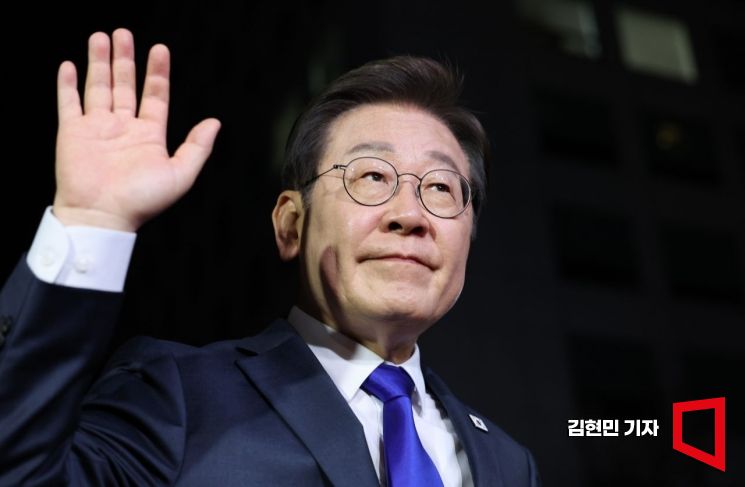 Lee Jae Myung, the Democratic Party presidential candidate who is expected to be elected as the 21st president, is entering the central party office in Yeouido, Seoul, early on the 4th to thank the campaign committee chairpersons. Photo by Kim Hyun Min
According to the healthcare sector and related sources on June 4, the conflict between the government and the medical community, which was triggered by the Yoon Suk Yeol administration's decision to increase the medical school quota by 2,000 students in February last year, and the subsequent mass resignations of resident doctors, have led to staffing shortages and gaps in medical services. Medical students have also refused to attend classes through a series of collective leaves of absence, and now, even if they return to school, it is inevitable that students from the classes of 2024, 2025, and 2026 will have to take classes together, resulting in a 'tripling' situation.
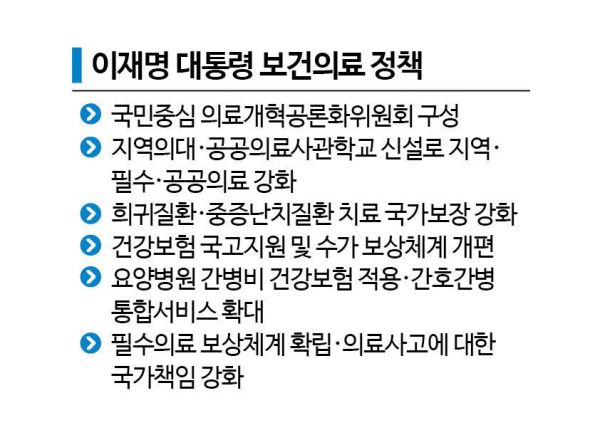
The Democratic Party has consistently advocated for securing healthcare personnel for regional, essential, and public medical services through regional doctors and regional medical schools, as well as establishing a public medical academy. However, these are all issues opposed by the medical community. As pledges have already been made to establish new public medical schools and medical colleges in regions such as Incheon, North Jeolla, South Jeolla, and North Gyeongsang, expectations in local communities for attracting medical schools have risen significantly. On the other hand, another clash is expected with the medical community, which opposes the expansion of the physician workforce.
Previously, the government decided that the medical school quota after 2027 would be discussed by the Healthcare Workforce Estimation Committee under the Ministry of Health and Welfare. However, controversy continues over the fairness and effectiveness of the committee's composition, making it uncertain whether cooperation from the medical community will proceed smoothly. For this reason, both inside and outside the healthcare sector, it is believed that how the new administration pushes forward with the policy on increasing medical school enrollment will have a decisive impact on the return of resident doctors and medical students.
However, President Lee has left open the possibility of dialogue with the medical community, stating that he will seek to reach a consensus on the general principles and direction of medical reform through a National Public Deliberation Committee, and that specific policies will be implemented through a transparent forum for public discussion. He also promised to restart discussions on essential healthcare policies based on sufficient social consensus that reflects the opinions of stakeholders in the medical community. The Korean Medical Association urged the new administration to make resolving the current issues its top priority so that medical students and resident doctors who have resigned can return to their original positions as soon as possible.
Another urgent task is how to secure funding for the rapidly deteriorating National Health Insurance finances. The health insurance budget is expected to fall into a deficit of 307.2 billion won next year, and the deficit is projected to increase to 1.5836 trillion won by 2028. The financial burden has grown more than ever, as health insurance premiums have been frozen for two consecutive years, and large amounts of health insurance funds have been spent on supporting emergency medical systems and implementing essential healthcare policies amid the conflict between the government and the medical community.
President Lee plans to stabilize the health insurance finances through government funding and to continuously expand coverage in order to ease the burden of medical expenses on the public.
In addition, the new administration faces immediate healthcare challenges such as establishing legal standards for telemedicine, integrating community-based care, and defining the scope of practice for physician assistant (PA) nurses. President Lee also proposed solutions during his candidacy, such as alleviating supply instability for essential medicines, building a stable supply system, and promoting alternative dispensing through limited ingredient-based prescriptions for essential medicines with unstable supply.
On May 28, he also pledged via his social media to reduce the burden of treatment costs for rare and intractable diseases and to expand health insurance coverage, promising to improve access to treatment for seriously ill patients, reduce their medical expenses, and strengthen the national supply of essential medicines.
© The Asia Business Daily(www.asiae.co.kr). All rights reserved.


















