"Promote Consistent Policies Without Being Swayed by Public Opinion"
Semiconductors & Electronics Urge Tax Credits for Enhanced R&D
Automotive Industry Calls for Swift U.S. Tariff Resolution and Urgent Support for Future Vehicles
President Lee Jae-myung faces significant economic challenges from the very start of his term, including tariff negotiations with the United States and recovery from the economic downturn. Within the business community, there are calls for the self-proclaimed 'pragmatist' to demonstrate a firm philosophy of governance, rather than being swayed by public opinion, and to create an environment conducive to business. We gathered the expectations that companies, from the semiconductor and electronics sectors to the export-driven automotive industry, have for the new administration.
A prominent figure in the business world, formerly the head of a major domestic conglomerate, told Asia Economy on the 4th, "Now is the time for President Lee Jae-myung to push forward with the necessary policies with the force of a storm." He noted, "Structural risks such as the increase in national debt, rising prices, sluggish exports, and heightened inter-Korean tensions are intricately intertwined," and diagnosed, "In such times, a clear philosophy of governance is more important than public opinion." He added, "The government should boldly consider an emergency supplementary budget, including an initial increase in spending," and emphasized, "Even if change is uncomfortable, now is the time to do what must be done."
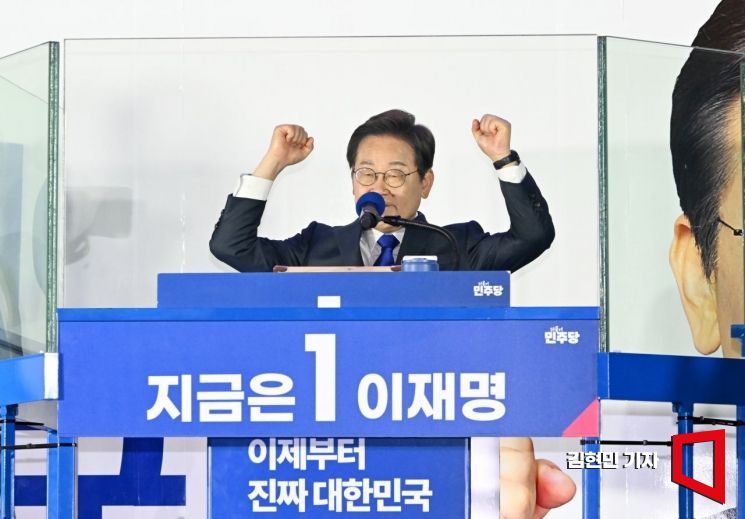 Lee Jae-myung, the Democratic Party presidential candidate who is expected to be elected as the 21st president, is giving a speech at the National Vote Counting Broadcast event held in front of the National Assembly in Yeouido, Seoul on the 4th. Photo by Kim Hyunmin
◆Business Community: "Show Consistent Economic Policy Philosophy, Not Just Public Opinion"= A senior executive at a major conglomerate pointed out, "During the campaign, every candidate promises to create a business-friendly environment or to reform unnecessary regulations, but after being elected, many become overly conscious of public opinion, making it difficult to implement consistent policies." He called for the government to ensure predictability so that companies do not face confusion.
He repeatedly stressed the importance of policy consistency, citing the example of 'fools in the shower.' He warned, "If policies swing back and forth like hot and cold water, it becomes difficult for both the government and businesses to respond." He continued, "If the government pursues policies based on a clear philosophy, companies can respond accordingly," adding, "Especially in times of significant economic uncertainty like now, it is crucial for the government to quietly and stably support businesses."
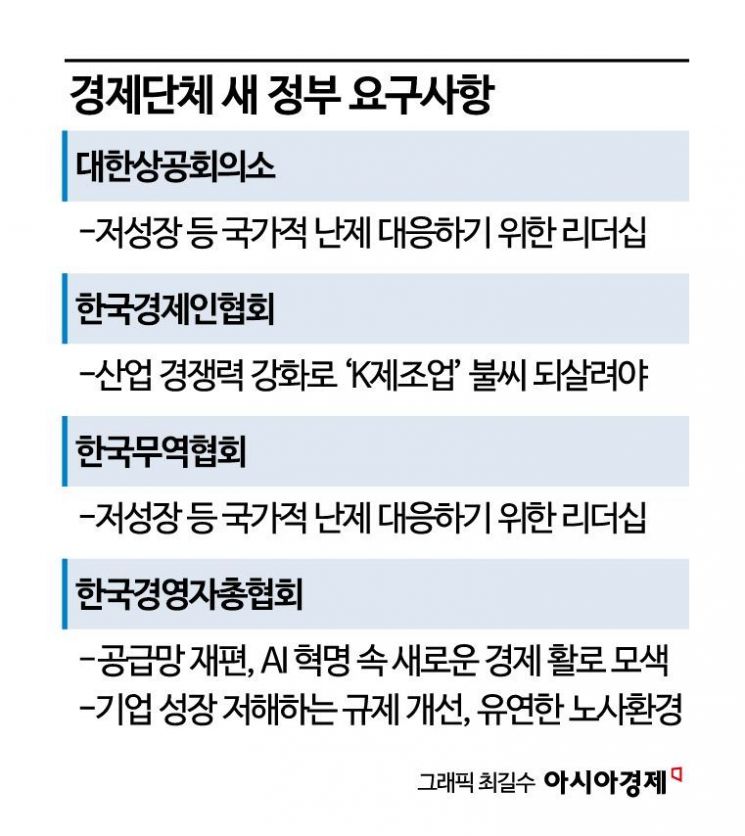
Economic organizations representing the voices of businesses congratulated President Lee Jae-myung on his election and urged him to demonstrate 'pragmatic policies' in response to the deteriorating global trade environment.
The Korea Chamber of Commerce and Industry stated, "In addition to national challenges such as low growth, low birth rates, and regional extinction, we are facing a rapidly changing global environment marked by the spread of protectionism and the AI technological revolution. We ask the new administration to demonstrate leadership that unites the nation's capabilities, and we will do our best to help lead an economic rebound."
The Federation of Korean Industries requested that the 'K-manufacturing' sector be revitalized. In a statement, the FKI emphasized, "Our economy is facing complex challenges, including the worsening global trade environment and domestic demand stagnation," and stressed, "The key to overcoming the crisis lies in restoring economic vitality through stabilizing people's livelihoods and strengthening industrial competitiveness."
The Korea International Trade Association identified resolving uncertainties arising from U.S. tariff policies as the top priority. The association stated, "The new administration must respond quickly to the rapidly changing external trade order," and called for "a practical, government-wide strategy to reduce risks for Korean companies by mobilizing all available trade diplomacy resources."
The Korea Employers Federation emphasized that revitalizing the private sector is crucial to respond to global supply chain restructuring. In particular, it urged the government to "boldly improve various regulations that hinder corporate growth, create a flexible labor market, and establish stable labor-management relations," while also calling for efforts toward national and social unity.
◆Semiconductors & Electronics: "Tax Credits Are Essential... Be Cautious About Shortening Working Hours"= Across the manufacturing sector, there were strong calls for increased research and development (R&D) support to secure future competitiveness. While strengthening tax credits to drive greater investment is necessary, there were also warnings that discussions about reducing working hours?an issue with significant impact on manufacturing?should be approached with caution.
Immediately after being nominated as the Democratic Party's presidential candidate in April, President Lee Jae-myung announced his first campaign pledge to support the semiconductor industry. He promised to enact a special semiconductor law that would include subsidies and tax incentives, and to apply up to a 10% production tax credit for semiconductors produced and sold domestically. His campaign platform also included numerous pledges to support the semiconductor industry, such as developing next-generation AI semiconductor technology.
An industry insider from the semiconductor sector repeatedly emphasized the need for 'expanded tax support and large-scale investment incentives.' He stated, "Building advanced fabs and upgrading manufacturing processes require preemptive investments in the trillions of won," and argued, "It is essential to continue expanding R&D tax credits." He added that the new administration must actively support the industry to compete globally, especially in light of the U.S. Inflation Reduction Act (IRA), Chinese semiconductor subsidies, and other international competition.
Given that the semiconductor market is exposed to diplomatic and trade risks such as U.S.-China rivalry and export controls, there were also calls for the government to strengthen its response capabilities. Another industry insider stressed, "It is necessary to pursue cooperative diplomacy to localize core equipment and materials and diversify sources of imports," and added, "Supporting the independence of fabless, materials, parts, and equipment companies is essential to rebalance the industry, which is currently dominated by large corporations, and to strengthen overall competitiveness."
A major electronics company expressed concern over the 'shortening of working hours,' a key issue in this presidential election. An industry representative warned, "Uniformly reducing working hours without improvements in productivity will undermine corporate competitiveness," and advised, "Since it is realistically difficult to operate flexible working hours for manufacturing site workers, the issue of reducing working hours requires more in-depth review and social consensus."
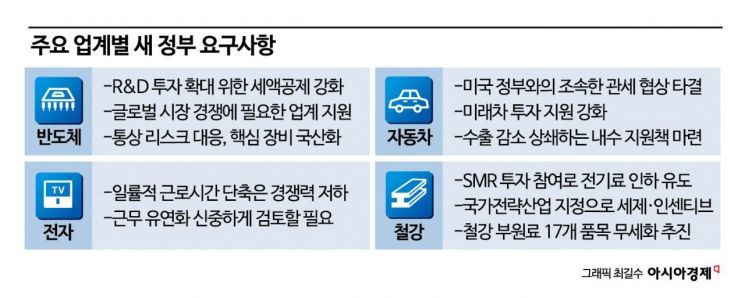
◆Automotive Industry at the Forefront of Exports: "Tariff Negotiations a Top Priority... Strengthen Support for Future Vehicle Investments"= The automotive industry's main expectations for the new administration can be summarized into three key points: ▲swift conclusion of tariff negotiations with the U.S. government, ▲strengthened support for future vehicle investments, and ▲measures to boost domestic demand to offset export declines.
Tariff negotiations with the United States are one of the most urgent issues facing the new administration. In order to sustain Korea's automotive industry, which is highly dependent on U.S. exports, tariff readjustments at a reasonable level are necessary. In April, the U.S. enacted an executive order imposing a 25% tariff on imported Korean vehicles, with a grace period until July 9. The industry hopes that speedy negotiations will lead to a readjustment of tariff rates within this month.
Additionally, the industry is requesting increased support for investments in future vehicles. There are calls to raise the tax credit rate for investments in production facilities for electric vehicles and other future vehicles to the same level as that of the semiconductor industry. Kang Namhoon, chairman of the Korea Automobile Mobility Industry Association (KAMA), stated, "We have asked the National Assembly and the government to strengthen tax credits for future vehicle investments to the level of the semiconductor industry," and emphasized, "It is also essential to strengthen support for the transition to future vehicles, including the parts industry."
In March of this year, the government promulgated the 'K-Chips Act,' an amendment to the Restriction of Special Taxation Act, raising the integrated investment tax credit rate for semiconductor companies to 20%. Although electric vehicles and other future transportation modes are included as national strategic technologies and can benefit from the 'K-Chips Act,' the March amendment increased the tax credit rate for semiconductors (20%) to 5 percentage points higher than that for future vehicles (15%), widening the gap between industries.
Lastly, the industry highlighted the need for policies to stimulate domestic demand to offset declining exports. If Korea's automobile exports decrease due to the impact of tariffs, it will inevitably lead to lower operating rates at domestic factories. The industry argues that revitalizing the domestic market is essential to maintain operation rates above a certain level. Extending the individual consumption tax cut for internal combustion engine vehicles, which is set to expire at the end of this month, is being discussed as a possible measure.
An industry insider commented, "It is disappointing that the Democratic Party's campaign pledges place less emphasis on mobility compared to AI and semiconductors," and added, "National-level support specialized for future mobility is urgently needed."
© The Asia Business Daily(www.asiae.co.kr). All rights reserved.
![Clutching a Stolen Dior Bag, Saying "I Hate Being Poor but Real"... The Grotesque Con of a "Human Knockoff" [Slate]](https://cwcontent.asiae.co.kr/asiaresize/183/2026021902243444107_1771435474.jpg)


















