The banking sector is set to request institutional reforms from the new government that will be launched after the 21st presidential election, including expanding opportunities for banks to enter the virtual asset industry and non-financial sectors.
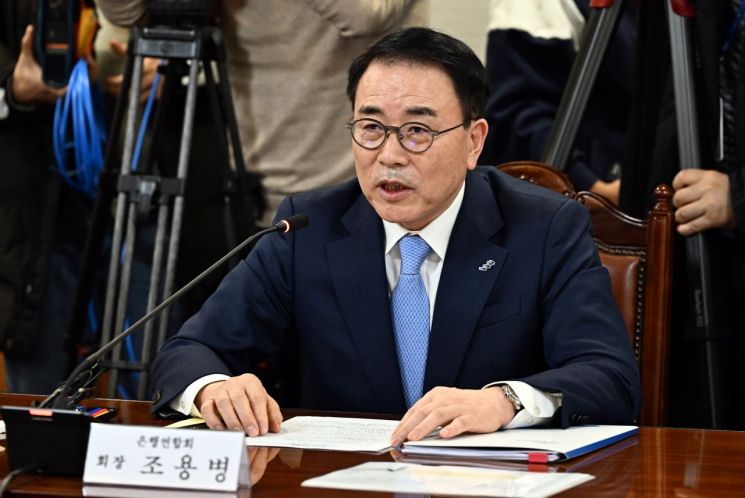 Cho Yongbyung, chairman of the Korea Federation of Banks, is speaking at the on-site meeting between the Democratic Party and the banking sector held at the Korea Federation of Banks in Jung-gu, Seoul. Photo by Yonhap News
The Korea Federation of Banks announced on the 3rd that it had prepared a draft of "key recommendations from the banking sector," which includes these requests, after gathering opinions at a luncheon meeting attended by vice presidents in charge of strategy from each bank at the end of last month.
In the draft, the banking sector argued, "Please improve the system so that banks, which have high credibility, accessibility, and levels of consumer protection, can enter the virtual asset business."
Banks are contributing to the creation of a sound virtual asset market by issuing real-name verified deposit and withdrawal accounts, but under current financial business laws, the scope of banking business does not include the virtual asset industry, so banks are not allowed to directly engage in virtual asset businesses.
The recommendations also include a full allowance for non-financial businesses. The banking sector is requesting that non-financial businesses such as distribution, transportation, travel, and ICT (information and communication technology) be permitted as ancillary businesses for banks, and that the regulation method for ancillary businesses and subsidiary ownership be changed to a "principle-based regulation" in line with the trend of industrial convergence. Unlike big tech companies, which have freely attempted to offer services that combine financial and non-financial businesses, banks are effectively prohibited from entering other industries.
Additionally, to provide high-quality comprehensive asset management services, the banking sector requested that banks be allowed to engage in discretionary investment management, as is permitted in the United States and Canada. If full permission is difficult, they asked that at least public funds be included as eligible for bank discretionary investment management. There was also a request to expand the scope of assets eligible for trusts and ease related restrictions to respond to the growing demand for asset management due to an aging population.
The draft also includes complaints about the way financial authorities impose sanctions. The banking sector stated, "While most financial business laws, such as the Capital Markets Act, specifically enumerate the grounds for sanctions, the Banking Act defines the grounds for sanctions against financial companies (executives and employees) in a comprehensive manner, making it difficult to predict which actions are subject to sanctions." They requested that the grounds for sanctions be specifically enumerated in relation to statutory obligations.
The banking sector plans to gather additional opinions and submit the final recommendations after the new government is inaugurated.
© The Asia Business Daily(www.asiae.co.kr). All rights reserved.

















