Key Cultural Pledges by Lee:
Construction of a 50,000-Seat Mega Arena
Expanded Tax Benefits and Support for K-Content
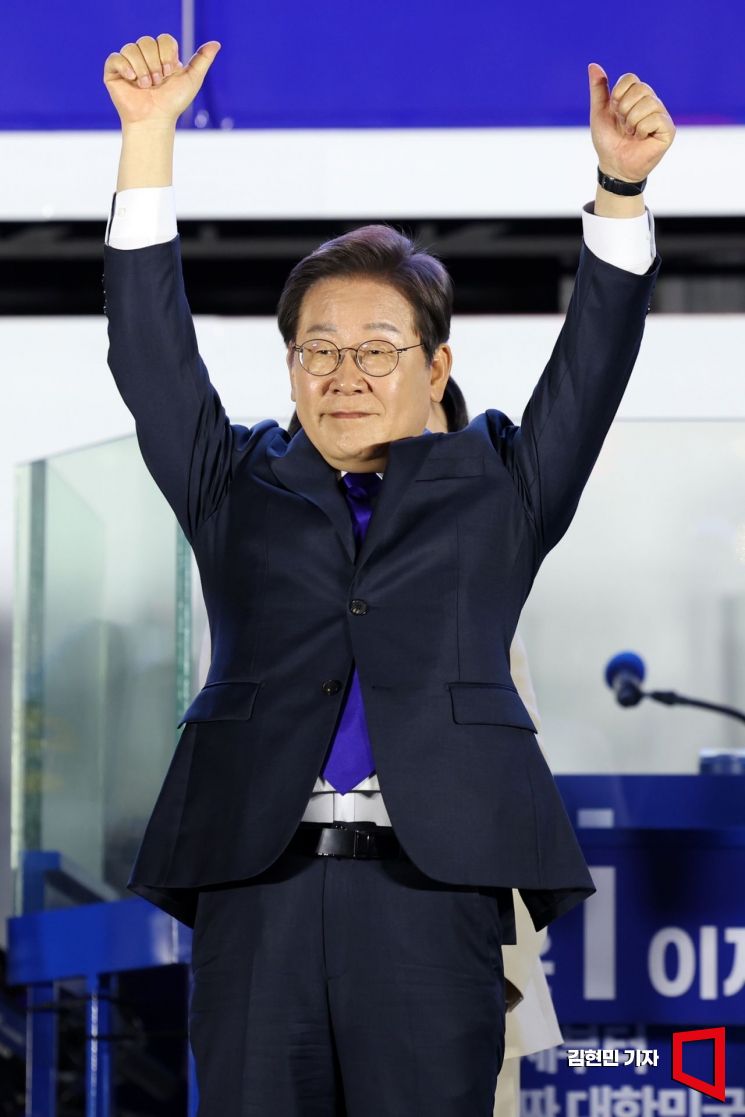 Lee Jae Myung, the Democratic Party presidential candidate who is expected to be elected as the 21st president, is greeting citizens at the National Vote Counting Broadcast event held in front of the National Assembly in Yeouido, Seoul on the 4th. Photo by Kim Hyun Min
"We will build a cultural powerhouse that leads the world with the strength of our vibrant culture."
President Lee Jae Myung, during his presidential campaign, referenced Kim Gu's vision of a culturally strong nation and expressed his belief that "If something succeeds in Korea, it can succeed worldwide."
The core of President Lee's K-content development strategy, as outlined in the '21st Presidential Election Democratic Party Policy Pledge Book,' is the construction of a 50,000-seat K-pop exclusive arena in the Seoul metropolitan area. The plan is to systematically support the global expansion of K-pop and other Hallyu content.
The K-pop arena will be the first large-scale dedicated K-pop performance venue in Korea. Currently, there are virtually no permanent performance halls in the country with a capacity of over 10,000 seats. Jamsil Sports Complex is undergoing remodeling until the end of next year, and large concerts are currently held by renting sports venues such as gymnasiums or baseball stadiums.
Venues such as KSPO Dome (15,000 seats) and Gocheok Dome (25,000 seats) often require performances to be split into multiple shows, while places like Goyang Stadium, Incheon Inspire Arena, and Incheon Munhak Stadium are used as alternative spaces. Industry voices have consistently emphasized the need for a large-scale performance venue in the Seoul area.
President Lee stated, "By building a dedicated K-pop arena, we will create a hub for Hallyu performances," expressing his intention to provide a foundation for the global advancement not only of popular artists such as BTS and Seventeen, but also for emerging singers.
The pledges also include support measures for the overall content industry. There are plans to significantly expand the current tax credit for video content production, which is now between 5% and 15%, and to extend these benefits to creative fields such as webtoons, music, and performances. The government will support the entire process from planning and production to distribution and overseas expansion of content, while also promoting expanded policy finance, enhanced welfare for creators, and increased investment in research and development (R&D).
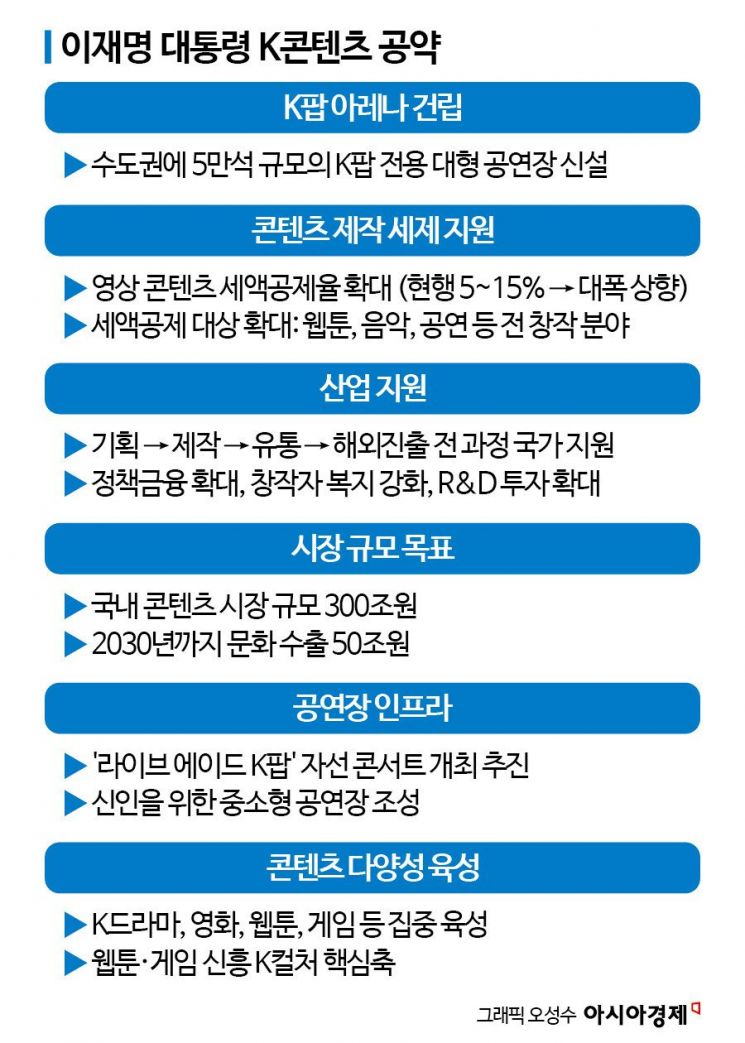
President Lee has set the goal of expanding the domestic content market to 300 trillion won and cultural exports to 50 trillion won by 2030. K-pop is regarded as the symbolic frontrunner of this strategy. In addition to the construction of the K-pop arena, large-scale charity concerts under the name 'Live Aid K-pop' and the creation of small and medium-sized venues for new artists are also planned.
However, President Lee's pledges should not be interpreted as support measures aimed solely at K-pop. The policy book repeatedly states the intention to foster various content fields such as K-dramas, films, webtoons, and games as national strategic industries. In particular, the phrase "We will foster emerging content industries such as webtoons and games as core pillars of K-culture" highlights a commitment to balanced development of the content industry.
While the K-pop arena is highly likely to become a symbolic hub of the Hallyu industry in the future, there are also significant challenges to overcome. President Lee has stated that he will pursue funding measures that combine national budget resources and private investment in order to realize this pledge.
An official from a major entertainment agency said, "We have always faced difficulties due to the shortage of large venues when planning concerts. I sincerely hope this pledge will be fulfilled. If such a venue is built, the number of shows will increase, and more international artists will visit Korea, making the market even more vibrant." However, he also emphasized, "Building a performance venue requires enormous costs, and securing a site in Seoul or the metropolitan area is not easy. Above all, it is crucial to create a sustainable ecosystem as a dedicated K-pop performance venue."
© The Asia Business Daily(www.asiae.co.kr). All rights reserved.
![Clutching a Stolen Dior Bag, Saying "I Hate Being Poor but Real"... The Grotesque Con of a "Human Knockoff" [Slate]](https://cwcontent.asiae.co.kr/asiaresize/183/2026021902243444107_1771435474.jpg)











