Fostering Energy Technologies by 2030
200 Billion Won Investment Including 10 Billion Won in National Funding
Demonstrating Core Technologies such as Eco-Friendly, High-Efficiency Solar Power
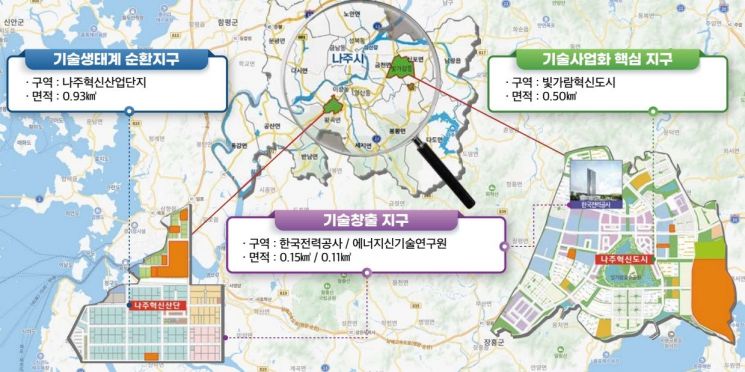 Aerial view of the designated area for the Small Giant Research and Development Special Zone. Provided by Naju City
Naju City in South Jeolla Province will enter the second phase of the Small Giant Research and Development Special Zone (hereinafter referred to as the Small Giant Special Zone) development project, which the city has been actively promoting to attract companies specializing in the energy industry and to establish research and technology development complexes.
On June 2, Naju City announced that it has been selected as a recipient of support for the second phase of the Small Giant Special Zone development project, organized by the Ministry of Science and ICT. The city was recognized for the achievements of the first phase, which was implemented from 2021 to 2024, as well as the potential for future expansion.
With the confirmation of the second phase, the city will accelerate the development of its specialized sectors within the Small Giant Special Zone, namely eco-friendly, high-efficiency solar power generation and grid stabilization, as well as the next-generation energy storage system industry.
A total of 20 billion won, including 10 billion won in national funding, is expected to be invested over five years from 2026 to 2030.
The Small Giant Special Zone is a system aimed at creating a science and technology-based regional innovation growth platform. It designates and fosters areas near core technology institutions located in the region as small-scale, high-density research and development (R&D) support zones.
The city has fostered Korea Electric Power Corporation and the Energy New Technology Research Institute as core technology institutions, and has developed the Naju Innovation Industrial Complex and the Innovation City Industry-Academia-Research Cluster as R&D support zones.
Over the past four years, the first phase of the project achieved results such as 143 technology transfers, the establishment of 24 research institutes and companies, 69 startups, and the creation of 471 new jobs.
In addition, as technology transfers tailored to the needs of companies in solar power, new and renewable O&M (operation and maintenance), and energy storage based on technology owned by Korea Electric Power Corporation have become more active, the zone has achieved cumulative sales of 356 billion won. These outstanding results have been recognized among the 14 Small Giant Special Zones nationwide.
The second phase of the project will focus more on practical technology demonstration and supporting company growth.
Naju City plans to intensively foster key technologies essential for the energy transition era, such as the advancement and grid stabilization of eco-friendly, high-efficiency solar technology and next-generation energy storage systems, based on local industry linkages, the KEPCO 2050 R&D Master Plan, and carbon neutrality technology strategies.
In particular, the city will also focus on establishing a system for technology demonstration, conducting joint R&D with Korea Institute of Energy Technology, a specialized energy research institution, and operating customized programs tailored to each stage of company growth.
Yoon Byungtae, Mayor of Naju, said, "Through the second phase of the Small Giant Special Zone development project, we will go beyond the previous stage centered on technology supply institutions and accelerate the creation of a self-sustaining industrial ecosystem based on cooperation among Small Giant Special Zones nationwide and the local energy industry."
© The Asia Business Daily(www.asiae.co.kr). All rights reserved.

















