Mention of AI Chip Export Controls and Cancellation of Student Visas
"We Will Protect Our Legitimate Rights with Firm Measures"
U.S. Economic Advisors Hope for Dialogue Between Leaders
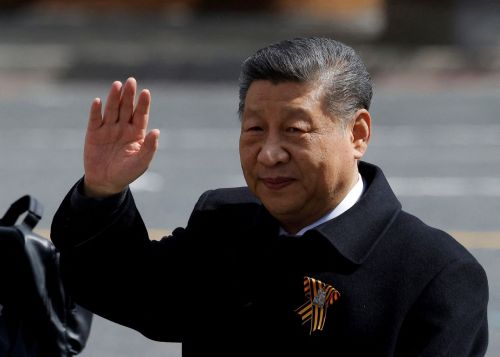 Chinese President Xi Jinping is waving his hand at the parade during his state visit to Russia for the China-Russia summit on the 9th of last month (local time). Photo by Reuters
After U.S. President Donald Trump accused China of failing to honor a trade agreement, the Chinese government on June 2 countered that it was, in fact, the United States that had violated the deal. The Chinese side made it clear that it had no intention of cooperating with the U.S. call for a swift resolution through dialogue between the leaders, stating that if the U.S. insists on prioritizing its own interests, China will "take firm and forceful measures to protect its legitimate rights and interests."
In a statement posted on its website that day, a spokesperson for China's Ministry of Commerce said, "China has taken a responsible attitude, treated the Geneva economic and trade agreement last month seriously, implemented it strictly, and actively defended it," adding, "China's commitment to safeguarding its rights and interests is unwavering, and its implementation of the agreement is sincere."
The spokesperson went on to say, "In contrast, the United States has continued to introduce various new discriminatory and restrictive measures against China even after the Geneva talks." These, the spokesperson noted, include the announcement of export control guidelines for artificial intelligence (AI) chips, the suspension of sales of electronic design automation (EDA) software, and the cancellation of visas for Chinese students.
The spokesperson continued, "The China-U.S. Geneva joint statement is a significant agreement reached by both countries based on the principles of mutual respect and equal negotiation, and it was not easily achieved. We urge the United States to face China and immediately correct its wrongful actions," adding, "If the United States stubbornly continues to undermine China's interests, China will continue to take firm and forceful measures to protect its legitimate rights and interests."
The Chinese government's statement was aimed at President Trump's post on the social media platform Truth Social on May 30 (local time). In his post, Trump said, "The bad news, which will not surprise some people, is that China has completely violated our agreement," adding, "Just two weeks ago, China was in a serious economic crisis." The main reason cited is that China has not withdrawn its rare earth export sanctions promised in Switzerland in May. The Chinese Embassy in Washington, angered by the accusation, immediately issued a statement urging the U.S. to "end discriminatory restrictions and for both sides to jointly adhere to what was agreed at the Geneva high-level talks."
However, U.S. economic advisors appear to be leaving room for negotiation, expressing hope that the issue can be resolved quickly through dialogue between the leaders. On June 1, Kevin Hassett, Chairman of the White House National Economic Council (NEC), said on ABC News that "a conversation between President Trump and Chinese President Xi Jinping is expected as early as this week," and that "the two sides are talking every day." U.S. Treasury Secretary Scott Besant also expressed optimism about dialogue between the two leaders in an interview with CBS News on the same day.
Meanwhile, concerns have resurfaced over the U.S.-China tariff suspension agreement, which had been a driving force behind the strong performance of the U.S. stock market in May. On May 30, the Dow Jones Industrial Average rose 0.13% at the New York Stock Exchange, while the S&P 500 and Nasdaq Composite indices closed down 0.10% and 0.32%, respectively.
© The Asia Business Daily(www.asiae.co.kr). All rights reserved.

















