Inhibition of Lycopene Synthesis Due to High Temperatures and Intense Sunlight
Concerns Over Decreased Farm Income
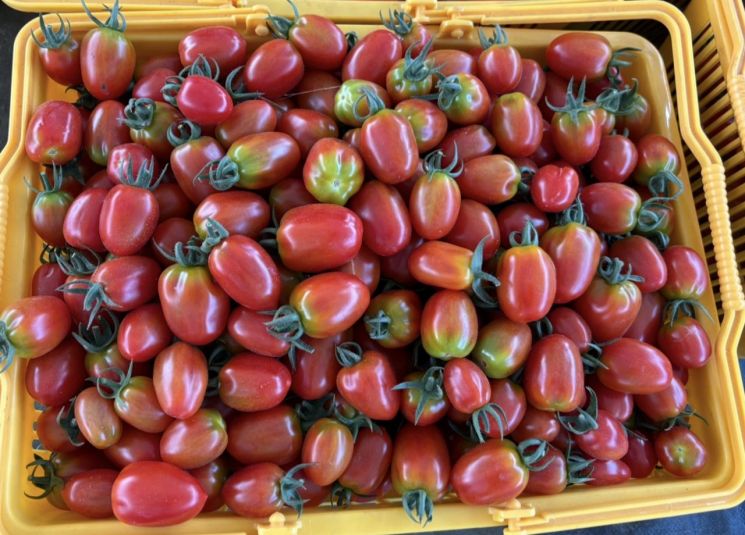 Cherry tomatoes with so-called 'shoulder blossom-end rot' discoloration. / Provided by Chungnam Agricultural Research and Extension Services
The Chungnam Agricultural Research and Extension Services announced on June 2 that it has provided guidance to cherry tomato growers on how to prevent physiological disorders caused by high temperatures and intense sunlight, which can result in poor coloration.
When ripening vegetables or fruits such as cherry tomatoes are exposed to excessive sunlight during May and June, the synthesis of lycopene and carotenoids?which produce the red color?is inhibited, resulting in a physiological disorder where the fruit develops uneven coloration.
Lycopene in cherry tomatoes is actively synthesized at average daytime temperatures between 24 and 30 degrees Celsius and light levels of 20,000 to 30,000 lux. However, when temperatures exceed 30 degrees Celsius and light intensity surpasses 50,000 lux, synthesis is suppressed, causing the shoulder area of the fruit to remain green instead of turning red?a phenomenon known as "nok-suk" (shoulder green coloration).
While this physiological disorder does not affect edibility, it reduces marketability, leading to the affected fruit being sold at prices 20 to 30 percent lower than normal fruit, thereby impacting farm income.
To prevent poor coloration, it is important to install shade nets and ensure proper ventilation. Installing a shade net with a 55% shading rate on the exterior roof of the greenhouse can block excessive sunlight and also help moderate the rise in internal temperature.
According to research by the Fruit and Vegetable Research Institute, the incidence rate of poor coloration in greenhouses equipped with a 55% shade net was more than 26 percentage points lower than in greenhouses without shading.
Lee Seungyeon, a researcher at the Fruit and Vegetable Research Institute, stated, "Complaints related to poor coloration in cherry tomatoes have been increasing recently," and emphasized, "During periods of intense sunlight, it is important to use materials such as shade nets to prevent fruit from being directly exposed to strong sunlight."
© The Asia Business Daily(www.asiae.co.kr). All rights reserved.
![Clutching a Stolen Dior Bag, Saying "I Hate Being Poor but Real"... The Grotesque Con of a "Human Knockoff" [Slate]](https://cwcontent.asiae.co.kr/asiaresize/183/2026021902243444107_1771435474.jpg)
















