U.S. Universities Have Trained Thousands of Chinese Officials for Decades
Harvard Kennedy School Known as the Top "Overseas Party School"
Many Children of Chinese Leaders Also Graduated from Harvard
American Politicians Raise Concerns Over CCP Influence and Academic Espionage
The Wall Street Journal (WSJ) reported on June 1 (local time) that prestigious educational institutions in the United States, such as Harvard Kennedy School, have served as training grounds for the Chinese Communist Party (CCP) for decades, functioning as so-called "party schools."
For decades, the Chinese Communist Party has sent thousands of mid-level and senior officials to American universities to complete executive education and graduate programs. In particular, Harvard University is so popular in some circles in China that it is called the top overseas party school. This nickname is a reference to the Central Party School, which trains high-ranking Communist Party officials.
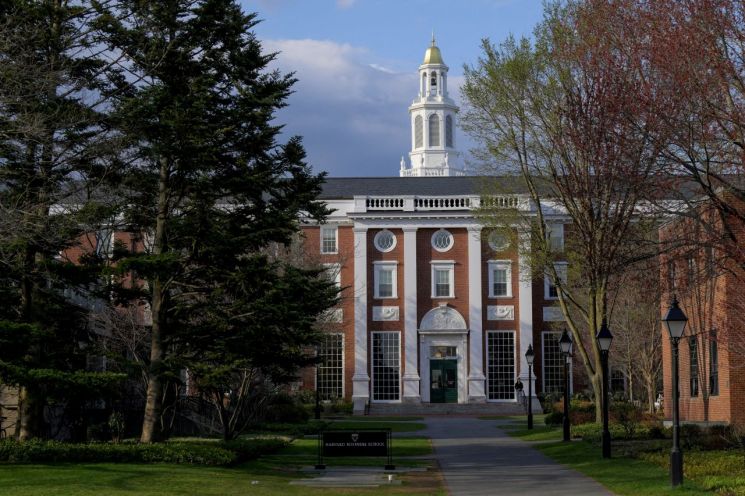
During this time, American universities have actively developed training programs targeting Chinese officials. Since the 1990s, Chinese authorities have launched large-scale training programs to expose officials to Western public policy and practices in an effort to improve governance.
Harvard, in particular, is highly popular among Chinese officials. There is even a saying that one must graduate from Harvard Kennedy School to attain a senior position in the Communist Party. In a 2014 commentary, Shanghai Observer stated, "If we were to rank the 'overseas party schools' of the Chinese Communist Party, the top spot should go to the John F. Kennedy School of Government at Harvard University in the United States."
The Kennedy School began admitting Chinese students in the early 1980s, and an educational program launched in 1998 saw about 20 senior Chinese officials participate each year. In the early 2000s, the school launched a program called "China's Leaders in Development," which was designed for Chinese officials and involved training sessions alternating between Harvard and Tsinghua University in China.
In fact, several Chinese officials who attended Harvard later assumed high-ranking government positions or joined the elite Politburo of the Communist Party. Li Yuanchao, who served as Vice President of China from 2013 to 2018, studied at Harvard Kennedy School in 2002 while he was Party Secretary of Nanjing. After returning to Nanjing, Li said that Harvard's crisis management course helped him respond to a major toxic substance incident, earning praise from both local residents and the central government. He remarked, "Thank you, Harvard!"
Liu He, who served as China's chief trade negotiator during the first Trump administration and as Vice Premier in charge of economic affairs, earned a master's degree in public administration from Harvard Kennedy School in 1995. Li Hongzhong, Vice Chairman of the Standing Committee of the National People's Congress, completed a short-term program at Harvard in 1999.
Many children of Chinese leaders are also Harvard alumni. Xi Jinping's daughter, Xi Mingze, enrolled at Harvard as an undergraduate under an alias in the early 2010s while Xi was Vice President. Alvin Zhang, grandson of former President Jiang Zemin, and Bo Guagua, son of former Politburo member and Xi's former rival Bo Xilai, also graduated from Harvard.
In addition to Harvard, institutions such as Syracuse University, Stanford University, University of Maryland, and Rutgers University have operated educational programs for Chinese officials. The Maxwell School at Syracuse University helped establish graduate programs in public administration at Chinese universities in the early 2000s. Beyond the United States, Chinese officials have also studied at major universities in Singapore, Japan, and the United Kingdom.
On May 28, U.S. Secretary of State Marco Rubio announced plans to revoke visas for Chinese students who are affiliated with the Chinese Communist Party or majoring in key fields. On May 22, the Trump administration announced the cancellation of foreign student admissions at Harvard, citing cooperation with the Communist Party. Some American politicians claim that the Chinese Communist Party seeks to collect American academic expertise to undermine U.S. interests. WSJ noted that the Trump administration's policy to block Chinese students could bring an end to such practices.
© The Asia Business Daily(www.asiae.co.kr). All rights reserved.

















