Major Candidates Favor Cryptocurrency Policies
...But Views Diverge on Stablecoins
Bloomberg News reported on June 1 (local time) that, as major presidential candidates in the 21st presidential election have pledged pro-cryptocurrency policies, South Korea's cryptocurrency industry is likely to benefit regardless of who wins.
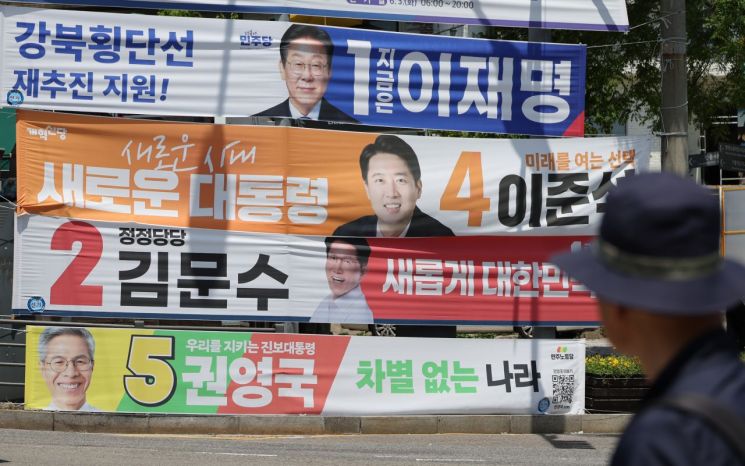
Bloomberg News noted, "With approximately 18 million people?more than one out of every three citizens?investing in virtual assets, South Korea is one of the most active cryptocurrency markets in the world," adding, "There are even days when cryptocurrency trading volume surpasses that of KOSPI and KOSDAQ, highlighting its growing influence."
In response, major presidential candidates are presenting pledges to expand access to the cryptocurrency market. Lee Jaemyung, the Democratic Party's presidential candidate, has made bold proposals such as introducing cryptocurrency exchange-traded funds (ETFs) and allowing the National Pension Service to invest in cryptocurrencies. Kim Moonsu, the People Power Party's presidential candidate, has also promised to introduce cryptocurrency ETFs and is largely seen as focusing on deregulation.
Kim Seojun, CEO of Hashed Ventures, a venture capital firm specializing in Web 3.0 investments, stated, "Since the major presidential candidates support crypto-friendly policies, Korean cryptocurrency investors are poised for a clear victory, no matter who is elected."

Although there is a 'bipartisan consensus' on overall policies to foster the cryptocurrency industry, opinions are divided regarding the expansion of won-based stablecoins. Stablecoins are virtual currencies whose value is pegged to specific assets in order to minimize price volatility.
On May 8, during a discussion with economic YouTubers, candidate Lee Jaemyung remarked, "We need to establish a won-based stablecoin market to prevent capital outflows." In fact, from January to March, the total amount of virtual assets that flowed out from domestic exchanges was estimated at 56.8 trillion won, of which about 27 trillion won, or 47%, consisted of dollar-based stablecoins such as Tether (USDT) and USDC.
Regarding this, Bank of Korea Governor Rhee Changyong stated at a press briefing on May 29, "If won-based stablecoins are issued by institutions other than banks, the effectiveness of monetary policy could be significantly undermined." He also pointed out, "Won-based stablecoins can be easily traded with dollar-based stablecoins and could be used as a means to circumvent capital regulations." He emphasized that, since allowing won-based stablecoins would be a major change akin to permitting an 'alternative currency,' a more cautious approach is needed.
Bloomberg News interpreted, "As U.S. President Donald Trump maintains a crypto-friendly stance, political circles across Asia are also actively working to foster the digital asset industry," and added, "The fact that South Korea's major presidential candidates have pledged to ease regulations and expand access to cryptocurrencies is a signal that South Korea may be transitioning into a crypto-friendly nation."
© The Asia Business Daily(www.asiae.co.kr). All rights reserved.


















