Senate Moves to Calm Market Fears Ahead of Tax Cut Bill Review
"Gradual Reduction of Fiscal Deficit... Additional Tariff Revenues Projected in Trillions of Dollars"
U.S. Treasury Secretary Scott Besant stated on June 1 (local time) that the United States will never default, addressing concerns over the recent worsening of the fiscal deficit. With the U.S. Senate set to begin reviewing the large-scale tax cut bill that passed the House last month, his remarks are seen as a preemptive move to calm market anxieties over debt and fiscal crises.
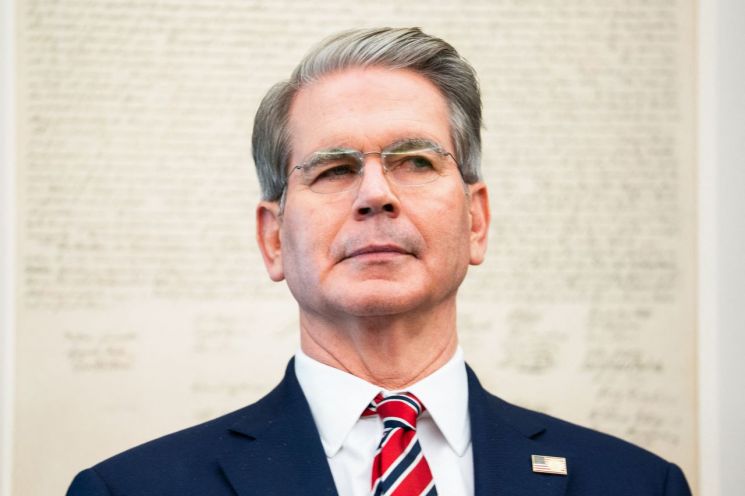
Appearing on CBS's "Face the Nation" that day, Secretary Besant said, "The United States will never default, and such a thing will never happen," adding, "We are in a warning zone right now, but we will never hit the wall."
His comments came as global credit rating agency Moody's recently downgraded the U.S. sovereign credit rating, and as President Trump’s tax cut bill, which he describes as "one big, beautiful piece of legislation," heads to the Senate after passing the House. If enacted, this tax cut bill would further reduce federal tax revenues, which, combined with negotiations on raising the debt ceiling, has raised concerns that it could seriously undermine U.S. fiscal soundness. Some Republican senators are also opposing the bill, suggesting that the Senate review process will be contentious. Before the bill passed the House, fears of fiscal deterioration pushed up long-term U.S. Treasury yields, and Secretary Besant’s remarks are interpreted as an effort to ease market concerns ahead of the Senate review.
Secretary Besant remained silent about the so-called "X-date," the point at which the debt ceiling is exhausted. He stated, "We do not disclose the X-date," and added, "We use that date to advance the legislation." The government’s reasoning is that if the X-date were revealed, Congress might delay its decision until the last minute; thus, the administration intends to keep the specific timing confidential to maintain negotiating leverage. Previously, Secretary Besant had warned that without an increase in the debt ceiling, the Treasury's cash and extraordinary measures would be depleted by August.
He stated, "We will reduce the fiscal deficit gradually, and our goal is to decrease it over the next four years," adding, "This year’s deficit will be smaller than last year’s, and it will be reduced even further in two years." He also projected that additional tariff revenues would amount to several trillion won, and pointed out that many agencies do not reflect this in their fiscal forecasts.
In contrast, markets and experts are offering the opposite outlook. The Committee for a Responsible Federal Budget (CRFB) has projected that the tax cut bill will increase federal debt by $3 trillion over the next decade. Even Elon Musk, CEO of Tesla, who led federal spending efficiency efforts as head of the Department of Government Efficiency (DOGE) during Trump’s second term, criticized the tax cut bill in a CBS interview that day as a "massive spending bill" and called it a "disappointing measure" that runs counter to efforts to reduce costs.
Regarding recent remarks by JP Morgan Chairman Jamie Dimon, who warned of potential cracks in the bond market due to the federal government’s astronomical debt, Secretary Besant dismissed the concerns, saying, "I’ve known Jamie for a long time and he’s made such predictions throughout his career," and "Fortunately, none of those predictions have ever come true."
Meanwhile, in the same interview, Secretary Besant stated that President Trump and Chinese President Xi Jinping will have a phone call for trade negotiations "very soon." Previously, on May 30, President Trump had announced that he would speak with President Xi, accusing China of violating the bilateral trade agreement. The U.S. claims that China’s failure to lift restrictions on rare earth and critical mineral exports constitutes a breach of the agreement.
Secretary Besant explained, "This issue could be a minor flaw in the Chinese system, or it could be intentional," adding, "We will know the truth after President Trump speaks with President Xi."
© The Asia Business Daily(www.asiae.co.kr). All rights reserved.
![Clutching a Stolen Dior Bag, Saying "I Hate Being Poor but Real"... The Grotesque Con of a "Human Knockoff" [Slate]](https://cwcontent.asiae.co.kr/asiaresize/183/2026021902243444107_1771435474.jpg)
















