Hassett, Chairman of the NEC, Interview with ABC
Mentions Super Section 232, Section 301, and Section 338 of the Tariff Act
Trump and Xi Jinping Expected to Hold Phone Call This Week
The White House stated on June 1 (local time) that it is confident President Donald Trump's tariff policy will be upheld by the courts. The administration also reaffirmed that it has sufficient means to continue its tariff policy regardless of the judiciary's decision.
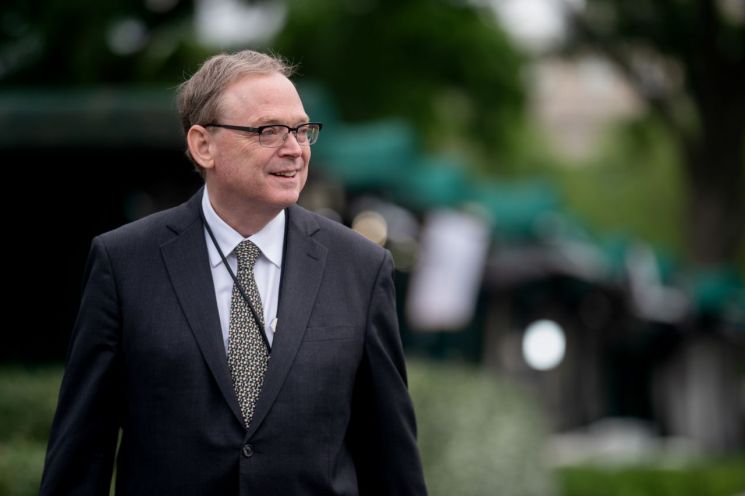
Kevin Hassett, Chairman of the White House National Economic Council (NEC), appeared on ABC's "This Week" and said, "We are very confident that judges will support this law (International Emergency Economic Powers Act, IEEPA)," adding, "We are very, very confident that Plan A is all we need."
His remarks came as President Trump's reciprocal tariffs and fentanyl tariffs, imposed under the IEEPA, have recently become the subject of legal controversy in the courts. Previously, on May 28, the U.S. Court of International Trade (CIT) ruled that tariffs imposed under the IEEPA were invalid. In response, the U.S. Court of Appeals for the Federal Circuit temporarily suspended the lower court's ruling the very next day and decided to review the legal legitimacy of the tariffs on appeal.
Chairman Hassett emphasized that even if the courts do not recognize tariffs imposed under Plan A, the IEEPA, the administration has various other options. He stated that even if reciprocal tariffs are found to be illegal, "there will be other alternatives we can pursue to make U.S. trade fair again," mentioning Section 232 of the Trade Expansion Act, Section 301 of the Trade Act, and Section 338 of the Tariff Act. Section 232 of the Trade Expansion Act allows the administration to impose tariffs in response to national security threats, while Section 301 of the Trade Act and Section 338 of the Tariff Act grant authority to impose tariffs as retaliatory measures against unfair trade practices.
Previously, Peter Navarro, White House Trade and Manufacturing Policy Advisor, also mentioned the possibility of using "Plan B," such as Section 122 of the Trade Act, saying, "Even if we lose regarding the IEEPA, we can take other measures." Section 122 of the Trade Act allows the imposition of tariffs in the event of a serious balance of payments deficit.
Chairman Hassett also said he expects a conversation between President Trump and Chinese President Xi Jinping to take place this week, although he does not know the exact timing. On May 30, President Trump stated that he would speak with President Xi, accusing China of violating the bilateral trade agreement. The U.S. claims that, contrary to the U.S.-China trade agreement reached last month, China has not lifted restrictions on exports of rare earth elements and critical minerals.
U.S. Treasury Secretary Scott Besant also said in an interview with CBS that "we will see something very soon" regarding the timing of a call between the two leaders.
© The Asia Business Daily(www.asiae.co.kr). All rights reserved.
![Clutching a Stolen Dior Bag, Saying "I Hate Being Poor but Real"... The Grotesque Con of a "Human Knockoff" [Slate]](https://cwcontent.asiae.co.kr/asiaresize/183/2026021902243444107_1771435474.jpg)
















