Estimating Photosynthetic Activity Using Satellite Data
Analyzing Time-Specific Plant Responses to Aerosol Effects
Improved Accuracy in Vegetation Carbon Absorption Estimation
Published in Remote Sensing of Environment
Approximately 30% of global carbon dioxide emissions are removed through plant photosynthesis.
An artificial intelligence-based analytical technology has been developed that can precisely predict this carbon absorption process on an hourly basis. This advancement is expected to contribute to scientific climate change response and the formulation of carbon neutrality policies.
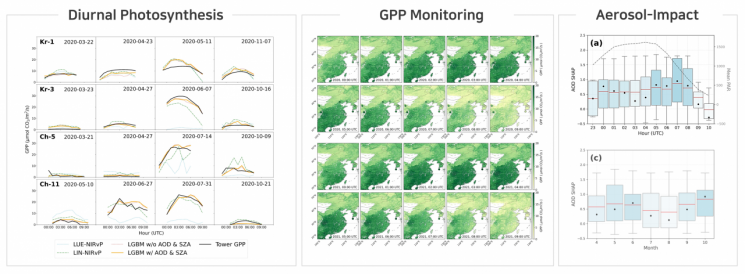
The research team led by Professor Lim Jeongho from the Department of Urban and Environmental Engineering at UNIST has developed an AI model that estimates gross primary production (GPP) on an hourly basis by training artificial intelligence with high-frequency radiative and meteorological data from geostationary weather satellites.

Gross primary production (GPP) is an indicator representing the amount of carbon actually absorbed by plants during photosynthesis, and is used to quantify the amount of carbon removed by ecosystems.
The model developed by the research team can accurately predict GPP on an hourly basis using observation data from the Himawari-8 geostationary satellite, which is collected at 10-minute intervals. Bae Sejung, the first author of the study, explained, "Existing polar-orbiting satellites can only observe one to four times a day, making it difficult to reflect changes in light conditions throughout the day. However, this model can accurately estimate changes in photosynthetic response based on much finer temporal resolution."
The prediction model incorporates various meteorological data, including aerosol optical depth (AOD), which indicates how much sunlight is absorbed or scattered by aerosols in the atmosphere. AOD is a satellite observation index that indirectly reflects the concentration of particulate matter such as fine dust, and it is a factor that alters photosynthetic conditions by affecting the intensity and quality of sunlight.
To determine what information the AI used for its predictions, the research team utilized an explainable artificial intelligence technique (SHAP). The analysis showed that AOD was the variable with the greatest influence on photosynthesis prediction during morning and evening hours. This result reflects the tendency for the proportion of scattered light to increase as the solar elevation angle decreases, making plant photosynthetic responses more sensitive to changes in light conditions.
Professor Lim Jeongho stated, "Because it is possible to estimate carbon absorption responses in East Asia on an hourly basis with a spatial resolution of 2 km, this technology can be applied to various fields such as ecosystem carbon flow analysis, vegetation response monitoring, and light environment-based carbon modeling."
The research results were published on June 1 in 'Remote Sensing of Environment' (IF 11.1), a leading international journal in the field of remote sensing. RSE is recognized as a journal that leads global trends in environmental science and satellite observation research.
The research was supported by the Korea Environmental Industry and Technology Institute under the Ministry of Environment and the Korea Agency for Infrastructure Technology Advancement under the Ministry of Land, Infrastructure and Transport.
© The Asia Business Daily(www.asiae.co.kr). All rights reserved.


















