Citizens Demand an End to Bus Subsidies
As the city bus strike in Changwon, South Gyeongsang Province, entered its fifth day on June 1, public patience with both labor and management has worn thin, and there are growing calls for a strong warning to cut off subsidies.
This is because, despite Changwon city buses receiving hundreds of billions of won in annual financial support under the quasi-public management system, which has greatly strengthened their public service and social responsibility, the strike inertia continues.
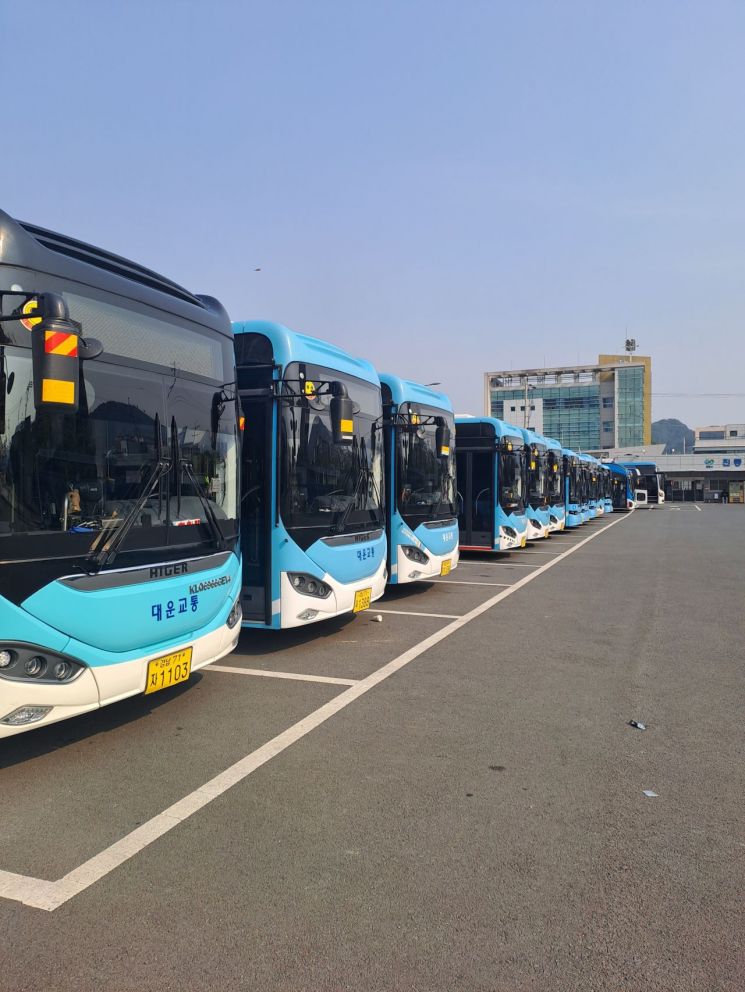 A bus stopped at Jindongmyeon Transfer Center after labor-management negotiations for Changwon city buses broke down on May 28. Photo by Song Jonggu
According to Yonhap News Agency and Changwon Special City on June 1, the city bus strike in Changwon, which began with the first buses on May 28, has now entered its fifth day. This is the longest strike on record.
It is extremely rare nationwide for city buses, known as the "wheels of the people," to continue a strike for five consecutive days.
Labor and management have failed to resolve their differences over several issues: whether to include regular bonuses in the base wage according to a Supreme Court ruling last December, the extent of wage increases, an increase in summer vacation allowances, and an extension of the retirement age.
For the first time since the strike began, labor and management held a follow-up mediation meeting under the auspices of the Gyeongnam Regional Labor Relations Commission from 3 p.m. on May 30 until about 1:30 a.m. the next day, but they were unable to narrow their differences.
There was also a suggestion to first reach an agreement on some items in the collective bargaining agreement and temporarily suspend the strike, even if a complete settlement could not be reached, but in the end, this was not accepted.
Although there is a possibility that labor and management may hold separate negotiations over the weekend, no further mediation meetings are currently scheduled.
As the prolonged strike becomes a reality, the inconvenience for Changwon citizens, who rely on city buses as their only means of public transportation, is snowballing.
A resident of Jindong-myeon, Happo-gu, Changwon Special City, said, "I work in Masan, but I end up being late every day waiting for temporary buses," expressing frustration and adding, "Do they really believe that causing this much inconvenience to citizens is the way to resolve the issue?"
This strike has led to criticism that the limitations of the quasi-public management system, introduced by the city in 2021, have been exposed.
The quasi-public management system is a policy in which local governments partially take over the management of private bus companies, intervening in matters such as route planning, while compensating for deficits.
The aim is to guarantee appropriate profits for bus companies to ensure stable operations, and to prevent bus drivers from suffering from job insecurity or unpaid wages, thereby improving services such as eradicating reckless driving.
While collective wage and bargaining negotiations are fundamentally issues to be resolved between labor and management, under this quasi-public management system, the results of these negotiations are in effect linked to the scale of municipal financial support.
The amount of financial support for city buses in Changwon increased from 58.6 billion won in 2020, before the quasi-public management system was implemented, to 85.6 billion won last year, an increase of about 27 billion won. The city explains that 19 billion won, or 70% of the increase, went to support driver wages.
The city also stated that if the 33 billion won increase in labor costs, resulting from the union's original demands for base wage and wage increases, is fully reflected in this year's wage and bargaining negotiations, the total financial support would balloon to 120 billion won, which would be unsustainable.
Due to these characteristics, the quasi-public management system requires greater public service and social responsibility from both labor and management. However, in Changwon, strikes have occurred every two years (in 2023 and this year) despite the introduction of this system.
This is a phenomenon rarely seen in other regions, including Seoul, which was the first in the country to introduce the quasi-public management system in 2004.
As a result, there is criticism that the purpose of the quasi-public management system has been undermined, and some are skeptical, questioning whether the system is simply fattening the bus companies' profits.
The city also agrees that the repeated strikes under the quasi-public management system are undesirable.
A city official said, "Under the current quasi-public management system, the city is structured to compensate for operational losses, so the amount the city has to bear increases depending on the outcome of negotiations. Both labor and management, as well as all parties involved, need to make concessions and compromises to reach a mutually acceptable agreement."
Citizens are now demanding that both labor and management stop ignoring the suffering of the public and resume bus operations as soon as possible, starting from June 2 at the latest.
© The Asia Business Daily(www.asiae.co.kr). All rights reserved.
![Clutching a Stolen Dior Bag, Saying "I Hate Being Poor but Real"... The Grotesque Con of a "Human Knockoff" [Slate]](https://cwcontent.asiae.co.kr/asiaresize/183/2026021902243444107_1771435474.jpg)
















