Swift Recovery from Wildfire Damage Completed
Full Support for Restoration of Agriculture, Livestock, Cultural Heritage, Forests, and Psychological Well-being
Uiseong County in North Gyeongsang Province, which suffered significant damage from a major wildfire in March, is turning the disaster into an opportunity for regional revitalization.
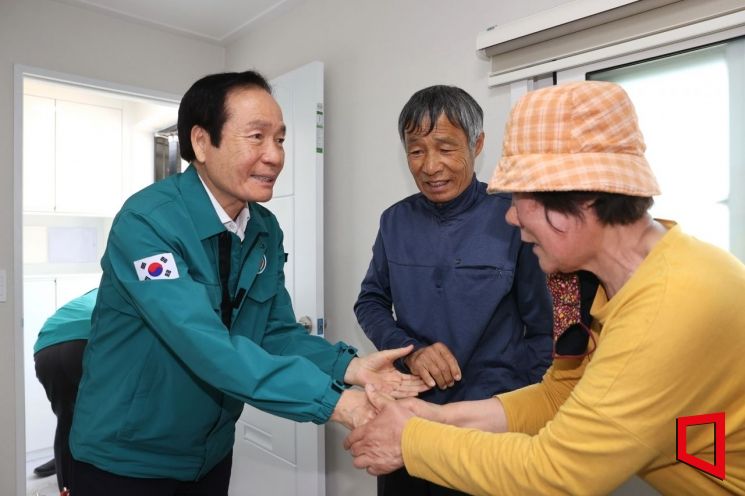 Jusoo Kim, Uiseong County Governor (left), installed 241 temporary housing units for disaster victims and completed the move-in for all victims by the end of May. Governor Kim is holding the hand of a disaster victim who moved into the temporary housing and offering comfort.
On May 31, Uiseong County announced that it has not only completed the recovery efforts swiftly, but is also actively pursuing mid- to long-term development strategies linked to the new Daegu-Gyeongbuk Airport.
Immediately after the wildfire, Uiseong County provided a total of 3.1 billion won in living safety support funds to 1,442 affected households and installed 241 temporary housing units, completing the move-in for all disaster victims by the end of May.
Recovery efforts in the agricultural and livestock sectors are also progressing rapidly. Restoration support worth approximately 8.1 billion won is being provided for 3,209 pieces of agricultural machinery, and comprehensive support is being given for livestock restocking and facility restoration in the livestock sector as well.
For the 27,961 hectares of forest that were destroyed, a mid- to long-term restoration plan has been established, and recovery is being carried out in phases. This includes logging on 343 hectares (16.4 billion won), installation of erosion control dams for landslide prevention (5.4 billion won), removal of hazardous roadside trees, and installation of disaster prevention facilities. The county also plans to restore roadside trees, stabilize slopes, and implement emergency erosion control projects in parallel to prevent secondary damage during the summer.
As eight traditional temples, including Gounsa, were destroyed in the wildfire, the county has established a restoration plan totaling 46.2 billion won and has begun full-scale restoration work.
In addition, the warmth of 8.2 billion won in donations?including 2.1 billion won in Hometown Love donations collected nationwide and 6.1 billion won from the Community Chest of Korea?is providing significant support to the disaster victims.
Efforts are also being focused on supporting the physical and emotional recovery of affected residents. Uiseong County Health Center has provided medical care to over 3,200 people in about 100 villages across six townships, and has identified 100 individuals at high risk for mental health issues early, connecting them to specialized institutions for treatment.
In cooperation with seven specialized institutions, including Gyeongbuk Province and the National Trauma Center, the county is systematically operating psychological counseling, medication treatment, and regular evaluations of temporary housing. A total of 549 medical personnel are participating in on-site medical services.
Uiseong County is also taking this disaster as an opportunity to restructure the local industrial landscape for sustainable future development.
The county is focusing on expanding industrial infrastructure, such as establishing an airport hinterland logistics complex and an agri-food cluster linked to the new Daegu-Gyeongbuk Airport. It also plans to address population decline and aging by integrating elderly medical care support, strengthening youth policies, and promoting the transition to smart agriculture.
Jusoo Kim, Governor of Uiseong County, stated, "This wildfire was a great ordeal for all county residents, but we are using this crisis as a foundation to leap forward into a better future for the region. Together with our residents, we will build a resilient and sustainable Uiseong."
© The Asia Business Daily(www.asiae.co.kr). All rights reserved.

















