Arrested at the Scene by Public Security Authorities
A man in China suffering from a mental illness jumped into the Terracotta Army pit at the Mausoleum of the First Qin Emperor in Xi'an, Shaanxi Province, damaging the terracotta warriors.
According to local media such as The Paper and Hualongwang, on May 30, the Lintong Branch of the Xi'an Public Security Bureau announced that a man in his 30s, surnamed Sun, jumped into the No. 3 tourist pit at the Mausoleum of the First Qin Emperor on that day. He pushed and pulled two terracotta warriors clad in armor, which are classified as second-class cultural relics, causing damage. The pit Sun jumped into is reported to be about 3 meters high. The specific extent of the damage to the terracotta warriors has not been disclosed.
A witness at the scene testified that while heading toward Pit No. 3 under the guidance of a tour guide, he saw a man jump into the terracotta warrior pit. The man first jumped onto the middle level and then jumped down to the bottom of the pit. The visitors, shocked by the scene, shouted at the man, asking, "What are you doing?" However, the man ignored them, stood up, touched the terracotta warriors, and then pushed one over. Afterward, he lay down on the floor of the pit and covered his face, while museum staff immediately evacuated all visitors.
Public security authorities stated that Sun suffers from a mental illness. He was arrested at the scene and is currently under investigation. An official from the Mausoleum of the First Qin Emperor said that it is uncertain whether the pit where the incident occurred will remain open to the public in the future.
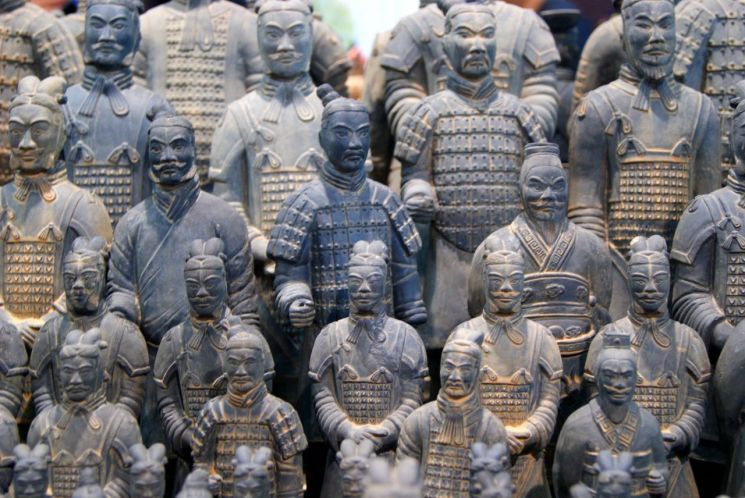
The Mausoleum of the First Qin Emperor, the tomb of Qin Shi Huang (259?210 BC), the first emperor to unify China, was constructed over 38 years from 246 BC to 208 BC. The entire site covers an area of 56 square kilometers, about seven times the size of the Forbidden City. To the east of the mausoleum lies the Terracotta Army pit, where more than 8,000 life-sized clay (terracotta) figures of soldiers, chariots, and horses are buried.
The Terracotta Army pits consist of three main sections, and the No. 3 tourist area, where this incident occurred, is known to have served as the military command center. Protective structures such as fences have been installed at the boundaries of this area and the Terracotta Army pits. The Mausoleum of the First Qin Emperor remained hidden for over 2,000 years until it was accidentally discovered by farmers digging a well near Xi'an, Shaanxi Province, in 1974. In 1987, it was designated as a UNESCO World Heritage Site.
© The Asia Business Daily(www.asiae.co.kr). All rights reserved.

















