Four Victims Recognized as Killed in the Line of Duty...
Posthumous Promotion by One Rank to Be Recommended
Funeral to Be Conducted with Full Military Honors by the Navy
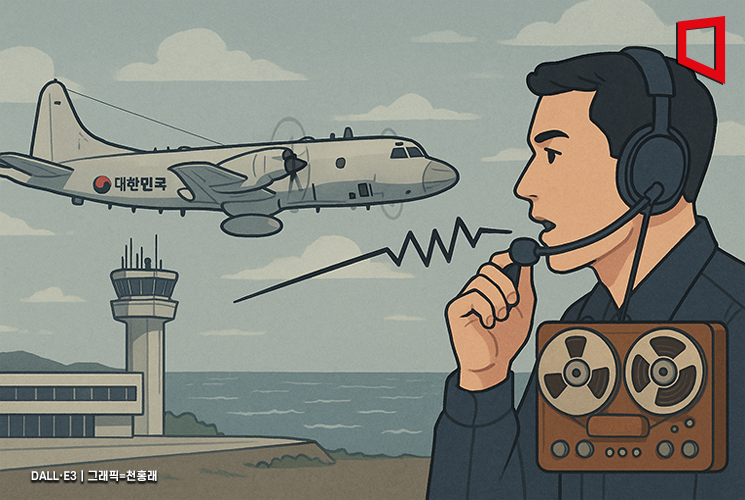
It has been found that the Navy maritime patrol aircraft (P-3CK) that crashed on the 29th showed no particular signs of abnormality in its communications with the control tower up until one minute before the accident. The Navy has retrieved the aircraft's cockpit voice recorder and plans to conduct a full-scale investigation into the accident.
According to the Navy on the 30th, at the time of the accident, the aircraft was conducting takeoff and landing training (Touch and Go?repeatedly touching down and taking off after circling the runway) at the Pohang base to enhance pilot proficiency. This procedure involves taking off from Pohang base, circling, touching down on the runway, and then taking off again in repetition.
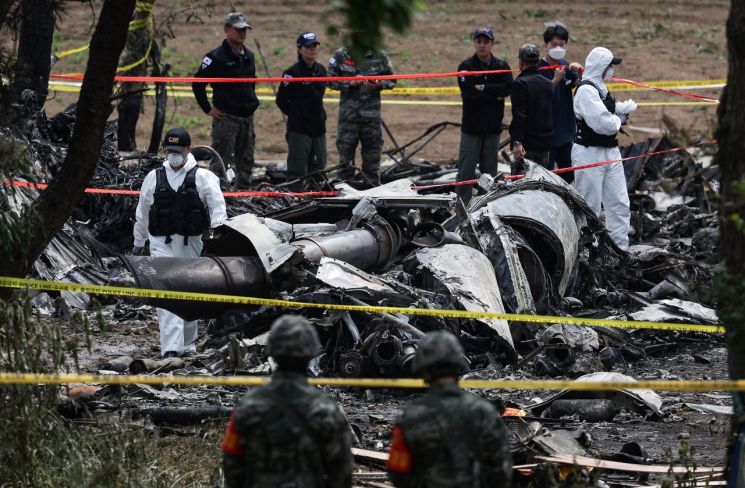 On the 30th, Navy officials are conducting an on-site investigation at the crash site of a Navy patrol aircraft in Donghae-myeon, Pohang City, Gyeongbuk. Photo by Yonhap News
The aircraft had planned a total of three training sessions that day. It took off at 1:43 p.m., completed the first session, and then took off again for the second session. While making a right turn after takeoff for the second session, the aircraft crashed into a nearby hill at around 1:49 p.m. The training flight path was the same as usual, and the weather conditions at Pohang base were favorable.
The accident resulted in the deaths of four crew members: Captain Park Jinwoo, the chief pilot; Captain Lee Taehun, the co-pilot; Sergeant First Class Yoon Dongkyu, a tactical officer; and Sergeant First Class Kang Shinwon, also a tactical officer. Captain Park, the chief pilot, had over 1,700 flight hours, and Captain Lee, the co-pilot, had over 900 flight hours. They had each served at Pohang base for approximately five years and about three months, respectively. Although the aircraft was equipped with 15 parachutes, none of the crew members were able to escape. A Navy official stated, "We believe it was a situation where escape was difficult at the time of the accident."
According to the Navy, the last communication between the aircraft and the control tower occurred at 1:48 p.m., one minute before the crash. There was no mention of an emergency in this communication. A Navy official explained, "After completing the first training session, the aircraft took off for the second session and communicated to the control tower that it would enter the traffic pattern before beginning the right turn and subsequently crashing."
Immediately after the accident, the Navy formed an accident investigation headquarters, headed by the Deputy Chief of Staff, to investigate the cause. Since there was no mention of an emergency during the final communication, the investigation is considering multiple possibilities, including a bird strike, sudden weather changes, turbulence, and other external factors that may have caused the crash.
On this day, the Navy recovered the aircraft's cockpit voice recorder (CVR). Typically, flight data recorders consist of a flight data recorder (FDR) and a cockpit voice recorder (CVR), but it was reported that only the CVR was installed on the aircraft. The Navy believes that the CVR may contain about one minute of cockpit conversation from the last communication with the control tower at 1:48 p.m. until the crash, and is investigating accordingly. Brigadier General Cho Youngseong, head of the Navy accident investigation team, stated, "The exact cause of the accident will be determined through a comprehensive analysis of the radar track data stored at the control tower, the recorded contents of the cockpit voice recorder, and the aircraft wreckage."
The P-3CK involved in the accident is an aircraft produced by Lockheed Martin in the United States in 1966. It was delivered to Korea Aerospace Industries (KAI) in 2007, underwent reinforcement and performance upgrades, and was introduced in 2010. Although the aircraft is 60 years old, the Navy explained that after reinforcement and upgrades, its operational lifespan was guaranteed until 2030, with a maximum flight time of 15,000 hours.
The aircraft's last major overhaul was in 2021, and another overhaul was scheduled for the end of this year in accordance with the regular 4.5-year maintenance cycle. Field and unit maintenance were also completed in February and April of this year. A Navy official stated, "In addition to major overhauls, regular periodic inspections are conducted, and there were no significant defects observed since the beginning of the year," adding, "All minor defects had been resolved."
Meanwhile, on the morning of the 30th, the Navy held a committee meeting at Navy Headquarters to review the case and decided to recognize the deceased as having died in the line of duty. Accordingly, the Navy plans to recommend to the Ministry of National Defense that the deceased be posthumously promoted by one rank. The Navy will also hold a military funeral for the victims in consultation with their families. A joint memorial altar will be set up at the Navy Air Command gymnasium from 1 p.m. on the same day. The funeral ceremony will be held at Navy Air Command on June 1, and the enshrinement ceremony will take place at the Daejeon National Cemetery.
The Navy stated, "Once again, we offer our deepest condolences to the bereaved families and pray for the souls of the deceased who lost their lives in this tragic accident," adding, "The Navy will thoroughly investigate the cause of this accident and establish measures to prevent such incidents from happening again."
© The Asia Business Daily(www.asiae.co.kr). All rights reserved.


















