Exploring Life Spaces Discovered at Home and Abroad
Seeking Strategies to Respond to New Housing Trends
Busan Urban Corporation (BMC, President Shin Changho) held the 29th meeting of 'Smart BOOKmorning' on May 28 to enhance its capabilities as a public developer.
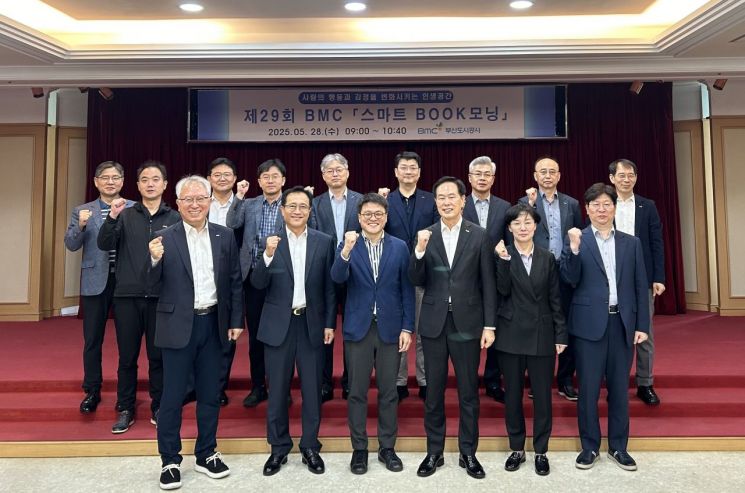 Busan Urban Corporation is holding the Bukmorning event and taking a commemorative photo. Photo by Busan Urban Corporation
For this lecture, Professor Cho Sungik from the College of Architecture and Urban Studies at Hongik University was invited to deliver a special lecture on the theme, "Life Spaces That Change Human Behavior and Emotions."
Professor Cho emphasized that "a space is not merely a physical structure, but can become a 'life space' that guides and transforms people's emotions and behaviors," and illustrated this through various examples.
He first introduced his own life space, the Vienna State Opera House in Austria, explaining that the theater's loge seats are available in a wide range of prices and forms, which enables generational integration, or a generation mix. He also discussed another life space, the Sankt Gerold Church, sharing his thoughts that architectural elements such as the entrance path shaped by people's footsteps and the glass windows at the church's front may be ways in which architecture expresses the passage of time and the presence of the divine.
Professor Cho then recommended that people seek out their own life spaces in everyday settings, such as their favorite cafes or restaurants, which can also influence their behaviors and emotions, even if these places are not famous landmarks.
He also mentioned the 'Mangrove Project,' which he personally led, emphasizing the importance of residential structures that enable "brief but frequent encounters" in response to the increase in single-person households and the changing housing needs of young people.
The lecture concluded with the concept of 'Lin' (隣), which refers to neighborly relationships as a modern residential element that goes beyond basic needs to include social connections. Professor Cho predicted that in each individual's life space, "weak ties"?where people recognize each other's faces but do not know each other's names?will become a "strong force" within future communities.
During the Q&A session that followed, participants engaged in active and in-depth discussions on issues such as the aging population in Busan and the future direction of public rental housing.
Shin Changho, President of Busan Urban Corporation, stated, "Future housing must go beyond simply providing space to enable communication and choice," and added, "All of our employees will do their utmost to ensure that Busan Urban Corporation keeps pace with changing housing trends and can provide citizens with both large and small life spaces."
© The Asia Business Daily(www.asiae.co.kr). All rights reserved.

















