Key Defense Issues for the New Administration
Momentum Builds for Martial Law Truth-Finding
Military Reform and Civilianization as Major Agendas
Under the Lee Jaemyung administration, which was born amid the scars of the 12·3 Martial Law, comprehensive military reforms are expected to be pursued. At the same time, the administration is set to actively promote measures to ease military tensions on the Korean Peninsula by restoring inter-Korean relations, such as the 9·19 Inter-Korean Military Agreement. Efforts will also be made to address security gaps arising from changes in the role of US Forces Korea.
First, the Lee Jaemyung administration is expected to accelerate efforts to uncover the truth behind the 12·3 Martial Law and hold those responsible accountable. Initiatives such as the ‘Special Prosecutor for Insurrection,’ which were previously blocked by vetoes during the tenures of former acting presidents Han Ducksoo and Choi Sangmok, are also expected to be revived.
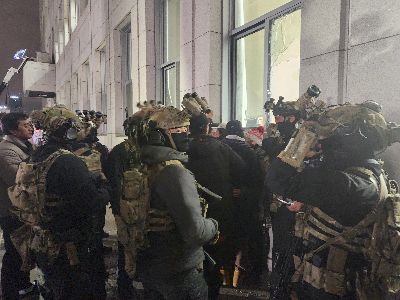 On the 4th, about 20 martial law troops attempted to break the glass windows and enter the main building of the National Assembly. Photo by Kim Hyunmin
Most experts agree that military-related investigations are a crucial element in uncovering the full extent of the martial law. There is a prevailing view that thorough investigations and accountability are necessary to prevent similar incidents from ever happening again. However, there are also concerns that the stability of the organization could be shaken depending on the scope and content of the investigations. This is why both inside and outside the military, there is keen attention on how the new government will carry out fact-finding efforts. A military official stated, "Swift fact-finding is the top priority to stabilize the morale of the troops," and added, "It is also necessary to establish clear standards for punishment so that all service members do not feel uneasy."
Other military reform initiatives are also expected to be launched in earnest. During his candidacy, President Lee pledged to ‘civilianize national defense.’ This means opening the position of Minister of National Defense?which has been monopolized by military personnel for over 60 years since the 5·16 military coup in 1961?to civilians as well.
Reforms of military intelligence agencies, such as the Defense Security and Intelligence Command, which led the 12·3 Martial Law, are also expected to be revisited. During the Moon Jaein administration, the Defense Security Command was disbanded in the wake of the martial law document scandal, and the Defense Security Support Command (now the Counterintelligence Command) was established. There is significant interest in the extent of mission and role adjustments this time.
The administration is also expected to actively pursue measures to gradually restore inter-Korean relations and ease military tensions, which became strained during the Yoon Sukyeol administration. During the presidential campaign, President Lee pledged to restore inter-Korean communication channels to prevent accidental clashes and manage situations. In addition, the administration plans to restore the 9·19 Military Agreement?which suspended the distribution of anti-North Korea leaflets, waste balloons, and broadcasts toward North Korea?whose effectiveness was halted under the Yoon Sukyeol administration.
With the advent of the second Donald Trump administration in the United States, the so-called ‘strategic flexibility’?which calls for shifting the role of US Forces Korea from focusing on North Korea to containing China?has become inevitable. Addressing the resulting security gaps is another challenge facing the Lee Jaemyung administration.
To this end, the Lee Jaemyung administration plans to enhance the performance of Korean-style ballistic missiles and strengthen deterrence against North Korea by advancing the Korea Air and Missile Defense (KAMD) system. Additionally, the government will establish a military satellite system to monitor the entire Korean Peninsula 24 hours a day, and, in the mid- to long-term, plans to create a Space Strategic Command to further strengthen response capabilities. Alongside these efforts, the administration intends to pursue the ‘reclaiming’ of wartime operational control based on a solid ROK-US alliance.
© The Asia Business Daily(www.asiae.co.kr). All rights reserved.
![Clutching a Stolen Dior Bag, Saying "I Hate Being Poor but Real"... The Grotesque Con of a "Human Knockoff" [Slate]](https://cwcontent.asiae.co.kr/asiaresize/183/2026021902243444107_1771435474.jpg)
















