A process that converts thermosetting waste plastics into synthesis gas, a raw material for hydrogen production, has been developed in South Korea.
Plastics are generally divided into thermoplastics, which can be molded into desired shapes when heated, and thermosetting plastics, which become difficult to decompose once hardened.
Among these, thermosetting plastics are highly resistant to high temperatures and chemically stable, so they are mainly used in mixed forms in automobiles and electronic products. However, due to their characteristic of only being decomposable at extremely high temperatures, they have so far been disposed of through landfilling or incineration after use, making them a major cause of environmental pollution. This gives particular significance to this research.
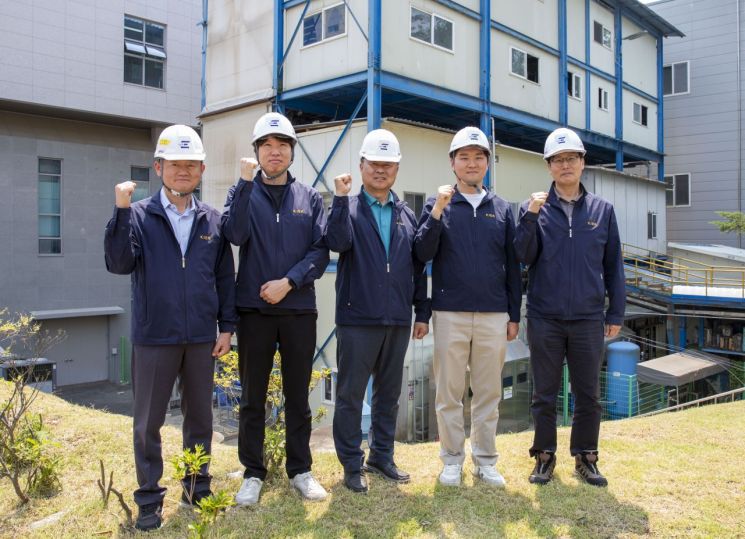 (From left) Dr. Jongpyo Cho, Engineer Youngjin Shin, Senior Engineer Junggeun Kim, Dr. Seungjae Lim, Dr. Seungjae Lee. Provided by Korea Institute of Energy Research
The Korea Institute of Energy Research (KIER) announced on May 30 that the research team led by Dr. Jongpyo Cho of the Energy Convergence System Research Division has succeeded in producing high-quality synthesis gas from thermosetting mixed waste plastics, which are difficult to recycle, by utilizing a continuous process based on oxy-fuel combustion.
Synthesis gas consists of carbon monoxide (CO) and hydrogen (H2). It is used as a feedstock gas for producing synthetic fuels. Among its components, carbon monoxide can be converted into hydrogen through a catalytic chemical reaction with superheated steam.
First, the research team developed an "oxy-fuel combustion-based gasification process" that converts thermosetting mixed waste plastics into synthesis gas, which serves as a raw material for hydrogen production. In addition, for the first time in South Korea, they established a process capable of continuous operation, improving efficiency and drastically reducing the amount of tar, a byproduct of the process, to levels far below the requirements for commercial synthesis gas.
The key technologies include oxy-fuel combustion control, which removes nitrogen from air to minimize heat loss, and a regenerative melting furnace that prevents heat supplied inside the gasifier from escaping. These technologies enable the continuous supply of high temperatures up to 1,300 degrees Celsius. According to the research team, this system allows for continuous processes such as feedstock input, pretreatment, and gasification, thereby maximizing process efficiency.
In particular, the amount of tar generated in the process has been drastically reduced. Tar, a byproduct of the process, is highly viscous and adheres to process lines, hindering continuous operation.
To prevent this, temperatures above 1,000 degrees Celsius are required. However, typical waste plastic decomposition processes use temperatures below 800 degrees Celsius, resulting in large amounts of undecomposed tar. While it is possible to install separate purification devices to remove tar, this increases process costs.
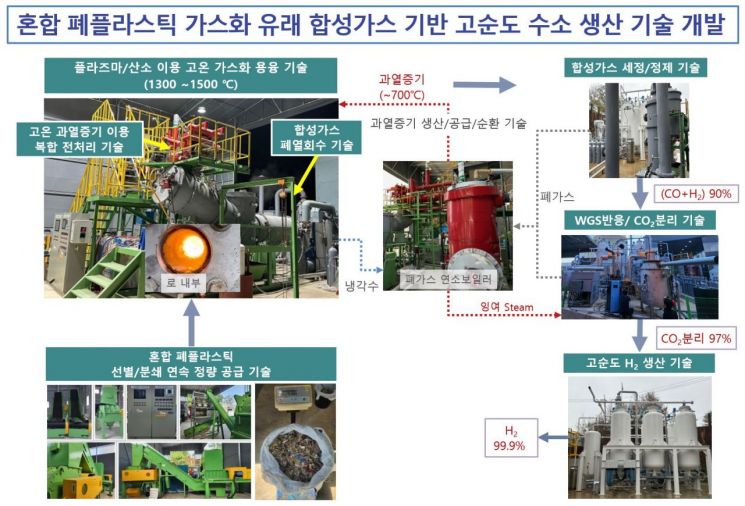 Process concept diagram developed by the research team. Provided by Korea Institute of Energy Research
In contrast, the research team succeeded in reducing tar generation to 0.66 mg/Nm3 (milligrams per normal cubic meter) without a purification device by maintaining ultra-high temperatures through the continuous process. This is a 93.4% reduction compared to the tar concentration requirement for synthesis gas used in chemical fuel synthesis processes (less than 10 mg/Nm3).
The research team demonstrated the developed process in a pilot plant capable of treating one ton of thermosetting mixed waste plastics per day. As a result, they were able to produce 0.13 kg of hydrogen from each kilogram of mixed waste plastics. Based on these results, the research team registered three domestic patents and filed one international patent, laying the foundation for commercialization.
Dr. Jongpyo Cho said, "This achievement is significant in that it greatly improves the efficiency of the gasification process and drastically reduces tar generation using proprietary domestic technology. The research team plans to scale up the process to a two-ton capacity and continue related research to promote commercialization."
© The Asia Business Daily(www.asiae.co.kr). All rights reserved.
![Clutching a Stolen Dior Bag, Saying "I Hate Being Poor but Real"... The Grotesque Con of a "Human Knockoff" [Slate]](https://cwcontent.asiae.co.kr/asiaresize/183/2026021902243444107_1771435474.jpg)












