Democratic Party's Industry Crisis Area Revitalization Committee
"Expansion of Government Abalone Purchase and Reduction of Aquaculture Facilities Needed"
"Establishment of Blue Carbon International Certification and Carbon Credit Infrastructure"
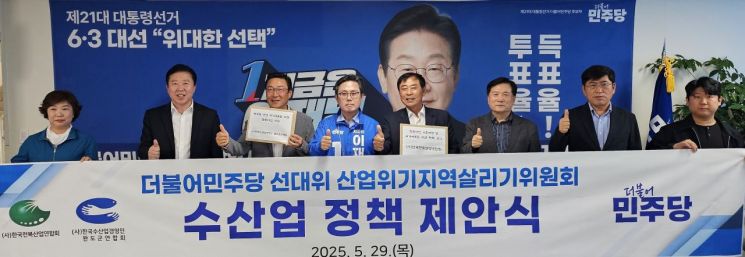 Ando Geol, Chair of the Industry Crisis Area Revitalization Committee of the Democratic Party's Presidential Campaign Headquarters, held a meeting on the 29th at the Gwangju Dongnam-eul Regional Committee office with representatives from the Korea Abalone Industry Association and the Wando County Federation of the Korea Fisheries Management Association to discuss overcoming the crisis in the fisheries industry. Photo by Ando Geol's office
Ando Geol, Chair of the Industry Crisis Area Revitalization Committee of the Democratic Party's Presidential Campaign Headquarters, held a meeting on the 29th at the Gwangju Dongnam-eul Regional Committee office with representatives from the Korea Abalone Industry Association and the Wando County Federation of the Korea Fisheries Management Association to discuss overcoming the crisis in the fisheries industry. During the meeting, he received a policy proposal from the participants.
The abalone industry was once a high value-added fisheries sector with annual sales reaching 900 billion won, serving as a key industry supporting the coastal regional economy and the livelihoods of fishing households. However, there are growing concerns about the collapse of the industry's foundation due to a sharp decline in abalone prices at production sites and sluggish distribution, which have worsened the management conditions for fishing households.
The Korea Abalone Industry Association proposed expanding the government’s stockpiling program and securing budget support for restructuring and reducing cage aquaculture facilities. Currently, the government’s abalone stockpiling covers only 12.5% of total production, which is insufficient to stabilize prices. In particular, the association argued that the government should actively purchase abalone and processed abalone products during the peak spring shipment season to help stabilize supply and demand. They also requested the implementation of a cage reduction project to address overproduction, along with the establishment of a national compensation plan for the resulting losses suffered by fishing households.
The Wando County Federation of the Korea Fisheries Management Association also highlighted the sustainability crisis facing the seaweed industry and emphasized the need to shift fisheries policies to address climate change. The federation pointed out that marine pollution, rising water temperatures, seedling loss, and bleaching phenomena have combined to cause a sharp annual decline in seaweed production, which threatens the overall coastal economy.
The federation requested the establishment of institutional infrastructure for international certification of seaweed blue carbon and carbon credit trading, as well as the inclusion of offshore-based smart seaweed aquaculture complexes in national policy. They proposed legalizing the official recognition of carbon dioxide absorbed by seaweed as blue carbon to allow entry into the carbon credit market, and transforming the seaweed industry into a future strategic industry by integrating smart aquaculture technologies using idle marine areas.
Chair Ando stated, "The abalone and seaweed industries are strategic sectors that connect climate crisis response, coastal economic recovery, and the creation of future national growth engines. It is time for the government to go beyond supporting industrial crisis areas and actively work to restructure the fisheries industry and establish a foundation for entering the carbon market."
Chair Ando also said, "At the National Assembly level, I will do my utmost to provide institutional and policy support to protect the livelihoods of fishers and restore the fisheries ecosystem through consultations with relevant ministries."
© The Asia Business Daily(www.asiae.co.kr). All rights reserved.

















