At the National Theater's Haneul Theater on June 21
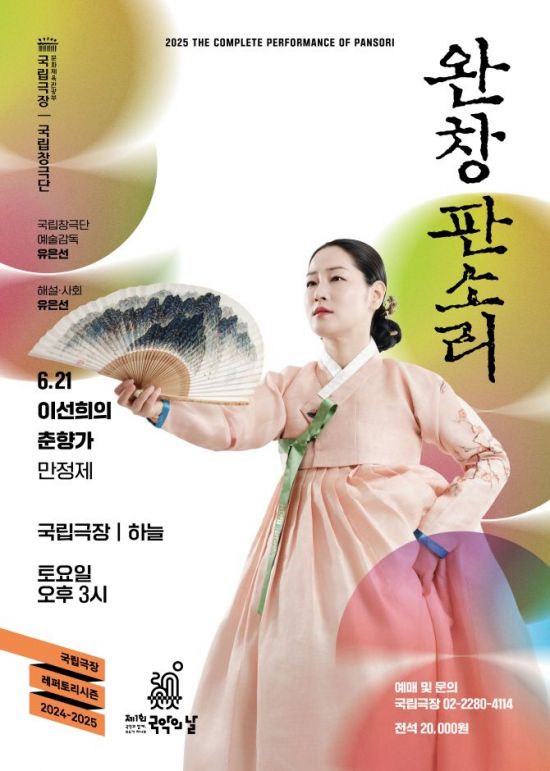
The National Changgeuk Company of Korea, a resident company of the National Theater of Korea, announced on May 29 that it will present "Wanchang Pansori: Lee Sunhee's Chunhyangga" at the Haneul Theater of the National Theater on June 21.
Master singer Lee Sunhee, who holds a doctorate for her research on the Kim Sohee school of pansori, will perform the complete Manjeong school version of "Chunhyangga."
"Chunhyangga" is regarded as the most outstanding work both musically and literarily among the five major pansori repertoires. In particular, the Manjeong school version of "Chunhyangga" is named after the pen name "Manjeong" of master singer Kim Sohee (1917-1995). This school is characterized by its pronounced tragic sentiment, refined musical structure, and sophisticated techniques such as sigimsae (ornamentation).
Lee Sunhee possesses a deep understanding and professional knowledge of the Kim Sohee school of pansori, having earned her doctorate through research on the Kim Sohee school version of "Chunhyangga." She also studied the Manjeong school version of "Chunhyangga" under master singer Ahn Sookseon, a beloved disciple of Kim Sohee. With her clear and elegant vocal tone and precise pitch, she is recognized as a faithful successor of Kim Sohee's artistry.
Lee Sunhee was born in Mokpo, Jeollanam-do, and began studying various traditional arts such as pansori, pansori gobup (pansori drumming), Korean dance, and gayageum at the Mokpo Municipal Gugak Institute at the age of six. At age seven, she learned Korean dance and the Park Dongshil school version of "Simcheongga" from master singer Lee Jio, and studied pansori gobup under Gam Namjong, a recognized holder of Intangible Cultural Heritage No. 11 in Gwangju Metropolitan City. This marked the beginning of her full-fledged journey into Korean traditional music. In her third year of middle school, she moved to Seoul, where she studied the Manjeong school version of "Chunhyangga" under Ahn Sookseon, and also learned the Kang Dogeun school version of "Heungboga" and the Jeong Gwangsu school version of "Sugungga."
Lee Sunhee demonstrated her talent by winning the Gold Prize in the student pansori and jeongga category at the 1995 Dong-A Korean Traditional Music Competition and the student pansori category at the Silla Cultural Festival National Gugak Competition. In 1999, she swept awards at the Dong-A Korean Traditional Music Competition, KBS Gugak Song Festival, and Onnara Gugak Competition. She also excelled in gobup, winning the Gold Prize at the Jeonju National Gosu Competition in both 1993 and 1994. In 2010, she received the Grand Prize in the master singer pansori category at the 22nd Mokpo National Gugak Competition, and in 2023, she won the Presidential Award in the master singer pansori category at the 35th Mokpo National Gugak Competition, establishing herself as a leading mid-career master singer in Korea. In addition to pansori performance, she is active in various fields such as album releases and pansori research, and she currently teaches at the Department of Traditional Arts at Chung-Ang University, dedicating herself to nurturing the next generation.
Pansori drummer Jung Junho, a certified trainee of the National Intangible Cultural Heritage pansori gobup, will accompany the performance from start to finish, while Eunseon Yoo, artistic director and head of the National Changgeuk Company of Korea, will provide commentary and serve as the host.
© The Asia Business Daily(www.asiae.co.kr). All rights reserved.

















