Honoring the Spirit of Brother Militia Leaders Kang Heebo and Kang Heeyeol, and Maechon Hwang Hyeon
Discovering the Poetic Spirit of National Poet Yun Dongju
June is known as the Month of Patriots and Veterans, filled with commemorative days related to national security, including Patriots' Day on the 1st, Memorial Day, and the anniversary of the Korean War.
On May 29, Gwangyang City in South Jeolla Province recommended the "Gwangyang Conceptual Tour" to honor the noble spirit of those who sacrificed themselves for the country, such as the brother militia leaders and Hwang Hyeon, also known as Maechon, in this meaningful month.
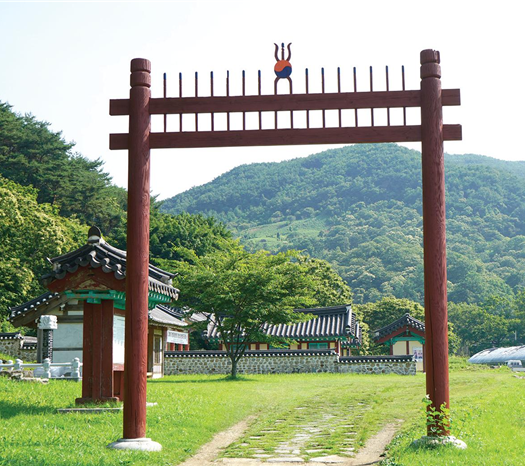 A pair of patriotic gateposts honoring the brother militia leaders Kang Heebo and Kang Heeyeol, who raised volunteer armies during the Imjin War, made great achievements, and died in battle. Provided by Gwangyang City
Gwangyang was a hub of militia activity due to its geographical features, including the deep valleys and rugged mountains of Baegunsan, and its location along the Seomjin River and Gwangyang Bay, which provided access to maritime routes.
In Bonggang-myeon, Gwangyang City, there is Ssangeuisa, a shrine honoring the brother militia leaders Kang Heebo and Kang Heeyeol, who raised volunteer armies during the Imjin War, made great achievements, and died in battle. When the Imjin War broke out, the two brothers fought alongside General Kim Cheonil against 100,000 Japanese troops, and they died in succession on June 27 and 29, 1593. Ssangeuisa consists of the East Hall, West Hall, Sammun (three gates), and Hong Salmun (red gateposts). Following the walking path, visitors will find the brothers' modest graves.
In Seoksa-ri, Bonggang-myeon, there is a historical park and the birthplace of Hwang Hyeon, also known as Maechon, who, as an intellectual, felt a deep sense of responsibility after the national humiliation of 1910 and took his own life in protest. Maechon, known as the last scholar of Joseon, was a literary figure who left behind over 2,500 poems and a historian who meticulously recorded 47 years of history. Outraged by Japan's forcible annexation, he left four poems before his death and became a martyr. Eight items, including Maechon's records such as Maechon Yarok, Ohagimun, Jeolmyeong Sicheop, collections of his calligraphy and documents, as well as Maechon Hwang Hyeon's stationery and personal artifacts, have been designated as National Registered Cultural Heritage for their value as anti-Japanese independence cultural assets.
In Mangdeok Port, Jinwol-myeon, there is the Jeong Byeonguk House (Registered Cultural Heritage), which preserves the handwritten manuscript of "Sky, Wind, Stars and Poetry" by Yun Dongju, the most beloved national poet among Koreans. Jeong Byeonguk and his family, who were seniors and juniors of Yun Dongju at Yeonhui College, carefully preserved Yun Dongju's handwritten poems written in Korean during the harsh period of Japanese colonial rule, allowing them to see the light of day.
Although Yun Dongju, who was born in Bukgando and died in Fukuoka Prison in Japan, never set foot in Gwangyang, he was spiritually revived as a poet at Mangdeok Port in Gwangyang thanks to his precious connection with Jeong Byeonguk. About 500 meters from the Jeong Byeonguk House, the "Yun Dongju Poetry Garden" features 31 monuments inscribed with poems from his posthumous collection "Sky, Wind, Stars and Poetry," including "Prologue" and "Counting the Stars at Night."
Kim Miran, head of the Gwangyang City Tourism Division, said, "In June, the Month of Patriots and Veterans, which commemorates the noble spirit of the nation's fallen heroes and patriots, I hope visitors will come to Gwangyang to follow in the footsteps of the brother militia leaders who fought against Japanese aggression and Maechon Hwang Hyeon, who took his own life in protest against the annexation."
She added, "I also hope visitors will spend a meaningful time visiting the Jeong Byeonguk House and the Yun Dongju Poetry Garden in Mangdeok Port, reflecting on the deep friendship and connection between Yun Dongju, who sang of the national spirit in Korean despite strict Japanese surveillance, and Jeong Byeonguk, who preserved his works."
© The Asia Business Daily(www.asiae.co.kr). All rights reserved.

















