United States Abandoned Space Interceptor Program in the 1990s
900 Interceptors Needed per Missile... Severe Inefficiency
Decades-Long 90% Drop in Transportation Costs Seen as a Positive Sign
Golden Dome, the space-based missile defense system (MD) that U.S. President Donald Trump pledged to complete by 2029 at a cost of $175 billion (approximately 240 trillion won), has predecessors in similar past projects that ultimately failed due to efficiency issues. Hundreds of space-based interceptors (SBI) were required to block a single missile. Although aerospace technology has advanced over the past 30 years, skepticism about the Golden Dome project still persists among experts.
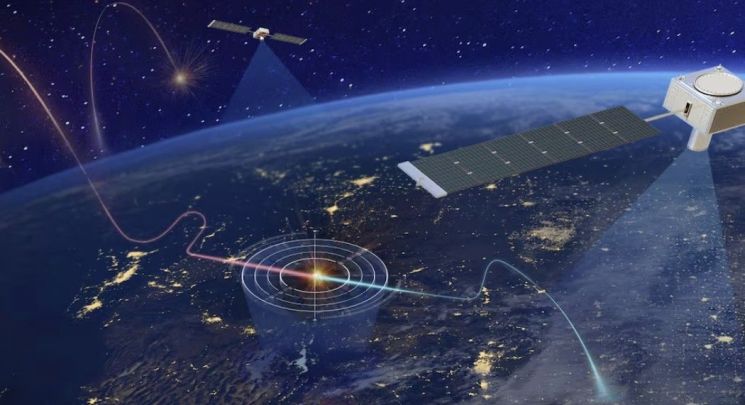 An illustration of the Golden Dome Space-Based Interceptor (SBI) colliding with a nuclear missile. Northrop Grumman website
The core of Golden Dome is the SBI, which orbits in low Earth orbit and intercepts nuclear missiles. Once a target ascending to a certain altitude is detected, the SBI is activated and neutralizes the threat by directly colliding with the target. In 1983, the Ronald Reagan administration envisioned the "Brilliant Pebbles" project, which involved densely deploying SBIs in low Earth orbit to intercept incoming missiles. Although most of the technologies used in Brilliant Pebbles were already proven in the 1980s, persistent questions about the actual defensive effectiveness relative to project costs prevented significant progress, and the project was ultimately scrapped in 1994.
"900 SBIs Needed to Block a Single Nuclear Missile"
The United States has continued to develop SBIs because they offer advantages in missile interception. Ballistic missiles carrying nuclear warheads fly in three main phases: the boost phase as they ascend into space, the midcourse phase as they travel through space, and the terminal phase as they re-enter the atmosphere and descend. Current MD systems can only intercept missiles in the terminal phase, but the typical speed of a nuclear missile in this phase reaches Mach 20 to 25, resulting in a low success rate.
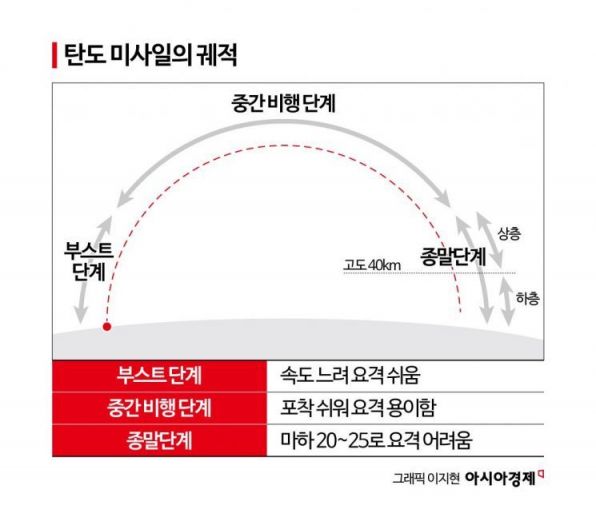
In contrast, the boost phase, when the missile is ascending relatively slowly into space, and the midcourse phase, which occurs in the vacuum of space, offer higher chances of interception. Targeting these phases, an SBI can collide with a nuclear missile and neutralize it more easily.
However, SBIs can only be activated in time if they are near the launch site of the nuclear missile. Because of Earth's rotation, ground-based nuclear missiles and SBIs in space constantly move closer and farther apart, making timely activation difficult. The solution is to deploy a large number of SBIs densely enough to surround the entire Earth, ensuring that a certain number of SBIs are always positioned above potential nuclear missiles.
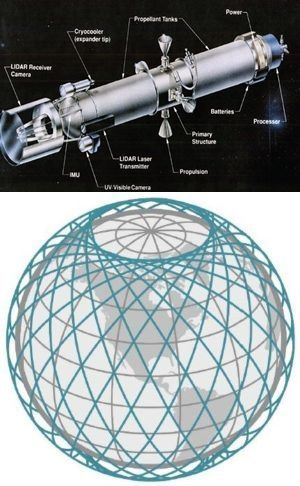 SBI designed in a simple stick shape with colorful pebbles (top). Arrangement form of SBI (bottom). Since SBI cannot always stay near nuclear missiles due to Earth's rotation, it must be arranged in a net-like form surrounding the entire surface. Reddit, Center for Strategic and International Studies (CSIS) capture
Even the scholars leading the Brilliant Pebbles project were uncertain about the exact number of SBIs required to block all Soviet nuclear missiles. Estimates ranged from 2,000 to 4,600, and even over 10,000 SBIs. In a 1990 paper published in Nature titled "Brilliant Pebbles Can't Work," physicist Richard L. Garwin calculated that 900 SBIs would be needed to block a single Soviet nuclear missile. Four years later, the U.S. government officially terminated the project.
Persistent Inefficiency and Lifespan Issues
In 2018, the Center for Strategic and International Studies (CSIS) in the U.S. conducted a simulation with American aerospace engineers to determine how many SBIs would be needed to defend against North Korean missiles. This was an attempt to see if improved technologies could make a space-based interception system feasible. The results showed that 1,000 SBIs would be required to block 7 to 8 nuclear missiles. Based on this research, CSIS concluded that "space-based interception remains an inefficient and provocative idea."
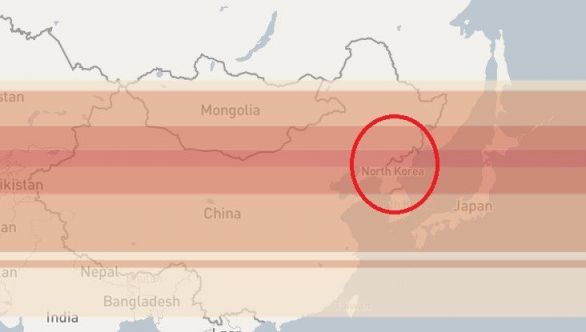 A simulation conducted in 2018 by the U.S. defense think tank Center for Strategic and International Studies (CSIS) together with aerospace experts. By deploying 1,000 SBIs in the orbit represented by the red band, there is an opportunity to intercept 7 to 8 North Korean nuclear missiles. CSIS website
The short lifespan of SBIs is another obstacle. SBIs must be positioned in low Earth orbit, specifically between 500 and 1,000 km above Earth's surface. At this altitude, atmospheric drag (the phenomenon where wind speed and direction change due to friction between the Earth's surface and the atmosphere) causes objects to gradually lose altitude. As a result, low Earth orbit satellites must constantly use propulsion fuel to maintain their original altitude, which shortens their effective lifespan. This means SBIs must be periodically replaced every few years. This is why there are predictions that the cost of the Golden Dome project could balloon to $540 billion (approximately 746 trillion won) over the next 20 years.
Will Lower Space Transportation Costs Change the Outcome?
There are also positive changes due to technological advancements. Over the past 30 years, rocket technology has improved significantly, leading to a substantial reduction in space transportation costs. In a recent letter to the Senate, the U.S. Congressional Budget Office, which estimates government project costs, stated, "Since the early 2000s, the price of space transportation per kilogram has dropped by 90 percent," and analyzed that "the launch cost of SBIs, which was initially expected to account for 40 percent of the total program cost, could now fall below 10 percent."
However, it remains unclear whether lower launch costs will also keep the total cost of Golden Dome in check. The Congressional Budget Office emphasized, "In contrast to launch vehicles, the price of SBI sensors has become more expensive than in the early 2000s," and added, "The true cost of a space interception program is still full of uncertainties and requires further research."
© The Asia Business Daily(www.asiae.co.kr). All rights reserved.



















