Successful Synthesis of High-Purity Nitrogen-Substituted MAX Precursor and Two-Dimensional MXene Material
Joint Research by Sunyong Kwon, Eunmi Choi, Kangil Byun of UNIST and Geondo Lee of Seoul National University
A MXene material, developed as an ultra-thin film just one-tenth the thickness of a human hair and capable of perfectly blocking electromagnetic waves in the ultra-high-frequency band, is expected to find applications in a wide range of fields such as next-generation communications, autonomous vehicles, defense industries, and space electronics.
The Ministry of Science and ICT (Minister Lee Sangim) announced that a research team led by Sunyong Kwon, Eunmi Choi, and Kangil Byun at UNIST, in collaboration with Geondo Lee’s team at Seoul National University, has succeeded for the first time in the world in synthesizing a high-purity, composition-tunable nitrogen-substituted MAX precursor and a two-dimensional MXene material derived from it.
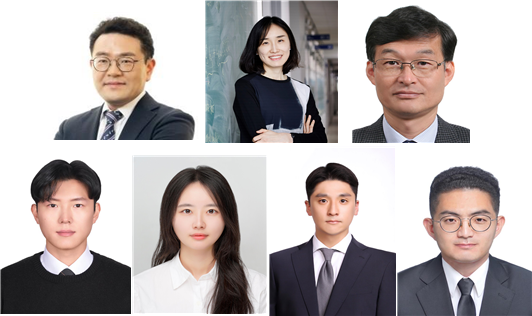 Research team (from the top left clockwise) Sunyong Kwon, Eunmi Choi (UNIST), Geondo Lee, Sungwoo Lee (Seoul National University), Mincheol Kim, Jaeun Park, Juhyung Han (UNIST) researchers. Provided by UNIST
MXene is a two-dimensional nanomaterial in which layers of metal and carbon are alternately stacked. It is renowned as a dream material due to its excellent electrical conductivity and the possibility of designing various compounds. In particular, it has attracted attention as a next-generation ultra-thin shielding material for blocking electromagnetic interference in the sub-THz frequency range. Unlike conventional metal shielding materials, which are heavy, prone to corrosion, and show a sharp decline in performance at high frequencies?thus limiting their applications?MXene is thin, lightweight, and exhibits outstanding shielding capabilities even in high-frequency bands.
To date, most MXenes have been carbon-based, but it has been predicted that substituting carbon with nitrogen would enhance their physical and chemical properties. However, due to process difficulties, this had not been realized until now. The joint research team succeeded in partially substituting carbon with nitrogen in the MAX precursor, developed a new titanium-based MAX precursor synthesis process, and elevated MXene performance to the highest global standards.
The nitrogen-substituted MXene film developed is an ultra-thin membrane, only about one-tenth the thickness of a human hair (approximately 50?100 μm), yet it achieved the highest electrical conductivity ever reported for MXene materials (35,000 S/cm), which translates to excellent shielding performance.
The developed process allows for free adjustment of the degree of nitrogen substitution from 0% up to nearly 100%, while maintaining a single crystal structure of the precursor, resulting in a high-purity MAX precursor free of intermediate impurities. This means that the electromagnetic properties of MXene can be precisely tuned according to the nitrogen content, maximizing electromagnetic shielding and reflection performance depending on the application field.
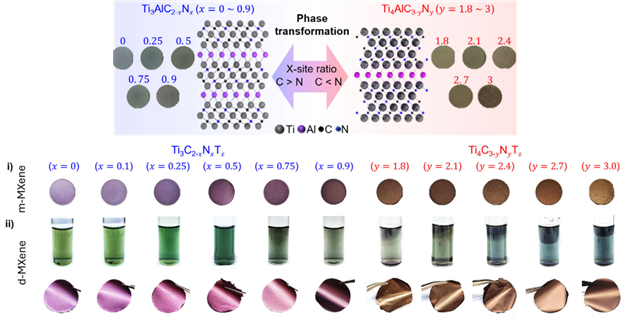 Composition MAX phase and MAX phase manufacturing process and form before high-purity nitrogen substitution.
Professor Sunyong Kwon stated, "Nitrogen-substituted MXene will be a groundbreaking breakthrough in next-generation electromagnetic wave blocking technology," adding, "It is expected to play a role in reducing electromagnetic interference in a wide range of fields, from mobile devices to electronic systems in vehicles and aircraft, and even next-generation communication base stations."
The results of this research, supported by the Nano and Material Technology Development Project promoted by the Ministry of Science and ICT and the National Research Foundation of Korea, were published on April 25 in Advanced Materials, a world-renowned journal in the field of materials science.
© The Asia Business Daily(www.asiae.co.kr). All rights reserved.


















