Domestic Research Team Succeeds in Synthesizing Two-Dimensional MXene Material
Achieves World's Highest Electrical Conductivity and Ultra-Thin Electromagnetic Shielding
Published in "Advanced Materials"
A domestic research team has developed a MXene material in the form of an ultra-thin film, just one-tenth the thickness of a human hair, that can perfectly block electromagnetic waves in the ultra-high frequency range.
On May 29, the Ministry of Science and ICT announced that a research team led by Professor Sunyong Kwon, Professor Eunmi Choi, and Professor Kangil Byun at Ulsan National Institute of Science and Technology (UNIST), in collaboration with Professor Geondo Lee’s team at Seoul National University, has succeeded for the first time in the world in synthesizing a high-purity, composition-tunable nitrogen-substituted MAX precursor and deriving a two-dimensional MXene material from it.
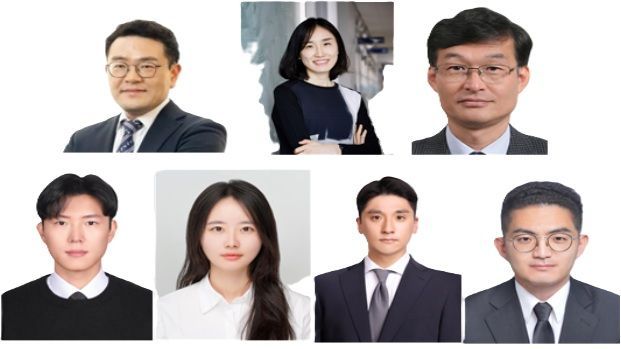 Research team. Above photo, corresponding authors Sunyong Kwon (UNIST), Eunmi Choi (UNIST), Geondo Lee (Seoul National University). Below photo, first authors Juhyung Han (UNIST), Jaeun Park (UNIST), Mincheol Kim (UNIST), Seongwoo Lee (Seoul National University). Provided by Ministry of Science and ICT.
MXene is a two-dimensional nanomaterial in which layers of metal and carbon are alternately stacked. It is called a “dream material” due to its excellent electrical conductivity and the possibility of designing various compounds. In particular, it is attracting attention as a next-generation ultrathin shielding material that blocks electromagnetic interference in the sub-THz ultra-high frequency range.
Conventional metal shielding materials are heavy, prone to corrosion, and their performance drops sharply at high frequencies, which limits their applications. In contrast, MXene is thin and lightweight while exhibiting excellent shielding capabilities even in high-frequency ranges.
Until now, most MXene materials have been carbon-based, but it has been predicted that substituting carbon with nitrogen would improve their physical and chemical properties.
However, this had not been achieved due to process difficulties. The joint research team succeeded in replacing some of the carbon in the MAX precursor with nitrogen, developed a new titanium-based MAX precursor synthesis process, and elevated the performance of MXene to a world-leading level.
The MXene film developed using nitrogen-substituted MAX is an ultra-thin membrane, about one-tenth the thickness of a human hair (approximately 50?100 micrometers), yet it recorded the highest electrical conductivity (35,000 S/cm) ever reported for MXene materials, demonstrating outstanding shielding performance.
The developed process allows the degree of nitrogen substitution to be freely adjusted from 0% up to nearly 100%, while maintaining a single crystal structure of the precursor to obtain high-purity MAX precursors with no intermediate impurities. This means that the electromagnetic properties of MXene can be precisely tuned according to the nitrogen content, enabling the maximization of electromagnetic wave shielding and reflection performance for various applications.
Professor Sunyong Kwon stated, "Nitrogen-substituted MXene will be a groundbreaking breakthrough for next-generation electromagnetic wave blocking technology," adding, "It is expected to play a role in reducing electromagnetic interference across a wide range of fields, from mobile devices to electronic systems in vehicles and aircraft, and even next-generation communication base stations."
The results of this research were published on April 25 in Advanced Materials, a world-renowned journal in the field of materials science.
© The Asia Business Daily(www.asiae.co.kr). All rights reserved.
![Clutching a Stolen Dior Bag, Saying "I Hate Being Poor but Real"... The Grotesque Con of a "Human Knockoff" [Slate]](https://cwcontent.asiae.co.kr/asiaresize/183/2026021902243444107_1771435474.jpg)
















