Secondhand Smoke Exposure Rate Rises Again After Three Years of Decline
Secondhand Smoke Also Causes Cancer and Contributes to Premature Death
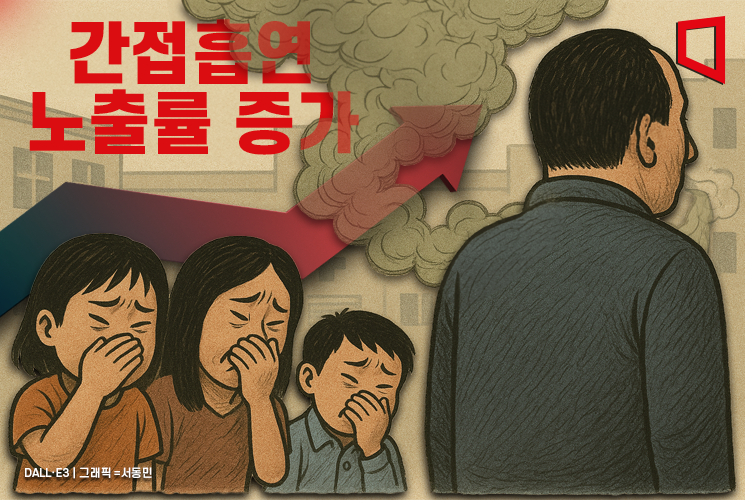
A recent survey has found that the rate of secondhand smoke exposure, which had been declining for three consecutive years, has increased again, particularly in indoor spaces at workplaces and public places. As secondhand smoke has a fatal impact on health, including causing cancer, there are growing calls for the urgent implementation of effective countermeasures.
According to the Korea Disease Control and Prevention Agency on May 29, the rate of secondhand smoke exposure in indoor workplace spaces among adult non-smokers (including former smokers) aged 19 and older was 8.0% in the 2023 survey. The exposure rate in indoor workplace spaces had declined for three consecutive years, from 14.1% in 2019 to 10.3% in 2020, 9.2% in 2021, and 6.3% in 2022, but it rebounded in 2023.
The rate of secondhand smoke exposure for non-smokers in indoor public places also showed a downward trend from 18.3% in 2019, to 12.0% in 2020, 7.5% in 2021, and 7.4% in 2022, but rose to 8.6% in 2023. Similarly, the rate of secondhand smoke exposure for non-smokers inside the home was not high in absolute terms, but after dropping for three consecutive years from 4.7% in 2019 to 3.9% in 2020, 3.6% in 2021, and 2.6% in 2022, it rose again to 3.0% in 2023, showing the same trend.
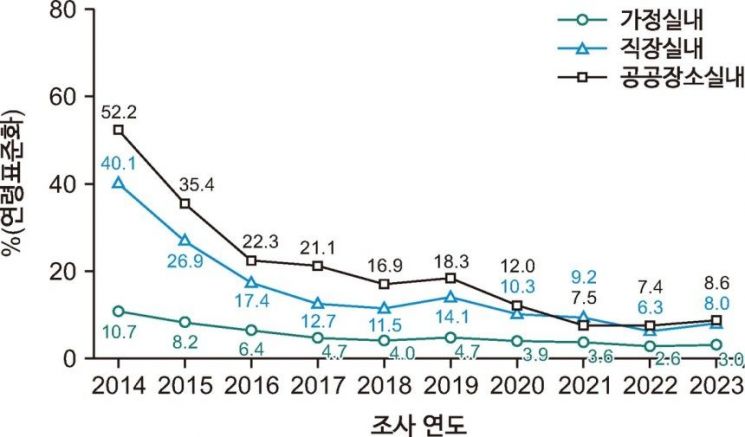 Trends in Secondhand Smoke Exposure Rates from 2014 to 2023. Korea Disease Control and Prevention Agency
Secondhand smoke, also known as passive smoking or involuntary smoking, refers to inhaling smoke from cigarettes that are being smoked by others, rather than directly smoking oneself. When exposed to secondhand smoke, non-smokers inhale mainstream smoke exhaled by smokers as well as sidestream smoke emitted from the burning end of the cigarette. It is known that cigarette smoke inhaled through secondhand exposure contains more than 69 carcinogenic substances, including arsenic and benzene. The official report of the International Agency for Research on Cancer also classifies secondhand smoke as a cause of cancer.
In addition to cancer, secondhand smoke contributes to premature death among non-smokers. Inhaling sidestream smoke, which accounts for about 80% of the smoke produced by secondhand smoking, irritates the airways and has a negative impact on the cardiovascular system in a short period of time. According to the Korea Disease Control and Prevention Agency, it is estimated that 46,000 people die each year in the United States due to secondhand smoke.
Secondhand exposure to electronic cigarettes, not just conventional cigarettes, is also harmful to health. Even electronic cigarettes that do not contain nicotine have been found to emit harmful substances such as formaldehyde, acetaldehyde, and acrolein, which are detrimental to health. According to a 2022 survey conducted by the University of Ulsan Industry-University Cooperation Foundation, commissioned by the Ministry of Health and Welfare, about 8 out of 10 electronic cigarette users reported secretly smoking in indoor and outdoor non-smoking areas.
© The Asia Business Daily(www.asiae.co.kr). All rights reserved.


















