Japan to Increase Burden for US Forces' Housing and Disaster Prevention Facilities
Skepticism Remains Over Meeting US Expectations
South Korea Also Faces Pressure to Raise Defense Cost-Sharing
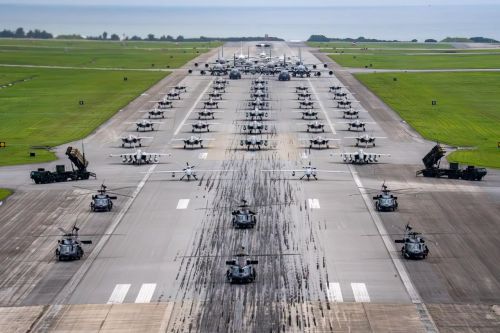
The Trump administration officially requested an increase in Japan's share of the costs for stationing US forces in Japan earlier this month. While the Japanese government is considering an increase amounting to several hundred billion yen (equivalent to several hundred billion won), there is also skepticism that this may not meet US expectations.
A US security official reportedly approached Japanese government officials earlier this month to discuss an increase in the costs for stationing US forces in Japan, and Japan is now considering raising its contribution by several hundred billion yen.
According to the Asahi Shimbun on the 29th, a White House National Security Council (NSC) official mentioned the issue of increasing the costs for US forces stationed in Japan to a Japanese National Security Secretariat (NSS) official who visited the United States earlier this month. This issue is being discussed separately from tariff negotiations, with the NSC and NSS handling the talks.
The Japanese government has begun considering raising the "Facility Improvement Program (FIP)" budget?which covers the construction of housing and disaster prevention facilities provided by Japan to US forces?by several hundred billion yen, in response to US demands. The Ministry of Defense will reportedly determine which facilities will be subject to the increase, taking US military requests into account.
According to Asahi, US President Donald Trump expressed dissatisfaction with the level of Japan's contribution to the cost of stationing US forces in Japan to Japanese Economic Revitalization Minister Ryosei Akazawa, who visited the US for tariff negotiations in mid-April. The request for an increase appears to have arisen as an extension of this complaint. Japan currently shoulders an average annual burden of about 211 billion yen (approximately 200 billion won).
A Japanese government official told Asahi, "Since President Trump has expressed dissatisfaction with Japan's share of the costs for US forces stationed in Japan, there is a need for discussions between the US and Japanese authorities."
However, the newspaper reported that there is strong skepticism within the Japanese government as to whether President Trump will be satisfied with an increase of several hundred billion yen.
John Bolton, who served as White House National Security Advisor during Trump's first administration, revealed in his memoir published in 2020 that President Trump demanded Japan pay $8 billion (about 1.1 trillion yen) annually for the cost of stationing US forces in Japan. This is 3.2 times the $2.5 billion calculated by the US side at the time.
South Korea is also concerned that President Donald Trump may demand an increase in its defense cost-sharing. Currently, South Korea's contribution to the cost of stationing US forces in Korea is $1.1 billion (about 1.52 trillion won), plus the annual inflation rate. Although South Korea rushed to begin cost-sharing negotiations ahead of President Trump's re-election in October last year, under US law, the administration can nullify such agreements.
South Korea and the US are conducting negotiations with July 8?the end date of a 90-day mutual tariff suspension?as the negotiation deadline. The South Korean government announced immediately after the first high-level talks that both countries had agreed not to include defense cost-sharing in the negotiation package. However, it is difficult to rule out the possibility that President Trump may change his stance after the Korean presidential election on June 3.
© The Asia Business Daily(www.asiae.co.kr). All rights reserved.
![Clutching a Stolen Dior Bag, Saying "I Hate Being Poor but Real"... The Grotesque Con of a "Human Knockoff" [Slate]](https://cwcontent.asiae.co.kr/asiaresize/183/2026021902243444107_1771435474.jpg)











