Busan Bus Labor and Management Agree to Include Bonuses in Ordinary Wages
Union: "We Will Respond If Negotiations Are at Busan's Level"
Seoul City: "Difficult to Accept 10% Wage Increase"
As the issue of ordinary wages continues to fuel conflict between labor and management of city buses nationwide, attention is focused on whether the first agreement reached in Busan will influence Seoul and its labor-management negotiations. In the past, when either Seoul or Busan reached a wage collective bargaining agreement first, the remaining regions would reflect that agreement in their own negotiations.
According to Asia Economy's reporting on the 29th, Seoul Metropolitan Government and the Seoul City Bus Labor Union have differing perspectives on the wage agreement reached in Busan just eight hours after the strike began on the 28th. The Busan bus labor and management accepted a mediation proposal presented by the Labor Relations Commission. The wage system was restructured by abolishing bonuses and summer vacation allowances and incorporating them into the base salary, so that they are reflected in the ordinary wage, resulting in a real wage increase of 10.48%.
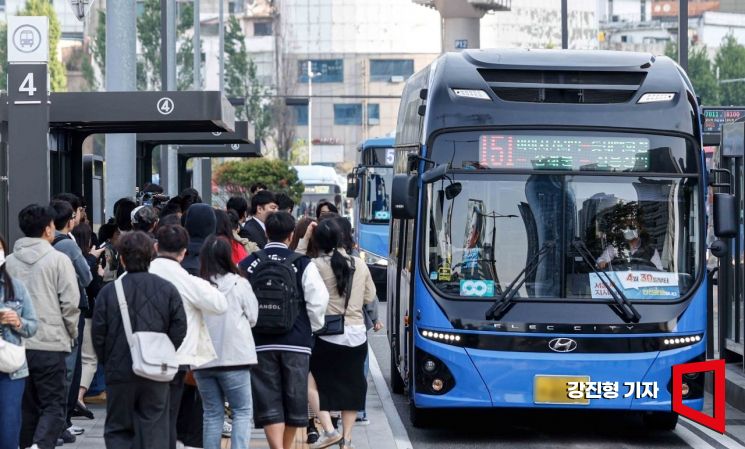 On April 30, as negotiations between labor and management of Seoul city buses broke down and the union began a lawful operation strike, a notice related to the strike was posted on a bus at the Seoul Station Bus Transfer Center in Jung-gu, Seoul. 2025.4.30. Photo by Kang Jinhyung
The Seoul city bus union views Busan's case, in which all bonuses were recognized as part of the ordinary wage, positively. A union official stated, "Busan implemented this in accordance with last year's Supreme Court ruling," and added, "There has never been a case where Busan and Seoul did not follow each other's lead: if Seoul concludes a wage collective agreement first, Busan follows, and vice versa." The official continued, "If management requests negotiations at a level similar to Busan's, we will respond; otherwise, we will not respond at all and will wait for the court's decision."
The Seoul Metropolitan Government agrees with the restructuring of the wage system as done in Busan, but maintains that it is difficult to accept a wage increase rate exceeding 10%. A city official said, "The method of abolishing items such as bonuses and incorporating them into the base salary is meaningful, so we will utilize it as much as possible," but also stated, "The increase rate accepted in that process is excessive." The official further explained, "In previous years, negotiations focused solely on the wage increase rate, but this year, due to the issue of ordinary wages, there is no atmosphere suggesting that all local governments will follow Busan's lead just because it acted first."
Seoul buses avoided a major disruption thanks to the union's decision to postpone the strike, but the underlying issue remains unresolved. The union insists that, in accordance with the Supreme Court ruling, bonuses should be fully reflected in the ordinary wage, and that it cannot accept any restructuring of the wage system aimed at reducing this amount. Seoul Metropolitan Government and the management, represented by the Seoul City Bus Transport Business Association, argue that such a move would impose an excessive financial burden, making a restructuring of the wage system to lower the ordinary wage level necessary.
© The Asia Business Daily(www.asiae.co.kr). All rights reserved.

















