Double Whammy of Export Slowdown and Weak Domestic Demand
0% Growth Becomes Visible as Rate Cut Responds to Low-Growth Concerns
On the 29th, the Bank of Korea lowered its base interest rate to 2.50% per annum. This move is intended to stimulate the economy in response to the dual challenges of declining exports and shrinking domestic demand. The Bank of Korea significantly revised its economic growth forecast for this year downward to 0.8%, citing prolonged weakness in domestic demand, particularly in consumption and construction, and anticipating that the tariff shock from the United States will be greater than previously expected.
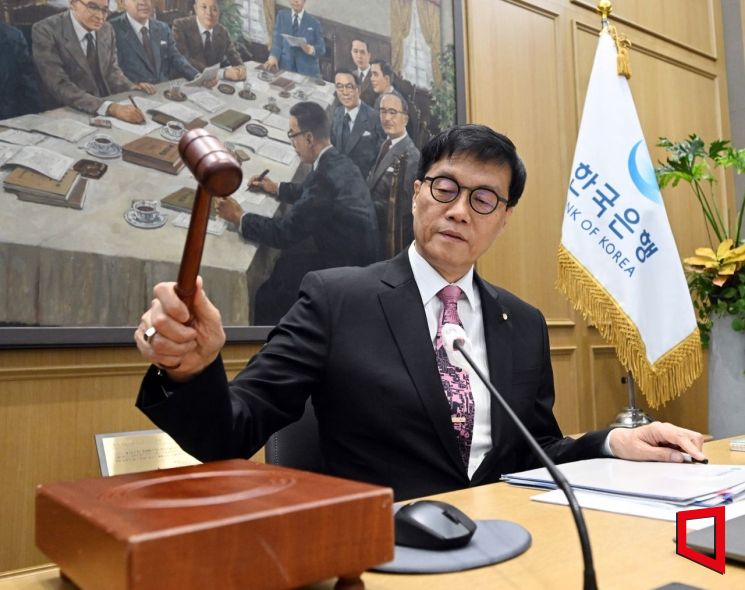 Lee Changyong, Governor of the Bank of Korea, is striking the gavel to declare the opening of the Monetary Policy Committee plenary meeting held at the Bank of Korea headquarters in Jung-gu, Seoul on the 29th. Photo by Joint Press Corps
The Monetary Policy Board of the Bank of Korea announced at its policy meeting held at the Bank of Korea headquarters in Jung-gu, Seoul on this day that it had lowered the base interest rate to 2.50% per annum. This is a decrease of 0.25 percentage points from the previous rate of 2.75% per annum, and is in line with market expectations. The Monetary Policy Board began a rate-cutting cycle in October last year, lowering the rate for the first time in three years and two months, and has since implemented a total of four rate cuts, including in November last year, February this year, and again this month.
The main reason for this month’s rate cut is concern over low growth due to downward pressure on the economy. With both exports and domestic demand?the pillars of the Korean economy?showing red flags and the growth forecast for this year dropping to the 0% range, there was a strong consensus that a rate cut was needed to support economic recovery. While concerns about household debt persist, the Bank of Korea judged that the environment now allows for monetary policy to focus on declining growth, given the stabilization of inflation and the easing of exchange rate pressures.
The impact of U.S.-imposed tariffs on exports is now evident in the numbers. From the beginning of this month to the 20th, total exports amounted to $32 billion based on customs clearance, a 2.4% decrease compared to the same period last year. Exports to the United States fell 10.6% last month and declined further by 14.6% this month. Automobile exports reached $3.1 billion, a 6.3% decrease year-on-year. On the domestic front, the sluggishness in construction investment, which dragged down Korea’s economic growth last year, continues, and the recovery in private consumption, particularly in services such as accommodation and food, remains slow. Weakened corporate investment sentiment is also contributing to continued sluggish domestic demand.
Concerns about household debt remain. This is due to the recent renewed rise in housing prices in some regions, and because the increase in household debt has accelerated two to three months after the temporary lifting of the designation of land transaction permit zones (Toheoguyeok) in February. However, the re-expansion and re-designation of Toheoguyeok and the implementation of the third phase of the stress-based Debt Service Ratio (DSR) in July are expected to gradually stabilize the situation. The consumer price inflation rate has recently remained in the low 2% range, but with expectations of a decline due to factors such as oil price adjustments, the annual forecast has been maintained at 1.9%. Additionally, recent exchange rate pressures have eased. The won-dollar exchange rate, which had threatened the 1,500 won level, is now moving around the 1,380 won range.
Experts believe that, in the short term, additional rate cuts are needed along with expansionary fiscal policies such as a second supplementary budget by the new government to mitigate the intensified downward pressure on the economy. However, the fact that the interest rate gap with the United States (upper bound of the policy rate) has widened to 2.00 percentage points as a result of this rate cut is a concern. Experts noted that, with the U.S. Federal Reserve expected to hold rates steady for the time being, it will not be easy for the Bank of Korea to make further rate cuts. While many in the market expect the FOMC to cut rates in July, the view that the cut may be postponed to September is also gaining traction. Kim Seongsu, a researcher at Hanwha Investment & Securities, pointed out, "The Fed’s position is to ensure whether inflation expectations have stabilized before taking action, given the unresolved uncertainties," adding, "It will be difficult to find answers to both conditions by the middle of the third quarter."
© The Asia Business Daily(www.asiae.co.kr). All rights reserved.

















