The Ministry of Culture, Sports and Tourism (MCST), the Ministry of Trade, Industry and Energy (MOTIE), and the Ministry of Land, Infrastructure and Transport (MOLIT) announced on May 29 that they held the launch ceremony for the "2025 Cultural Leading Industrial Complex Development Project" at the Gateway Tower near Seoul Station on May 29. The ceremony was attended by officials from the local governments of Gumi in North Gyeongsang Province, Changwon in South Gyeongsang Province, and Wanju in North Jeolla Province, which were selected as sites for the development of cultural leading industrial complexes.
The Cultural Leading Industrial Complex is a core initiative of the "Industrial Complex Development Plan Embracing Culture," which was jointly announced by several ministries in September last year. The goal is to transform industrial complexes into vibrant spaces that attract young people by establishing unified brands and landmarks that reflect the main industries and historical backgrounds of each complex, and by focusing support on infrastructure expansion projects led by MCST, MOTIE, and MOLIT, as well as on cultural and content projects.
In March, following a joint public contest by the relevant ministries, on-site inspections, and face-to-face evaluations by a private evaluation committee, three sites were selected: Gumi National Industrial Complex, Changwon National Industrial Complex, and Wanju General Industrial Complex. The government plans to designate a total of 10 such complexes by 2027.
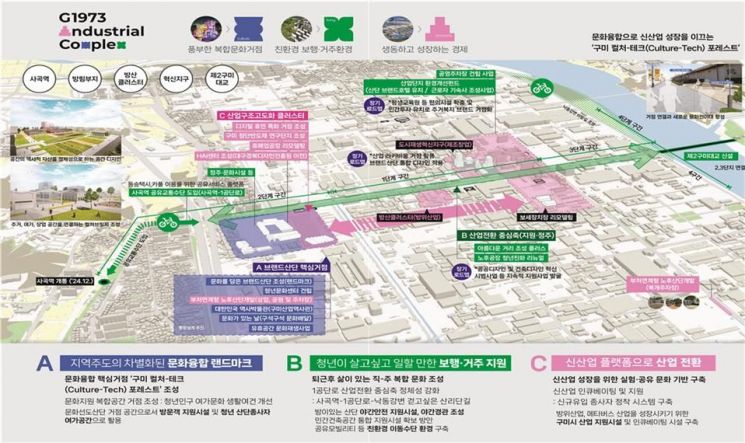
The vision for Gumi National Industrial Complex is to become "a home where youth want to live, where industrial heritage and culture coexist." A landmark will be created by utilizing a building (Bangnim) that preserves the history of the textile industry. Next to this landmark, a park, a performance plaza, and an underground parking lot will be newly constructed, and the streetscape of 1 Gongdan-ro, stretching from the landmark to Nakdonggangbyeon-ro, will be improved. In addition, spaces for displaying industrial complex content (media wall and media facade) will be built on the entire exterior walls of some buildings within the complex, and monthly festival performances for workers will be held to further expand cultural content within the complex.
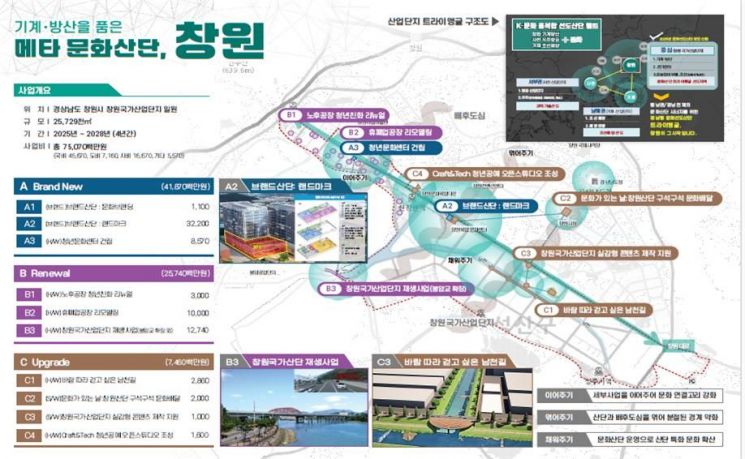
The vision for Changwon National Industrial Complex is to become a "meta cultural industrial complex embracing machinery and defense industries." An experience and exhibition hall themed around precision machinery and defense industries will be established within the landmark. To create a brand befitting the nation's largest comprehensive machinery industrial complex, experiential content that merges the machinery and defense industries with culture and the arts will be developed and exhibited, and "industrial tourism tours" in collaboration with related companies will be operated. In addition, the landscape and pedestrian walkways along the Namcheon Stream, which runs through the complex, will be improved, and the Bongam Bridge, the main entrance to the complex connecting to Masan, will be expanded to improve logistics and transportation. Cultural events for workers, such as the Changwon Industrial Complex Workers' Arts Festival, will also be expanded.
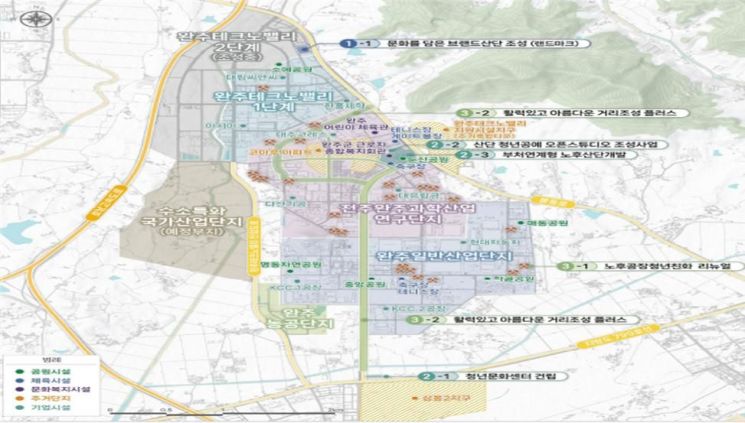
The vision for Wanju General Industrial Complex is to become "the leading site for cultural convergence where people work, enjoy, and grow." Landmarks will be created to promote the history of Wanju Industrial Complex (agriculture, automobiles, hydrogen) and to allow visitors to experience the automobile and hydrogen industries within the complex. In addition, the workers' welfare center within the complex will be converted into an educational space for video production and 3D modeling, and creative programs linked to the automobile and hydrogen industries will be operated. Furthermore, an outdoor performance hall and landscaped rest areas will be created in the complex's park, a closed school near the complex will be renovated as a cultural communication hub, and other cultural infrastructure will be established. Food festivals for workers and cultural experience events such as crafts and music will also be held.
At the three cultural leading industrial complexes, a "Youth Design Living Lab" will also be operated, involving about 200 young workers. The lab will generate ideas for remodeling the complex spaces from the perspective of young people and will propose and develop programs and services in essential areas for workers, such as daily life, leisure, safety, and tourism.
At the launch ceremony, the mayor of Gumi, the vice mayor of Changwon, and the county governor of Wanju attended and presented the vision and detailed development plans for each cultural leading industrial complex. In addition, a signing ceremony for agreements was held among the three local governments and the project management organizations, including Korea Industrial Complex Corporation, Korea Institute of Design Promotion, Regional Culture Promotion Agency, and Korea Research Institute for Human Settlements.
© The Asia Business Daily(www.asiae.co.kr). All rights reserved.



















