A "nano-delivery platform" has been developed to treat infections caused by super bacteria. Methicillin-resistant Staphylococcus aureus (hereafter referred to as Staphylococcus aureus), a type of super bacteria, is one of the main causes of hospital-acquired infections. Traditionally, treating Staphylococcus aureus has been challenging due to its high resistance to antibiotics and its ability to form biofilms, which are microbial membranes that protect the bacteria from external treatments. However, a new platform has been developed that delivers gene-targeting nanoparticles using microbubbles to break down the biofilm, providing a potential solution for treating infections that were previously resistant to antibiotics.
On May 29, KAIST announced that the research team led by Professor Hyunjung Jung from the Department of Biological Sciences at KAIST and Professor Hyunjun Kong from the University of Illinois in the United States have jointly developed a microbubble-based "nano-gene delivery platform (BTN-MB)."
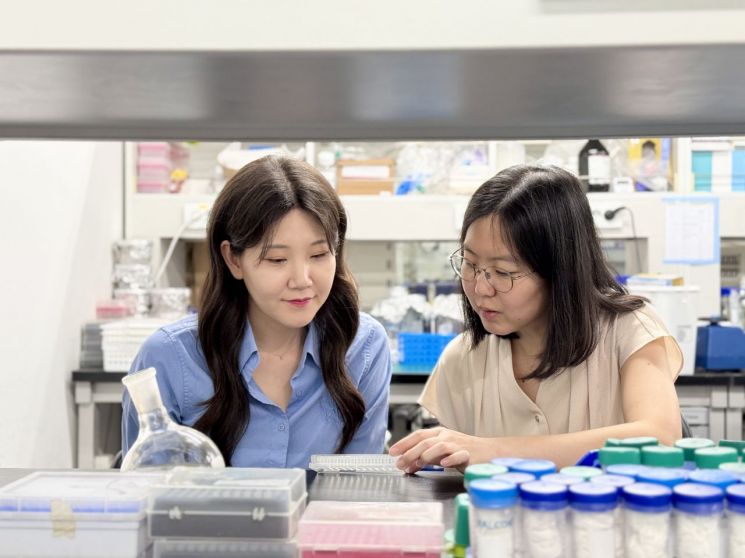 (From left) Juyeon Jung, integrated master's and doctoral course, Hyunjung Jung, professor. Provided by KAIST
This platform was designed to deliver gene inhibitors precisely into bacteria in order to effectively remove bacterial biofilms formed by Staphylococcus aureus.
First, the joint research team designed short DNA fragments (oligonucleotides) that simultaneously inhibit three major genes of Staphylococcus aureus: biofilm formation (icaA), cell division (ftsZ), and antibiotic resistance (mecA). They then developed nanoparticles (BTN) capable of carrying these fragments into the bacteria.
In addition, by using microbubbles to increase the permeability of the biofilm formed by Staphylococcus aureus, the team implemented a dual-strike strategy that fundamentally blocks bacterial proliferation and the acquisition of resistance using the previously developed technology.
This treatment system operates in two stages. First, microbubbles induce pressure changes within the bacterial biofilm formed by Staphylococcus aureus, enabling the penetration of nanoparticles. Next, the nanoparticles penetrate the bacteria through gaps in the biofilm and deliver the gene inhibitors precisely. According to the research team, this process simultaneously blocks biofilm reformation, cell proliferation, and the expression of antibiotic resistance in Staphylococcus aureus through genetic regulation.
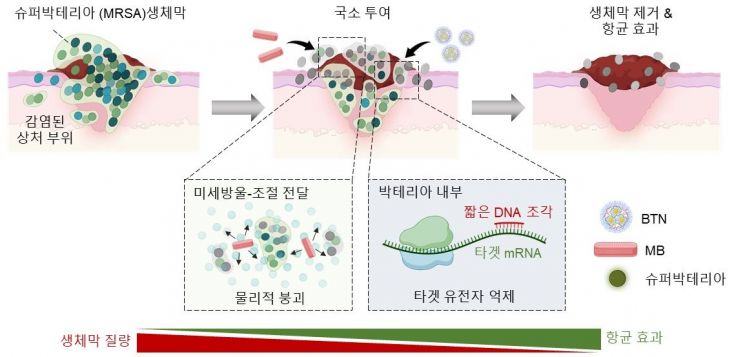
When this approach was tested in a pig skin infection biofilm model and a mouse wound model infected with Staphylococcus aureus, the group treated with nanoparticles and microbubbles showed a significant reduction in biofilm thickness, as well as a marked decrease in bacterial count and inflammatory response, demonstrating clear therapeutic effects.
The joint research team emphasized that these results are difficult to achieve with antibiotic monotherapy alone and highlight the potential applicability of this method to the treatment of various drug-resistant bacterial infections in the future.
Professor Hyunjung Jung stated, "This study is meaningful in that it presents a new solution for treating super bacteria infections that could not be addressed with conventional antibiotics, by integrating nanotechnology, gene inhibition, and physical approaches." She added, "The joint research team plans to continue research so that these findings can be expanded to systemic applications and a wider range of infectious diseases in the future."
This research was supported by the National Research Foundation of Korea and the Ministry of Health and Welfare. The paper, with Juyeon Jung from the Department of Biological Sciences at KAIST and Yujin Ahn from the University of Illinois as co-first authors, was published online in the international journal 'Advanced Functional Materials' on May 19.
© The Asia Business Daily(www.asiae.co.kr). All rights reserved.


















