Scott Snyder: "The Special Measures Agreement Covers Only a Narrow Aspect of Security Cooperation"
Calls for a More Comprehensive Approach by the Next South Korean Administration
Low Likelihood of 'Package Deal' Linking Security and Tariff Negotiations
Concerns in Washington Over Trump's 'Tariff Bomb' and Shift Away from Shared Values
Partial Redeployment of US Forces Korea Unlikely, but Security Strategy May Change
Scott Snyder, Director of the Korea Economic Institute (KEI) and a leading expert on the Korean Peninsula in the United States, stated on the 28th, "The Special Measures Agreement (SMA) on defense cost-sharing between South Korea and the United States represents only a narrow aspect of the security partnership," adding, "The next administration in South Korea will need a more comprehensive approach to security cooperation."
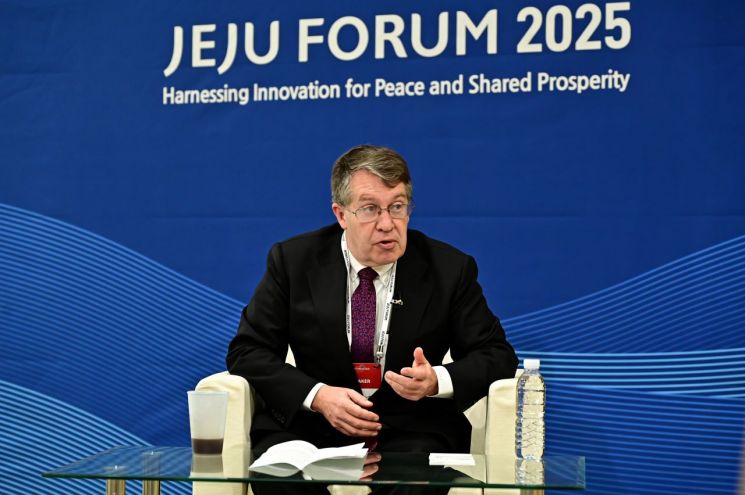 Scott Snyder, Director of the Korea Economic Institute (KEI), is holding an interview with the press on the 28th at the Jeju International Convention Center. Jeju Forum Secretariat
Snyder, who is visiting South Korea to attend the 'Jeju Forum' marking its 20th anniversary this year, made these remarks during a press interview at the Jeju International Convention Center when asked for advice to the next administration regarding the renegotiation of the SMA. He said, "Even during the first Trump administration, defense cost-sharing negotiations were used as a bargaining chip, but they did not yield significant results," explaining, "Since South Korea is a partner that can sufficiently cooperate in security fields such as defense industry, military exports, shipyard reconstruction, and technology sharing, it is necessary to consider various methods and pursue comprehensive cooperation."
Snyder noted, "High-level working-level discussions on tariffs are already underway, and security issues have not yet been brought to the negotiation table," predicting that the likelihood of the United States directly linking security matters to tariff negotiations with South Korea and attempting a 'package deal' is not high. However, he added, "It is important to remember that President Trump continues to keep security issues in mind," and said, "Such continuous 'series negotiations' are likely to persist throughout the Trump administration's term." This suggests that, even if a full 'package deal' does not materialize, negotiations on individual issues such as tariffs or the SMA could still influence each other.
Regarding President Trump's so-called 'tariff bomb' policy, Snyder conveyed that there are negative reactions even within Washington's political circles. He said, "Economists cite tariff policies from the 1930s as examples, expressing the view that protectionism could lead to another financial crisis," and added, "Security experts are also concerned that, while the United States has built relationships with its allies based on shared values over the past decades, President Trump's actions are moving in the opposite direction." He continued, "There is discomfort within the United States about abandoning the benefits achieved through long-term investment in shared historical values, and focusing solely on achieving 'a single deal.'"
Regarding recent reports in the U.S. media about the possible partial redeployment of U.S. Forces Korea, Snyder said, "The United States and South Korea still perceive North Korea as a 'shared threat,'" and assessed that "the likelihood of actual discussions taking place is low." However, he noted, "The Trump administration is expected to establish a national security strategy this fall, and how it assesses the threats from China and North Korea will be key," adding, "At this point, no assumptions can be made with certainty, and the situation could change as needed."
© The Asia Business Daily(www.asiae.co.kr). All rights reserved.

















