No Drinking Water or Electricity: Seoul's Iconic Unauthorized Settlement
Project Operator Withdrew, But Communication Overcame Reassignment Hurdles
Targeting Completion in 2029... Demolition Begins in May
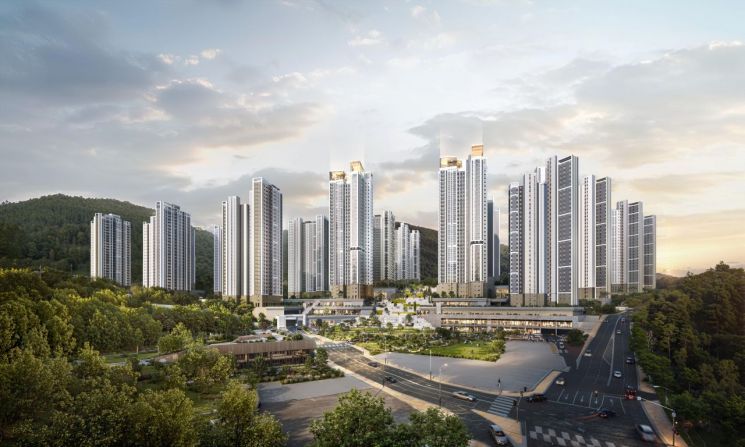 Aerial view after redevelopment project of Baeksa Village, a representative 'Dal-dongne' in Nowon-gu, Seoul. Seoul City
The redevelopment project for Baeksa Village in Nowon-gu, once known as a representative 'Dal-dongne' (hill village) in Seoul, is now moving forward in earnest. This comes 16 years after its designation as a redevelopment maintenance area in 2009. A nature-friendly apartment complex with more than 3,000 units will be constructed, with completion targeted for the first half of 2029.
On the 29th, the Seoul Metropolitan Government announced that the redevelopment maintenance plan for Baeksa Village had been finalized last month. The integrated review of the maintenance project conditionally approved the Baeksa Village maintenance plan, which unified the previous division between for-sale and rental housing sites into a single plan.
Baeksa Village will see the construction of a nature-friendly apartment complex consisting of 26 buildings, ranging from four basement levels to 35 above-ground floors, with a total of 3,178 units. The original plan, which separated for-sale and rental units, was revised to introduce a social mix (combining for-sale and rental housing), thereby addressing potential friction among residents.
Baeksa Village is located in Nowon-gu, at the foot of Bulamsan Mountain, on the border between Seoul and Gyeonggi Province. The name 'Baeksa (104) Village' originates from the former address, which included the area around San 104. In the 1960s and 1970s, the government relocated residents of unauthorized settlements to the border area between Seoul and Gyeonggi Province, leading to the formation of Baeksa Village.
In the early 1960s, Baeksa Village suffered from a lack of infrastructure and poor sanitation, resulting in outbreaks of infectious diseases and generally harsh living conditions. It was not until the 1980s, when a policy was introduced to provide communal water supply to unauthorized housing areas, that living conditions began to improve.
Unlike other resettlement areas that were transformed into apartment complexes through redevelopment in the 1990s, Baeksa Village remained undeveloped due to its designation as a greenbelt, despite its poor environment. Only in 2000, when a law was enacted allowing for the lifting of greenbelt restrictions, was the foundation laid for the Baeksa Village redevelopment project.
The initial maintenance plan was established in May 2009, and in June of the same year, Korea Land and Housing Corporation (LH) was designated and announced as the project implementer. However, after changes to the maintenance plan reduced the project's profitability, LH decided to withdraw in January 2016.
Despite the risk of the project being derailed, the residents' representative council of Junggye-bondong requested that Seoul Housing and Communities Corporation (SH Corporation) be designated as the project implementer, marking a turning point. In February 2017, a memorandum of understanding was signed between SH Corporation and Nowon-gu residents, giving new momentum to the project.
In March 2018, the city institutionalized a residential area preservation project to reflect realistic prices for the sale of rental housing by amending the Urban and Residential Environment Maintenance Ordinance. Since then, communication among the city, residents, and the project implementer led to the achievement of an integrated maintenance plan revision. From April 2022 to February last year, the city held more than 150 meetings with local residents and relevant experts, ultimately deciding to pursue the integrated maintenance plan. At the general meeting of landowners and other stakeholders in March last year, over 95% of participating residents overwhelmingly approved the plan, allowing for rapid progress. The Baeksa Village redevelopment project began full-scale demolition this month, with construction set to start in the second half of the year. Completion is targeted for the first half of 2029.
Kim Seongbo, Seoul's Second Vice Mayor for Administrative Affairs, stated, "Even as the Baeksa Village redevelopment project went through years of trial and error, the residents did not give up and continued to trust the city. Thanks to them, we were able to create a plan for a nature-friendly residential complex that meets the residents' needs. We will do our utmost to ensure the Baeksa Village redevelopment project is completed as soon as possible."
© The Asia Business Daily(www.asiae.co.kr). All rights reserved.
![Clutching a Stolen Dior Bag, Saying "I Hate Being Poor but Real"... The Grotesque Con of a "Human Knockoff" [Slate]](https://cwcontent.asiae.co.kr/asiaresize/183/2026021902243444107_1771435474.jpg)
















