Closing Ceremony Held Today After Two-Day Event
Joint Statement Issued: "Expanding Economic Ties and Exchanges"
"Activities to Support CPTPP Accession to Be Pursued"
Calls for Korea and EU to Join... Cooperation with Japan
"Discussion of Economic Union in the Long Term"
Business leaders from South Korea and Japan concluded the 57th Korea-Japan Business Meeting, held on May 27-28 at the Lotte Hotel in Sogong-dong, Jung-gu, Seoul, and issued a joint statement that included a commitment to cooperate for South Korea's accession to the Comprehensive and Progressive Agreement for Trans-Pacific Partnership (CPTPP).
In the joint statement released on this day, the Korea-Japan Business Meeting announced, "As part of efforts to create an environment for realizing cooperation and collaboration between the Korean and Japanese business communities, we will proactively cooperate with relevant organizations to carry out activities supporting South Korea's accession to the CPTPP."
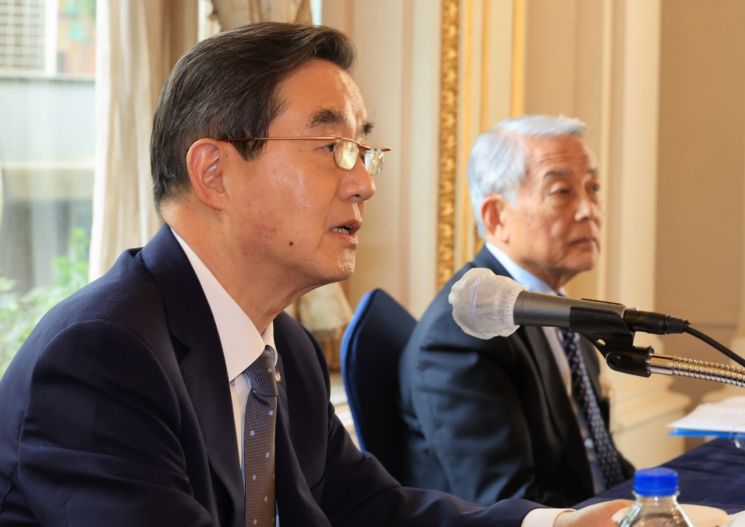 Kim Yoon, chairman of the Korea-Japan Economic Association (left), is speaking at a press conference for the adoption of the joint statement of the 57th Korea-Japan Business Meeting held at a hotel in Seoul on the 28th. On the right is Aso Yutaka, vice chairman of the Japan-Korea Economic Association. Photo by Yonhap News
The CPTPP is an economic agreement that was newly launched in December 2018 under Japan's leadership after the United States withdrew from the Trans-Pacific Partnership (TPP), which it had previously led. Currently, 12 countries including Japan, Canada, the United Kingdom, and Vietnam are participating, and the combined gross domestic product (GDP) of these member countries accounts for 15% of the global total, demonstrating significant influence. Amid a global rise in calls for South Korea and the European Union (EU) to join the agreement in response to the protectionist trade policies of U.S. President Donald Trump, who has prioritized tariffs, the joint statement is significant as it marks the Japanese business community's official declaration of support for South Korea's accession to the CPTPP, where Japan plays a central role.
In addition, the Korea-Japan Business Meeting pledged in the joint statement to build and advance mutual trust, and to expand economic ties and exchanges. "On the occasion of the 60th anniversary of the normalization of diplomatic relations between Korea and Japan, business leaders of both countries reaffirmed the value of the trust and friendship built up over the years and resolved to pursue innovative partnerships and cooperation for the bright future of Korea, Japan, and the world," the statement said. It continued, "Korea and Japan are neighboring countries in East Asia and share the ideals of freedom and democracy. In business, they are both competitors and complementary partners. Furthermore, as both countries face many common challenges, Korea-Japan cooperation is inevitable." The statement also noted, "We agreed to cooperate for the sustainable economic development of both countries, including collaboration on achieving carbon neutrality and a hydrogen society, linking up on artificial intelligence (generative AI) and semiconductors, fostering the bio and healthcare industries, strengthening supply chains, securing energy, and addressing social issues such as low birth rates and aging populations."
The statement also added, "We call for the simplification and abolition of procedures required for entry and exit in order to realize borderless human exchanges, and we look forward to progress on this front."
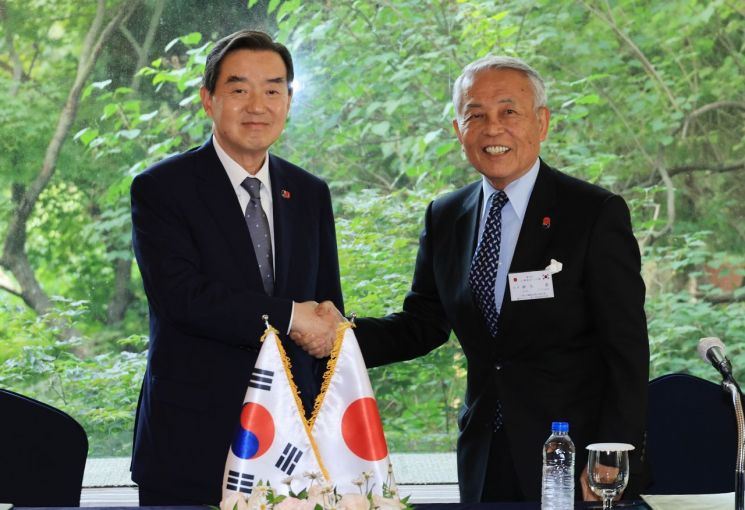 Kim Yoon, chairman of the Korea-Japan Economic Association (left), and Aso Yutaka, vice chairman of the Japan-Korea Economic Association, shake hands on the 28th at a hotel in downtown Seoul before a press conference to adopt the joint statement of the 57th Korea-Japan Business Meeting. Photo by Yonhap News
Kim Yoon, head of the Korean delegation and chairman of the Korea-Japan Economic Association (and chairman of Samyang Holdings), said at a press conference following the announcement of the joint statement, "Trade pressure from the new U.S. administration and technological catch-up by China are common challenges for both South Korea and Japan," adding, "There also seem to be some opinions suggesting that we should respond jointly to U.S. trade pressure."
However, he noted that specific joint response measures were not discussed at this meeting, saying, "As far as I know, there is close information exchange by industry."
Aso Yutaka, head of the Japanese delegation and vice chairman of the Japan-Korea Economic Association (and chairman of Aso Cement), also said, "Since the Trump administration took office, both countries have felt a sense of crisis due to policies such as 'America First' and the possibility that this could prompt China to take stronger actions," adding, "I believe Korea and Japan should not remain in a competitive relationship but should build a solid foundation together."
Regarding bilateral cooperation for South Korea's accession to the CPTPP, Chairman Kim said, "There was discussion that since the free trade agreement (FTA) between the two countries faces various issues and will take time and be complicated to conclude, it would be better to proceed with the CPTPP first and, in the long term, aim to form an economic union."
Vice Chairman Aso also said, "We agreed that pursuing the FTA should be the next step."
When asked what message he would like to convey to South Korea's next administration, Vice Chairman Aso replied, "I would like to say that I hope the new government will value Korea-Japan relations and pursue reforms. If both countries join forces, they can have a major impact, so I hope the new administration will send a message to strengthen bilateral ties." Regarding the expansion of exchanges, business leaders from both countries said, "We call for the simplification and abolition of procedures required for entry and exit in order to realize borderless human exchanges, and we look forward to progress on this front."
The Korea-Japan Business Meeting is a leading private-sector economic forum between the two countries. After the normalization of diplomatic relations in 1965, it was institutionalized in 1969 to discuss economic cooperation and has been held annually ever since. Since the first meeting in 1969, it has never been suspended, not even during political conflicts or the COVID-19 pandemic, and has alternated between the two countries each year, contributing to economic growth and mutual development.
The next, 58th Korea-Japan Business Meeting will be held in Tokyo, Japan next year.
© The Asia Business Daily(www.asiae.co.kr). All rights reserved.


















