Number of Marriages Decreases in Gwangju, Jeonbuk, Jeonnam, and Jeju
Average Age Rises, Number of Children Falls
Dual-Income Households and Income Both Increase
The number of newlywed couples in the Honam and Jeju regions decreased by 22.4% over the past five years, falling below 100,000 couples.
According to the "Lives of Newlyweds in the Honam and Jeju Regions," released by the Honam Regional Statistics Office on May 28, 2025, the number of newlywed couples with a marriage duration of five years or less stood at 97,703 in 2023. This represents a 22.4% decrease from 125,917 couples in 2019. The survey targeted couples who registered their marriage and maintained their marital relationship between November 1, 2018, and October 31, 2023.
By region, there were 25,954 couples in Gwangju, 27,473 in Jeonbuk, 30,445 in Jeonnam, and 13,831 in Jeju, all showing a decrease compared to 2019.
 An infographic comparing the number of marriages, proportions of first marriages and remarriages, average number of children, dual-income households, homeownership, households with children, income, and loan distribution segments of newlyweds in the Gwangju and Jeonbuk regions between 2019 and 2023. It visually presents the declining trend of newlywed couples and changes in housing and economic conditions. Provided by Honam Regional Statistics Office.
The average age at first marriage for newlywed husbands was 33.1 years in Gwangju, 32.9 years in Jeonbuk, 32.8 years in Jeonnam, and 33.0 years in Jeju. For wives, the average age was 30.7 years in both Gwangju and Jeju, 30.3 years in Jeonbuk, and 30.1 years in Jeonnam. For remarried newlyweds, the average age for husbands was 46.5 years in Gwangju and 47.7 years in Jeonbuk, Jeonnam, and Jeju. The average age for wives was 43.0 years in Gwangju, 44.0 years in Jeonbuk, and 43.9 years in both Jeonnam and Jeju.
The proportion of newlywed couples where the husband is older was 67.3% in Gwangju, 66.6% in Jeonbuk, 66.8% in Jeonnam, and 65.1% in Jeju, representing a decrease of 1.7 to 2.3 percentage points compared to 2019. The proportion where the wife is older increased by 1.2 to 1.8 percentage points, reaching 18.3% in Gwangju, 19.3% in Jeonbuk, 19.2% in Jeonnam, and 20.1% in Jeju.
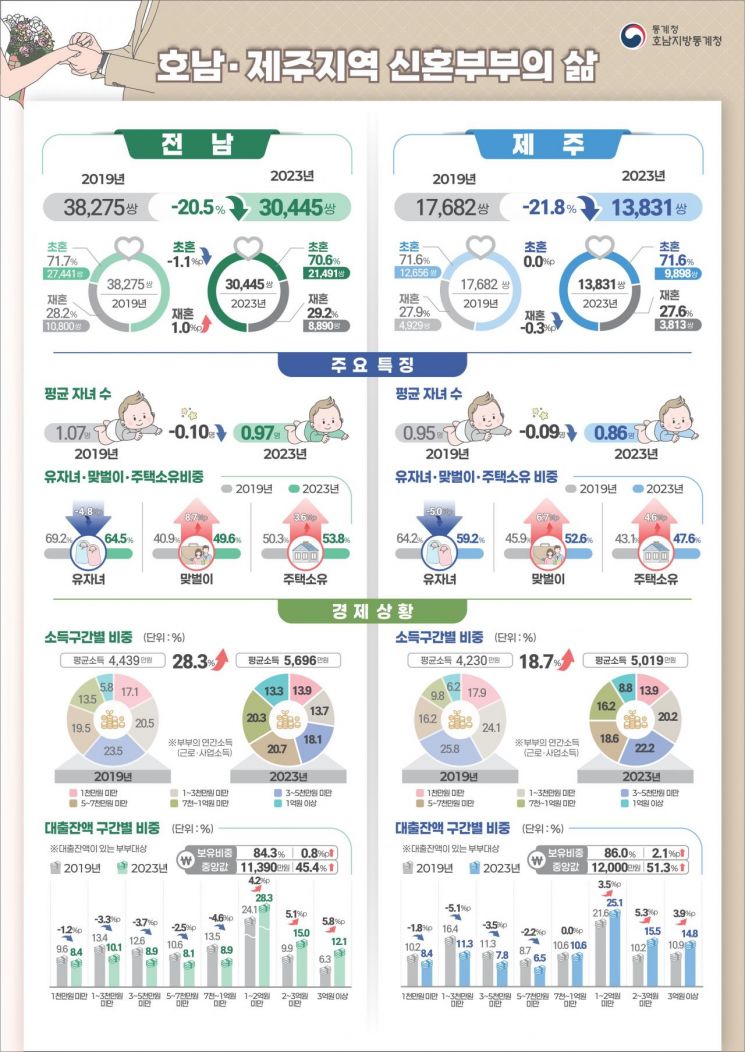 An infographic comparing data of newlyweds in the Jeonnam and Jeju regions between 2019 and 2023. It provides an overview of the settlement conditions and trends of newlyweds through key indicators such as marriage type, number of children, dual-income status, homeownership rate, income level, and loan burden rate. Provided by Honam Regional Statistics Office
The proportion of newlywed couples with children (national average: 56.4%) was 62.5% in Gwangju, 62.1% in Jeonbuk, 64.5% in Jeonnam, and 59.2% in Jeju. The average number of children per couple (national average: 0.77) was 0.86 in Gwangju, 0.92 in Jeonbuk, 0.97 in Jeonnam, and 0.86 in Jeju, with all regions showing a decrease compared to 2019.
The proportion of dual-income newlywed couples was 55.4% in Gwangju, 51.6% in Jeonbuk, 49.6% in Jeonnam, and 52.6% in Jeju. Compared to 2019, this represents an increase of 7.4 percentage points in Gwangju, 7.9 percentage points in Jeonbuk, 8.7 percentage points in Jeonnam, and 6.7 percentage points in Jeju.
In 2023, the average income of newlywed couples (national average: 68.34 million won) was 62.39 million won in Gwangju, 54.96 million won in Jeonbuk, 56.96 million won in Jeonnam, and 50.19 million won in Jeju. Compared to 2019, this represents an increase of 25.6% in Gwangju, 27.3% in Jeonbuk, 28.3% in Jeonnam, and 18.7% in Jeju. In all regions, the number of newlywed couples with a combined income of less than 50 million won decreased, while those with an income of 50 million won or more increased.
© The Asia Business Daily(www.asiae.co.kr). All rights reserved.
![Clutching a Stolen Dior Bag, Saying "I Hate Being Poor but Real"... The Grotesque Con of a "Human Knockoff" [Slate]](https://cwcontent.asiae.co.kr/asiaresize/183/2026021902243444107_1771435474.jpg)


















