Focused Only on Opponents' Well-Known Weaknesses
Difficult to Expect Effects Beyond Consolidating Support Base
"There was nothing for voters to pay attention to, and only well-known controversies were repeated in the debate..." On May 27, political circles and observers gave a cold assessment of the third TV debate for the 21st presidential election. The debate, which turned into a heated clash far from public expectations, left only disappointment. This has led to the analysis that it will be difficult to expect any effect beyond consolidating the existing support base.
During the presidential TV debate hosted by the National Election Broadcasting Debate Commission that day, each candidate continued to attack their opponents by framing them as either "sympathizers with insurrection" or "shielding dictatorship." Kim Moon Soo, the presidential candidate of the People Power Party, persistently targeted Lee Jae Myung, the Democratic Party of Korea's candidate, for his legal risks. Listing the fact that Lee is facing a total of five trials, Kim criticized, "I've never heard of a 'shielding dictatorship' where a criminal rules to protect himself."
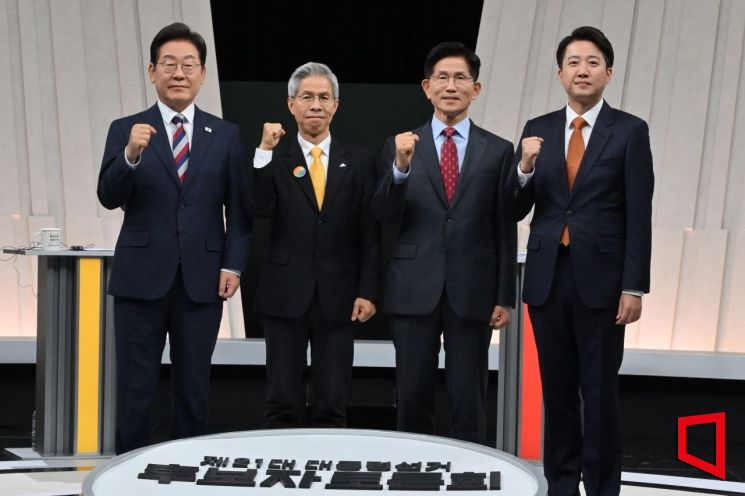 Lee Jae Myung of the Democratic Party of Korea (from left), Kwon Young Guk of the Democratic Labor Party, Kim Moon Soo of the People Power Party, and Lee Jun Seok of the Reform New Party presidential candidates pose before a political TV debate held at the MBC studio in Sangam-dong, Mapo-gu, Seoul on May 27, 2025. Photo by the National Assembly Press Photographers.
Lee Jae Myung, in turn, accused Kim Moon Soo of being part of a group that sympathizes with insurrection. He persistently questioned Kim about his stance on martial law, the meaning of insurrection, and his relationship with former President Yoon Suk Yeol. Lee directly asserted, "Kim is not only part of the insurrectionist group but is its very embodiment."
Lee Jun Seok, the presidential candidate of the Reform New Party, attacked both major parties, stating, "I will push out both the irrational forces defending martial law and the anti-principled forces luring people with populism." However, since he used his opponents' past remarks as the basis for his attacks, his strategy did not stand out as particularly distinctive. Criticizing Lee Jae Myung's 'hotel economics,' he said, "He is trying to teach us communist philosophy," and regarding the controversy over the alleged personal use of corporate credit cards, he asked, "Did you buy 27.91 million won worth of fruit because you are raising an elephant at home?"
Although it was a political TV debate, there was no in-depth discussion on political reform. While there were mentions of preventing satellite parties, introducing a runoff voting system, and directions for constitutional amendment, these topics did not receive significant attention.
Choi Byung Cheon, head of the New Growth Economy Research Institute, said, "There was no attack strong enough to shake up the election landscape, like the military service corruption issue involving Lee Hoi Chang's son in the past." He analyzed, "Kim Moon Soo's repetitive controversies without impact and Lee Jun Seok's provocative remarks only served to consolidate their own bases."
Meanwhile, Lee Jun Seok, who had previously made remarks about women's bodies, has been reported to authorities on charges of insult and violating the Public Official Election Act by slandering another candidate. A political insider predicted, "This will result in delivering the votes of women in their 20s and 30s, who have high voter turnout, to the Democratic Party."
© The Asia Business Daily(www.asiae.co.kr). All rights reserved.

















