China and Russia's Security Chiefs Meet in Moscow
Pledge to Strengthen Security Cooperation and Strategic Partnership
Joint Criticism of Trump's "Golden Dome" Initiative
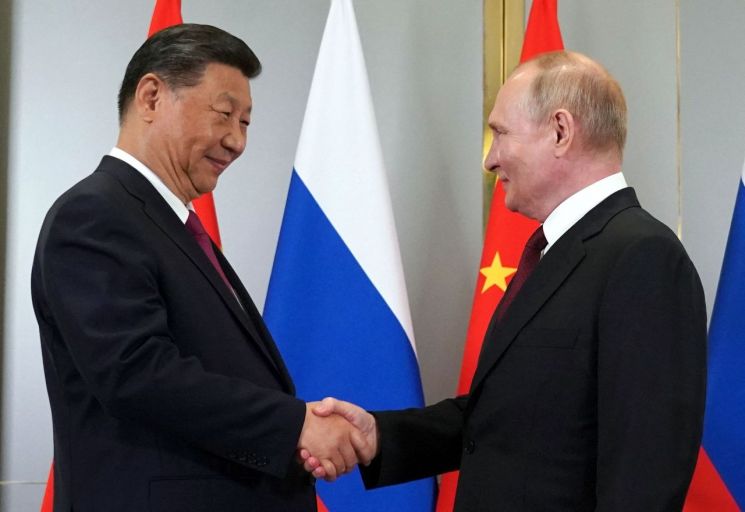 Chinese President Xi Jinping (left) and Russian President Vladimir Putin shake hands in Astana, Kazakhstan, during the Shanghai Cooperation Organization (SCO) summit on July 3, 2024 (local time). Photo by AFP Yonhap News
China and Russia are strengthening their ties to counter the United States led by President Donald Trump. Sergei Shoigu, Secretary of the Russian Security Council, and Chen Wenqing, Secretary of the Central Political and Legal Affairs Commission of the Chinese Communist Party, said on the 27th (local time) that China-Russia relations serve as a model for relations between major powers.
Shoigu: "Bilateral relations can withstand external pressure"
According to Russian state news agency TASS, Secretary Shoigu, during talks with Secretary Chen in Moscow, Russia, stated, "The relationship between Russia and China is built on a solid foundation, possesses intrinsic value, and has the resilience to withstand external pressure." He added, "It cannot be sacrificed for temporary political gain," and emphasized that "the comprehensive partnership and strategic cooperation between the two countries have reached an unprecedentedly high level, marking the best period in history."
Secretary Chen responded by saying, "The cooperation between China and Russia serves as a model for relations between major powers, based on strategic partnership and interaction." He continued, "We are fighting together against attempts to undermine our sovereignty, security, and development interests," and assessed that "bilateral cooperation provides new momentum for the democratization of international relations."
On this day, Secretary Shoigu and Secretary Chen attended an exhibition showcasing Russian-made drones, weapons, and combat equipment. Secretary Shoigu had visited China in November last year to tour the 15th China International Aviation and Aerospace Exhibition (Zhuhai Airshow). Starting from this day, Secretary Shoigu will chair the 13th International Meeting of High Representatives for Security Issues in Moscow for two days. The meeting will be attended by more than 125 delegations from over 100 countries, including China and North Korea, as well as 14 international organizations.
Shared interests drive both countries... United stance against US 'Golden Dome' initiative
It is believed that the growing closeness between China and Russia stems from their shared determination to counter the US strategy aimed at containing both countries. Chinese President Xi Jinping and Russian President Vladimir Putin expressed this determination during their summit on the 8th and adopted a joint statement calling for the deepening of bilateral relations.
The recent US push to establish its own missile defense system, the "Golden Dome," is also unwelcome. On the 20th, President Trump, accompanied by Secretary of Defense Pete Hegseth, announced at the White House his plan to deploy the US missile defense system, the "Golden Dome," during his term by January 2029. This move is seen as a revival of the so-called "Star Wars" initiative, which was pursued but left unfinished by former President Ronald Reagan during the US-Soviet Cold War era.
Even before President Trump officially announced the Golden Dome initiative, China and Russia issued a joint statement criticizing it as "a seriously destabilizing act." They argued that "strategic offensive and defensive weapons are inseparable, and this plan completely denies that relationship." They also expressed a united stance against attempts to use outer space as a domain of warfare.
China maintained a hardline position even after President Trump's announcement on the 21st. Mao Ning, spokesperson for the Chinese Ministry of Foreign Affairs, warned that "this plan will militarize space and trigger a space arms race," and "could undermine the international security and arms control regime."
In contrast, Russia adopted a more moderate stance. Kremlin spokesperson Dmitry Peskov stated, "This is a sovereign decision by the United States," and added, "If the US feels threatened by missiles, it is only natural to build a defense system." However, he also mentioned that it is not yet the time to judge the impact on nuclear balance. The US weekly magazine TIME pointed out that "Russia has taken a more 'muted' stance following President Trump's announcement."
© The Asia Business Daily(www.asiae.co.kr). All rights reserved.
![Clutching a Stolen Dior Bag, Saying "I Hate Being Poor but Real"... The Grotesque Con of a "Human Knockoff" [Slate]](https://cwcontent.asiae.co.kr/asiaresize/183/2026021902243444107_1771435474.jpg)
















