
Gwangju Institute of Science and Technology (GIST) announced on May 28 that JD BioScience Co., Ltd., a faculty startup led by CEO Jinhee Ahn (Professor of Chemistry at GIST), has received approval from the U.S. Food and Drug Administration (FDA) for a global Phase 2a clinical trial plan (IND) for its new drug candidate, GM-60106.
GM-60106 is a small molecule-based new drug candidate currently under development for the treatment of steatohepatitis caused by metabolic disorders. The development began in 2018 after the technology was transferred from GIST. The compound is characterized by its novel mechanism of action, which inhibits the HTR2A receptor and simultaneously suppresses both hepatic fat accumulation and liver fibrosis.
JD BioScience started preparing for clinical trials in the United States last November, beginning with a pre-IND meeting with the FDA and collaborating with IQVIA, a global contract research organization (CRO). On March 31 of this year, the company submitted its clinical trial plan (IND) to the FDA and subsequently received approval for the Phase 2a trial on April 29.
Following this approval, JD BioScience plans to begin patient recruitment as soon as possible, either independently or in partnership with a potential licensee, and to promptly administer the first dose to a patient.
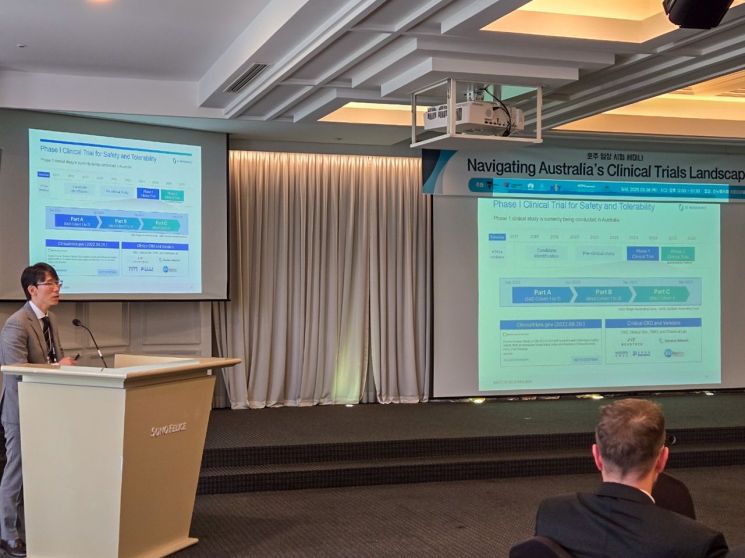 A representative from JD BioScience is presenting a clinical trial at the Australia Clinical Trial Seminar. Provided by GIST
This clinical trial is a proof-of-concept study involving 90 patients with MASH, designed to evaluate the safety, efficacy, biological activity, and pharmacokinetic properties of GM-60106. The trial will be conducted over 12 weeks at multiple hospitals in the United States using a randomized, double-blind, placebo-controlled design. The primary endpoint of this study is the change in liver fat content, measured by MRI-based proton density fat fraction. Secondary or exploratory endpoints will include assessments of inflammation, liver fibrosis, and insulin resistance.
In clinical trials, endpoints are pre-specified criteria used to evaluate the efficacy or safety of a drug. The primary endpoint is the most important indicator for determining the main objective of the clinical trial, while secondary endpoints serve as supplementary indicators to assess additional effects or side effects.
Jinhee Ahn, CEO of JD BioScience, stated, "With the approval of this Phase 2a trial, we have even greater confidence in the innovation and therapeutic potential of GM-60106," and added, "We are actively pursuing collaborations with strategic partners to ensure the successful execution of the Phase 2 trial."
Meanwhile, the Phase 1 clinical trial of the new drug candidate GM-60106 was conducted with support from the National New Drug Development Project, led by Director Park Youngmin. This government-led project provides financial support for the entire new drug development process, from preclinical research and clinical trials to regulatory approval and technology transfer.
© The Asia Business Daily(www.asiae.co.kr). All rights reserved.
![Clutching a Stolen Dior Bag, Saying "I Hate Being Poor but Real"... The Grotesque Con of a "Human Knockoff" [Slate]](https://cwcontent.asiae.co.kr/asiaresize/183/2026021902243444107_1771435474.jpg)

















