The Czech government announced on May 27 (local time) that the final contract for Korea Hydro & Nuclear Power's new nuclear power plant construction project in the Czech Republic could be postponed until after the Czech general elections in October.
According to a Reuters report citing Czech news agency CTK, Czech Prime Minister Petr Fiala stated on the same day that the original schedule to begin operation of the new nuclear power plant in 2036 remains unchanged, but made this remark regarding the contract.
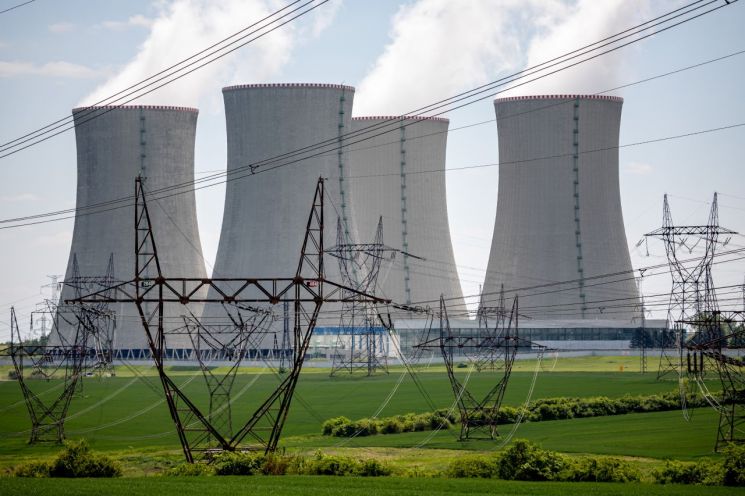
Korea Hydro & Nuclear Power and Dukovany II Nuclear Power Company (EDU II), a subsidiary of the Czech utility company CEZ and the project owner, had initially planned to sign the final contract on May 7. However, one day before the scheduled signing, the Brno District Court in the Czech Republic accepted a request for an injunction filed by the competitor Electricite de France (EDF), which had lost the bid, and ruled to prohibit the final contract until a verdict is reached in the main lawsuit.
In response, the project owner EDU II and Korea Hydro & Nuclear Power appealed to the Czech Supreme Court to overturn the decision prohibiting the contract. Separately from the appeal, the project owner also requested the Brno District Court on the same day to withdraw its injunction decision. Their argument is that the court issued the injunction without hearing from the other parties, and that the delay in the contract threatens the entire schedule of the new nuclear power plant construction project. The Czech Republic had planned to finalize a priority contract with Korea Hydro & Nuclear Power for the construction of two new units at the Dukovany nuclear power plant, and then confirm plans to build two additional units at the Temelin nuclear power plant complex, negotiating these with Korea Hydro & Nuclear Power as well.
EDF has filed objections not only with the Czech courts but also with the European Union (EU), claiming that Korea Hydro & Nuclear Power violated the Foreign Subsidies Regulation (FSR). The EU is currently considering whether to launch an ex officio investigation.
The Czech government and electricity authorities have previously stated that they would seek compensation for damages from EDF resulting from the delay in the contract, arguing that national security and strategic interests are also at risk.
© The Asia Business Daily(www.asiae.co.kr). All rights reserved.

















