Ground subsidence causing casualties...
Proactive inspections of high-risk areas even without local government requests
Disclosure of underground voids and restoration rates...
Integration of local government underground information by 2026
As a series of fatal ground subsidence accidents have occurred near excavation sites, raising public anxiety, the government will now proactively inspect high-risk sites and conduct ex officio ground investigations, issuing immediate corrective orders and administrative actions if problems are found. Until now, the government could only conduct ground surveys in areas requested by local governments, in accordance with the principle of local autonomy.
Starting in June, the locations of underground voids nationwide will be fully disclosed to the public. The restoration rate will also be made public to encourage prompt recovery by local governments, who are responsible for management. Essentially, each neighborhood’s “underground safety report card” will be revealed, making it difficult for local governments with poor restoration records to avoid criticism from residents.
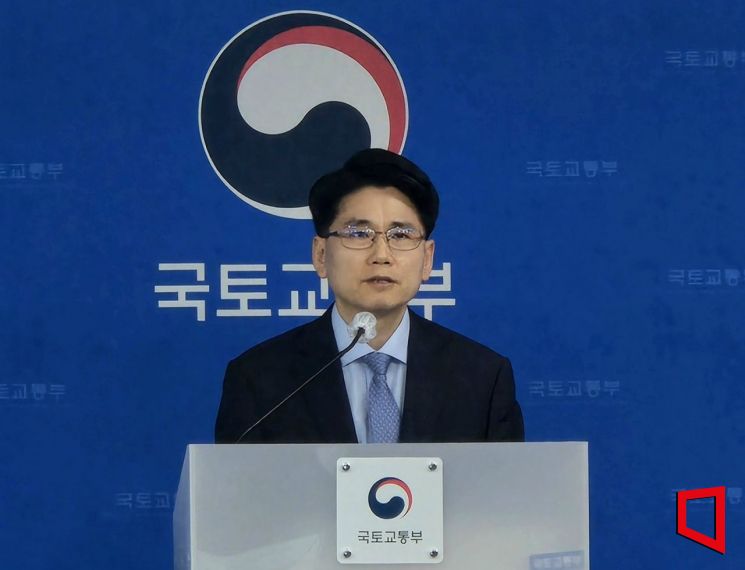 Kim Taebyung, Director of Technology and Safety Policy at the Ministry of Land, Infrastructure and Transport, is announcing the "Measures to Strengthen Safety Management at Excavation Construction Sites" at the Government Sejong Complex on the 27th. Photo by Choi Seoyoon
On the 27th, the Ministry of Land, Infrastructure and Transport announced these measures as part of its "Measures to Strengthen Safety Management at Excavation Construction Sites." Additional measures include requiring specialized teams within local governments to respond immediately to complaints about ground subsidence, such as cracks; strengthening on-site inspections to ensure compliance with cutoff wall construction standards (methods to prevent water leakage); and strictly applying measurement management standards. Furthermore, the ministry plans to amend the Underground Safety Act in the second half of this year to introduce a penalty clause imposing fines of up to 10 million won on companies that conduct inadequate underground safety investigations after starting excavation work.
These measures are based on the ministry’s analysis of ground subsidence accidents over the past five years, which found that the main cause of major accidents (those affecting an area of at least 9 square meters and a depth of at least 2 meters) was "poor excavation-related construction." Of the 867 ground subsidence accidents that occurred from 2020 to last year, 57 cases (6.6%) were classified as major accidents with a high risk of casualties. Among the causes of major accidents, poor excavation-related construction, such as insufficient soil compaction and shoddy buried utility work, accounted for the largest share at 36.8%.
Kim Taebyung, Director of Technology and Safety Policy at the Ministry of Land, Infrastructure and Transport, said, "During a special inspection of 94 excavation sites nationwide (selected by each local government) from October to December last year, we discovered 68 additional underground voids, and the number of voids found in these areas was 166% higher than in regular inspection zones." He added, "There were 209 cases of on-site corrections, including inadequate installation of measurement devices, improper cutoff wall construction, and poor management of retaining walls and earth-retaining structures."
Ground subsidence causing casualties... Proactive inspections of high-risk areas even without local government requests
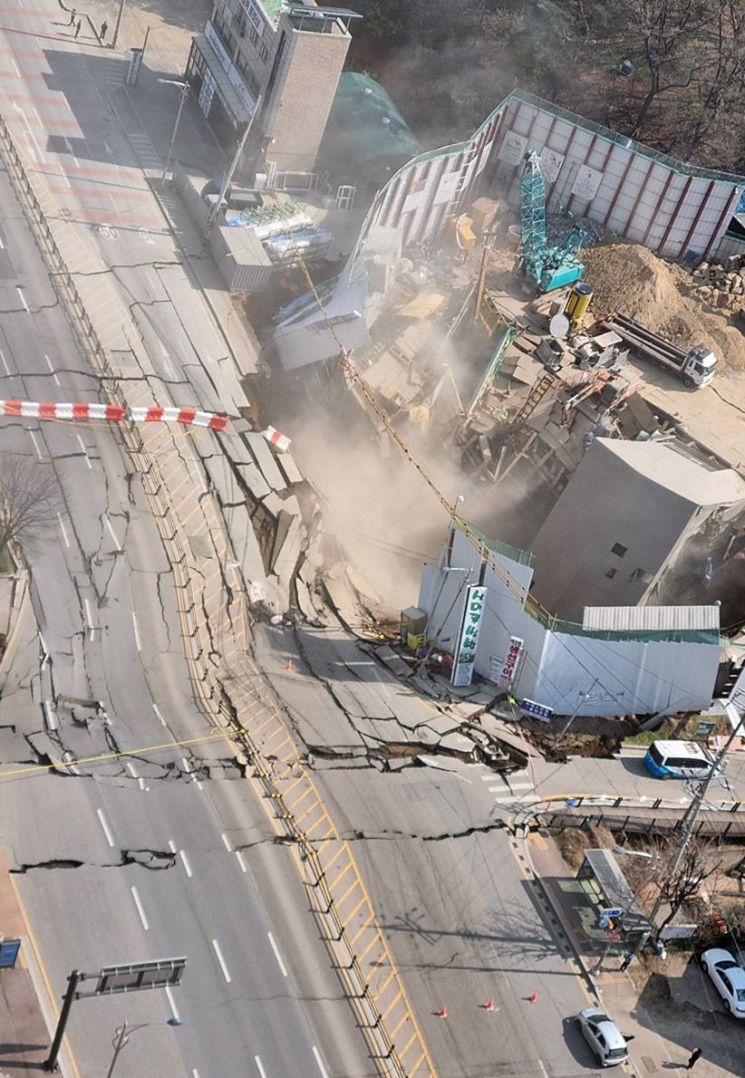 Underground collapse site at the Sinansan Line construction in Iljik-dong, Gwangmyeong-si, Gyeonggi Province. Photo by Yonhap News and a reader
The ministry’s ex officio ground investigations will be implemented immediately starting in the second half of this year. This month, the ministry amended the "Special Act on the Management of Underground Safety" to grant itself the authority to conduct on-site investigations ex officio. Among large-scale excavation sites, those built on soft ground, those adjacent to subway lines or stations, and areas with a history of ground subsidence will be considered high-risk and prioritized for inspection. Areas with frequent subsidence accidents, such as Seoul and Busan, and those with many complaints, such as the Gwangju subway, will also be subject to priority inspections. Inspections will be conducted twice a year. The ministry also plans to establish a continuous management system by linking these with regular inspections during the rainy and winter seasons.
The ministry’s investigations go beyond simple inspections and can result in administrative actions, increasing pressure on sites to maintain safety. If construction deviates from design drawings, or if even minor issues such as fine cracks (0.3mm or more) or water leaks are found, corrective orders will be issued, and administrative actions will follow if these are not addressed. To enhance the effectiveness of inspections, experts from relevant organizations such as Korea Expressway Corporation and the Korea Underground Safety Association will participate. Inspections typically take about two months.
Director Kim stated, "Our inspections are so thorough that on-site personnel say they are 'chilled to the bone.' From the perspective of company CEOs, they know well that the cost of accident recovery, which can reach hundreds of billions of won, is far greater than the cost of prevention, so when the government takes action, sites respond quickly, creating a butterfly effect." He added, "Since it is impossible to know in advance which sites will be inspected, all 1,100 excavation sites nationwide will have no choice but to pay close attention to safety management at all times."
Ground Penetrating Radar (GPR) equipment, which emits radar waves underground to assess conditions, will be used in the investigations. The number of GPR devices, currently 13, will be increased to 30 by 2029. This year, the ministry’s ground investigations will cover 3,700 kilometers, an increase from the original target due to the addition of 500 kilometers for ex officio inspections. The ministry will also provide matching national funding for GPR survey services conducted by local governments, significantly expanding the scope of ground investigations. Local governments plan to conduct GPR surveys over 4,360 kilometers this year.
Disclosure of underground voids and restoration rates... Integration of local government underground information by 2026
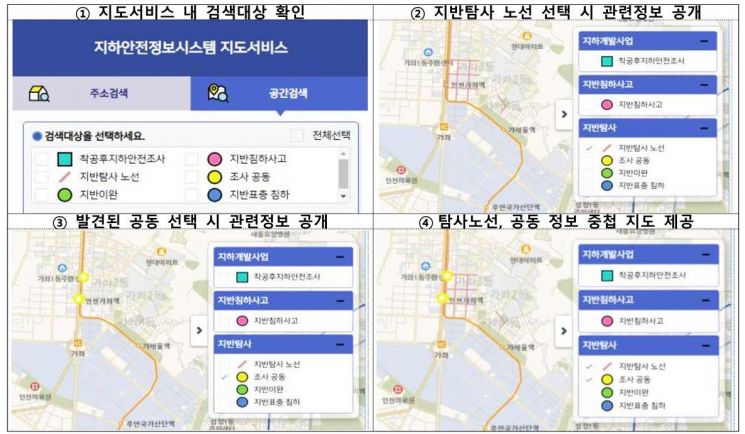 Example of the Underground Safety Information System (JIS) map service screen operated by the Korea Land and Geospatial Safety Authority. Starting next month, various information such as ground subsidence accidents, underground voids, ground survey routes, and surface ground subsidence will be provided on the map. It is accessible to all citizens and can be used to identify underground risk factors in advance to prevent accidents. Provided by the Ministry of Land, Infrastructure and Transport
The results of ground investigations, locations of underground voids, and restoration status will be disclosed to the public on a map via the Underground Safety Information System (JIS). The ministry plans to enhance the effectiveness of the integrated underground space map, which was established in 2022 but saw little use, by linking it with construction information, ground subsidence history, and soft ground data. A total of 8 billion won will be invested by 2029. On May 16, the ministry began disclosing information about ground subsidence accidents (date, location, scale, damage, restoration status, etc.).
Starting next month, the results of ground investigations and data on 793 underground voids discovered by the Korea Land and Geospatial Safety Authority through GPR surveys over the past five years, along with restoration rates, will be made public. Of the voids reported to local governments by the authority, only 393 (49.6%) have been restored. The main reasons are lack of local government funding and shifting of responsibility. Multiple facilities, such as water and sewage, telecommunications, heating, and electricity, are often clustered underground, making it difficult to pinpoint the cause of accidents and leading to frequent disputes over restoration responsibility. Without legal authority to compel action, the government cannot enforce restoration of underground voids if local governments do not take initiative. By disclosing restoration rates, the ministry aims to track "discovered but neglected voids" and create a foundation to compel local governments to take substantive action.
However, survey data and restoration status from Seoul and Busan are not included on the map at the request of these local governments. This is interpreted as a response to concerns that low restoration performance could lead to increased resident complaints or administrative liability, and negatively impact the local real estate market. In fact, Seoul refused to disclose its "underground risk map," which it produced independently, claiming that the data had little relevance to ground subsidence risk and that there were security concerns regarding buried facilities such as telecommunications and gas lines.
Nevertheless, the ministry maintains that "restoration performance must be disclosed to ensure the public’s right to know and transparency in underground safety." Director Kim stated, "Our goal is to persuade all local governments nationwide to integrate their regional data into the JIS by 2026." He added, "In cooperation with the Ministry of the Interior and Safety, we plan to include the underground void restoration rate as an evaluation criterion for local governments and encourage participation by awarding extra points for data submission."
© The Asia Business Daily(www.asiae.co.kr). All rights reserved.
![Clutching a Stolen Dior Bag, Saying "I Hate Being Poor but Real"... The Grotesque Con of a "Human Knockoff" [Slate]](https://cwcontent.asiae.co.kr/asiaresize/183/2026021902243444107_1771435474.jpg)


















