Professor Anne Neuberger Shares U.S. Telecom Hacking Experience at FKI Seminar
"Telecom Hacks Aim to Cause Civilian Disruption"
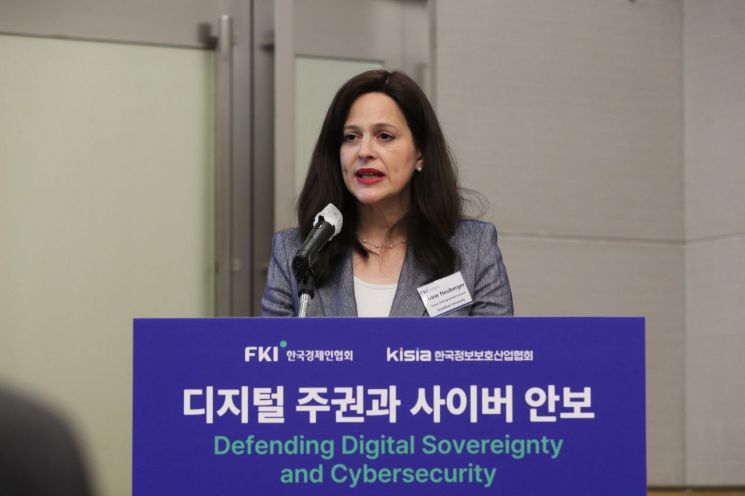 Anne Neuberger, a professor at Stanford University, is presenting at the seminar "Digital Sovereignty and Cybersecurity in the AI Era," jointly hosted by the Federation of Korean Industries and the Korea Information Security Industry Association at the FKI Tower on the 27th.
A former senior White House official who directly responded to last year’s hacking incidents targeting major U.S. telecommunications companies emphasized on the 27th that “hacks against telecommunications companies and other critical infrastructure are intended to cause civilian disruption, so public-private cooperation is essential in responding to them.”
Anne Neuberger, a professor at Stanford University who served as Deputy National Security Advisor for Cyber and Emerging Technology at the U.S. National Security Council (NSC) during the Biden administration, stated at the seminar “Digital Sovereignty and Cybersecurity in the AI Era,” jointly hosted by the Federation of Korean Industries and the Korea Information Security Industry Association at the FKI Tower on this day, that “malicious code created by Chinese hackers is so powerful that even the U.S. government may not be aware of it, so a public-private cooperation framework must be established to respond.” She personally led the response to the incident in December last year, in which a hacker group breached at least eight U.S. telecommunications companies and accessed communication records of senior officials.
In her keynote speech, Professor Neuberger explained, “Looking at the most serious cyberattacks over the past 15 years, cyber weapons have become a crucial means of influencing global affairs and a powerful tool for state action,” and added, “We have learned that cyber is a tool of national power in competition, crisis, and conflict.” Regarding the discovery of malicious code in the capital cities and power systems of multiple countries, including the United States, she analyzed, “This appears to go beyond simple espionage and seems to be preparation to hinder U.S. military mobilization or to cause civilian disruption during a crisis,” emphasizing that the purpose of hacking is to create widespread social chaos.
Based on her experience responding to the U.S. telecommunications hacking incidents, Professor Neuberger repeatedly stressed the importance of public-private cooperation. She said, “During the major U.S. telecom hacking incident, the initial detection began when a private cybersecurity company notified the U.S. government,” and added, “The White House convened telecom CEOs to facilitate industry-wide cooperation and led the response.”
She emphasized, “In my 15 years at U.S. intelligence agencies, I have experienced both offense and defense, and I have often seen defense lag behind,” and continued, “There is a competition between offense and defense, and we must ensure that defense stays ahead.” She also stated, “As hacking crimes target all countries, we must develop solutions through public-private cooperation and international solidarity,” stressing that cybersecurity is no longer an issue for a single nation alone.
Kim Changbeom, Vice Chairman of the Federation of Korean Industries, stated in his opening remarks, “Cyberattacks can impact not only individual companies but also entire industries, the national image, and even international credibility,” and added, “We must now move beyond information protection at the individual company level and strengthen public-private cooperation in protecting digital sovereignty.”
Recently, a series of incidents in Korea?including personal data leaks in the financial sector, ransomware attacks, and global supply chain hacking?have highlighted the growing need to strengthen cyber response capabilities not only in the private sector but also in public institutions.
Kim Hwigang, a professor at Korea University, warned in his presentation on “Information Sovereignty and Digital Control in New Technology Fields in the AI Era,” that “serious risks are arising during the large-scale data collection process for AI model training,” and added, “The likelihood of data leaks related to cybersecurity, including personal information, has increased.”
He suggested countermeasures for new security threats in the AI era, stating, “It is necessary to analyze the software and hardware components of devices equipped with AI, such as robots and IoT devices, to verify their safety against supply chain attacks.”
Lee Youngjoo, Head of Information Security at Shinhan Financial Group, also stated, “With recent institutional changes such as the relaxation of network separation in the financial sector, information security measures must be strengthened in tandem.”
© The Asia Business Daily(www.asiae.co.kr). All rights reserved.

















