A pathway has opened for the localization of gallium nitride (GaN) integrated circuits, which are among the core components of military radar and satellite transceiver modules.
The Electronics and Telecommunications Research Institute (hereinafter ETRI) announced on May 27 that, in collaboration with Waveis Co., Ltd., it has developed, for the first time in Korea, a GaN-based monolithic microwave integrated circuit (MMIC) for transceiver applications using fab-based technology.
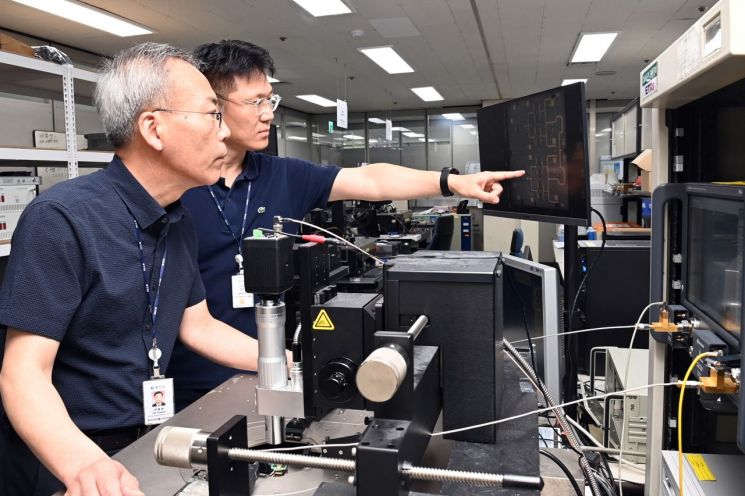 ETRI researchers are checking and analyzing the circuit structure of a gallium nitride MMIC on a monitor. Provided by Electronics and Telecommunications Research Institute (ETRI)
The development of the GaN MMIC is significant in that it establishes the foundation for mass-producing high-performance, military-grade semiconductor core components?previously entirely reliant on imports?using domestic technology and production facilities. This achievement is expected to contribute to the self-reliance of national defense technologies, which are directly linked to national security, as well as to the ability to respond to export regulations.
In particular, the new product is expected to dramatically improve the performance of military and satellite communication radars, such as active electronically scanned array (AESA) radars, by providing higher output and efficiency compared to conventional gallium arsenide (GaAs)-based products.
An active electronically scanned array radar is an advanced radar technology that uses electronic beam steering to rapidly detect and track targets. It consists of an antenna array with multiple transceiver units.
Within this antenna, a power amplifier for boosting transmitted signals, a low-noise amplifier for clean reception of incoming signals, and a switch for transmit/receive switching are all integrated into a single module.
A similar transceiver module configuration is used in high-resolution synthetic aperture radar (SAR) systems, and ETRI expects that GaN semiconductors, with their high output and efficiency characteristics, will contribute to both miniaturization and performance enhancement of such devices.
Meanwhile, this research has been underway since 2023 as part of the Creative Convergence Research Program of the National Research Council of Science & Technology (NST). The goal of the project is to develop three types of transceiver chips operating in the X-band by combining ETRI's semiconductor design technology with Waveis's manufacturing process technology.
The key components developed through this effort include a power amplifier (PA), a low-noise amplifier (LNA), and a switch (SW) integrated circuit. These components demonstrate performance equivalent to commercial products from leading overseas foundries in the United States and Europe. Above all, ETRI emphasized the significance of this achievement as the first result produced using Korea's only mass-production GaN fab facility.
Lim Jongwon, head of the Power Components Research Laboratory, stated, "By combining ETRI's design technology with Waveis's process technology, we have developed three types of high-performance transceiver chips for the first time in Korea. We expect this technology will contribute to the localization of core components for military radar and satellites."
© The Asia Business Daily(www.asiae.co.kr). All rights reserved.
![Clutching a Stolen Dior Bag, Saying "I Hate Being Poor but Real"... The Grotesque Con of a "Human Knockoff" [Slate]](https://cwcontent.asiae.co.kr/asiaresize/183/2026021902243444107_1771435474.jpg)
















