2025 Personal Information Protection Fair Held
Real-Time Location Data May Be Exposed
"Impossible to Regulate AI with Outdated Systems"
"When you look at someone through smart glasses, various pieces of information about that person appear on the screen. While surveillance of the public was previously limited by law, with artificial intelligence (AI) technology, anyone can now monitor the public." (Jin Kyu Lee, Naver Chief Privacy Officer (CPO))
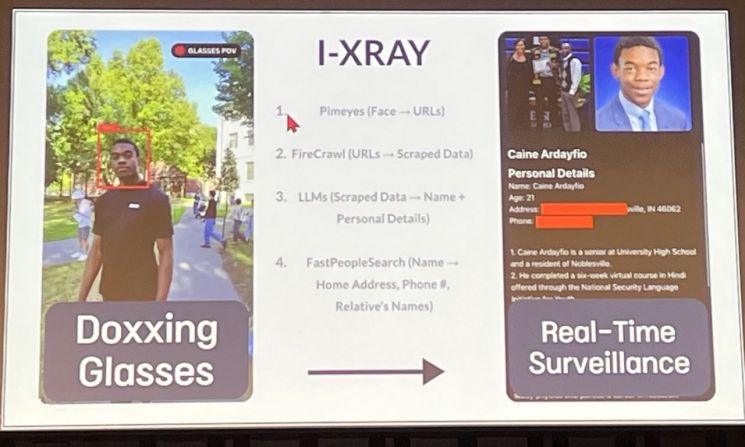 Naver CPO Jin Kyu Lee introduced the US I-XRAY project at the "2025 Personal Information Protection Fair" held on the 27th.
Jin Kyu Lee, Naver CPO, introduced the US I-XRAY project at the "2025 Personal Information Protection Fair" held at COEX in Seoul on the 27th. I-XRAY is an AI-based smart glasses technology developed by Harvard University students. It was implemented by integrating Meta's smart glasses and the PimEyes solution, which utilizes facial recognition technology. With this technology, it is possible to identify personal information such as the name, address, and phone number of a person encountered on the street. Lee warned of privacy infringement, stating, "AI enables real-time surveillance in the real world."
He also explained that even with just a single photo, it is possible to infringe on privacy through location tracking using ChatGPT o3, developed by OpenAI. He said, "When a user uploaded a single photo and asked, 'Tell me where this place is on Earth,' the AI was able to infer and search for the location."
He continued, "Businesses that analyze the time, location, and angle of photos taken in specific areas to estimate who was where and when, and then sell that location information, are rapidly emerging in the market," adding, "Technology that enables anyone to violate privacy is now open to the public."
AI technology poses a critical threat to personal information protection because it can even neutralize existing laws and systems. Even pseudonymized or anonymized information, which has been processed to prevent identification of individuals, can sometimes be re-identified through the combination and analysis capabilities of advanced AI.
However, Lee noted, "Recently, even Europe has been actively working to secure AI technological competitiveness," and added, "Only high-risk areas are being regulated, while other areas are shifting toward growth and investment. It is not possible to regulate AI evolution with outdated systems." He suggested, "We should consider risk as a constant, but we must avoid being overly confident that an approach aiming to eradicate risk entirely will work."
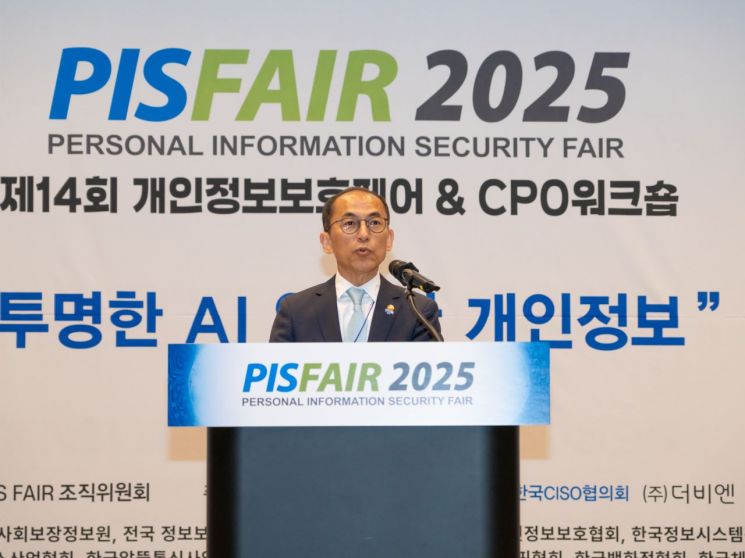
In addition, Haksoo Ko, Chairman of the Personal Information Protection Commission, emphasized in his opening remarks that the recent SK Telecom personal information leak should serve as an opportunity to strengthen the national personal information protection system.
Chairman Ko stated, "The SKT personal information leak has caused significant public anxiety regarding personal information protection," and added, "It is time to use this incident as an opportunity to strengthen the national personal information safety management system so that we can develop the capabilities to respond to complex personal information infringement risks."
He continued, "Public institutions and private companies must re-examine the entire process of handling personal information and establish comprehensive improvement measures," and stressed, "There needs to be a paradigm shift to recognize human and material investments in personal information protection as core investments, not as costs."
Meanwhile, the Personal Information Protection Commission is holding the 2025 Personal Information Protection Fair over two days, from the 27th to the 28th. This event, held under the theme "Transparent AI, Safe Personal Information," emphasizes the safe use of personal information in the AI era.
© The Asia Business Daily(www.asiae.co.kr). All rights reserved.


















