Difficult for China to Detect or Attack
Rapid Response Capability in Emergencies
The Wall Street Journal (WSJ) reported on the 25th (local time) that the U.S. Marine Corps has deployed its latest anti-ship missile system, the Navy and Marine Corps Expeditionary Ship Interdiction System (NMESIS), to Batan Island in northern Philippines, near Taiwan, in an effort to counter the Chinese navy.
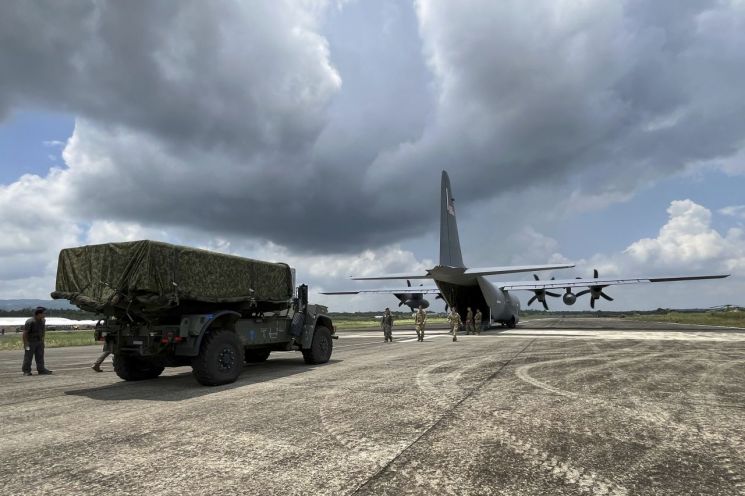 On the 26th of last month (local time), during the large-scale joint exercise "Balikatan" between the Philippines and the United States, U.S. military personnel loaded some of the Navy and Marine Corps Expeditionary Ship Interdiction System (NMESIS) equipment onto a C130 transport aircraft. Photo by AP
According to the WSJ, the U.S. 3rd Marine Littoral Regiment (MLR), based in Hawaii, deployed NMESIS to Batan at the end of last month as part of its annual training. This regiment was the first among Marine units to receive the system at the end of last year.
NMESIS, which stands for Navy and Marine Corps Expeditionary Ship Interdiction System, is a weapon system that launches precision-guided missiles from land to strike moving maritime targets such as warships. The launcher uses the Naval Strike Missile (NSM) produced by the Norwegian defense company Kongsberg.
The vehicle carrying the missile is unmanned, and the operation of the weapon is conducted remotely by separate vehicle operators. Because NMESIS can move freely on land, it is difficult for enemy forces to detect or attack it when deployed in mountainous terrain like Batan Island. Captain Benjamin Dorsey of the U.S. Air Force's 39th Airlift Squadron, who was involved in transporting NMESIS to Batan, explained, "It's like keeping your head down and hiding."
The WSJ explained that the U.S. Marine Corps is focusing on enhancing its rapid response capabilities in the event of a contingency, with NMESIS at the center of these changes. Since taking office in 2022, Philippine President Ferdinand Marcos Jr. has actively cooperated with the U.S. government's Indo-Pacific strategy to contain China, increasing the number of bases in the Philippines accessible to U.S. forces. While the U.S. does not maintain a permanent garrison in the Philippines, it uses Philippine bases for training, pre-positioning of equipment, and refueling and maintenance of ships and aircraft.
The U.S. military is expected to use NMESIS, which has a range of about 185 kilometers, to control the straits between Taiwan and the Philippines, and to combine naval and air power to strengthen its maritime presence in the South China Sea to the west, the Philippine Sea to the east, and as far as the East China Sea to the northeast.
© The Asia Business Daily(www.asiae.co.kr). All rights reserved.

















